a16z Raised $1.1 Billion for AI's Physical Layer. Its Bet: Capital Now Beats Code.
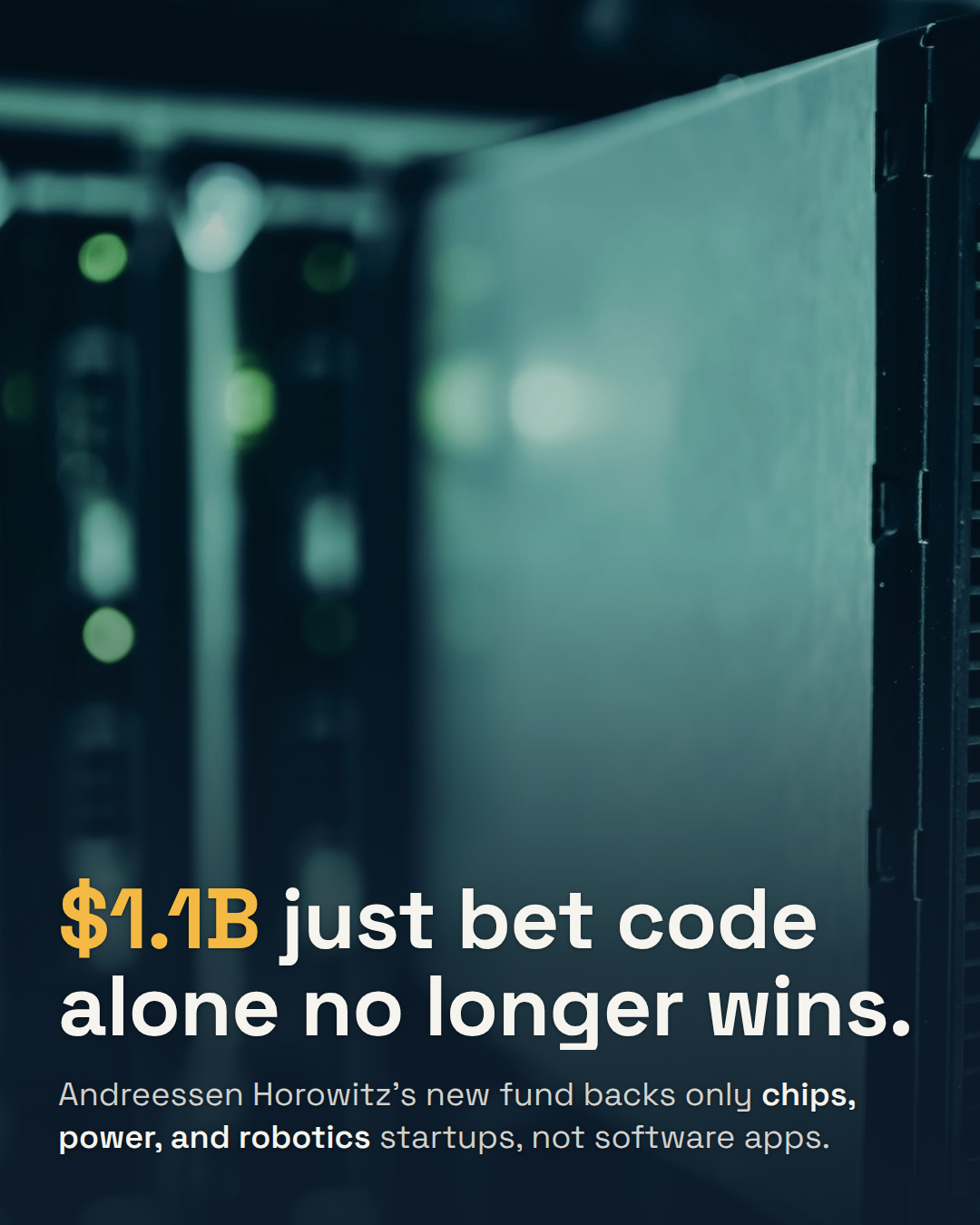
Andreessen Horowitz launched a new $1.1 billion fund dedicated only to AI chips, power, and robotics. The pitch to founders: hardware moats now beat software speed.

Fiscedge Academy
Contributing Faculty & Practitioner
News Breakdown · FiscEdge Academy
Andreessen Horowitz just closed a $1.1 billion fund called the Machine Age Fund, and it will not touch a single line of application code. The mandate: chips, memory, networking, storage, power, data centers, robotics, and "home AI appliances." Five general partners put their names on the launch: Ben Horowitz, Martin Casado, Raghu Raghuram, David Ulevitch, and David George.
The number is the least interesting part. a16z already raised a $15 billion slate of funds earlier this year, including a dedicated $1.7 billion Infrastructure fund for compute and AI tooling. This is a second, separate pool of capital, carved out specifically for the physical layer of AI. When a firm that already has an infrastructure fund goes back for more, purely for atoms rather than software, that is the signal under the headline.
The thesis, in the partners' own words
Horowitz, Casado, and Raghuram framed the bet as a new economic law for this cycle: "A thousand engineers cannot erase a two-year software lead, but a massive GPU cluster can turn capital directly into capability." Translation for founders: in a market where any team can spin up a competent AI product in weeks, the durable moat has shifted from clever code to who controls scarce physical capacity, chips, power contracts, and the racks to run them on.
That shift shows up in the fund's own numbers. Rack power density has jumped from roughly 5-10 kilowatts a few years ago to 100-250 kilowatts today, and the partners expect it to hit 1 megawatt within three years. That is not a software problem. It is a power-procurement, cooling, and capital-intensity problem, and it is exactly the kind of moat that cannot be cloned by a competitor with better prompts.
Why this matters even if you build software
Most SaaS founders reading this are not building chips or robots, and that is precisely the point. The Machine Age Fund is a bet that the next layer of defensible value sits underneath the application layer you are building on. Practically, that means three things:
- Your infrastructure costs are not going down soon. If VCs are pouring billions into power and chip scarcity, the compute your product depends on stays a real, not shrinking, line item. Model it accordingly rather than assuming API prices keep falling at the same pace as last year.
- "Thin AI wrapper" is now a harder pitch to fund. With a thousand engineers unable to out-build a GPU cluster, investors are pricing software moats lower unless you can point to proprietary data, distribution, or a workflow lock-in that survives a model upgrade.
- Adjacent hardware and infra plays just got a dedicated buyer. If your roadmap touches physical AI, edge inference, robotics tooling, or power-aware software for data centers, there is now a named $1.1 billion check writer actively looking, not a generalist fund squeezing hardware into a software-shaped thesis.
The bigger pattern
This fund lands the same week Nvidia-backed Lambda pulled together roughly $1 billion in private debt, arranged by JPMorgan, to buy the GPUs it leases back to Microsoft. Two very different instruments, equity from a16z and debt from JPMorgan, are converging on the same conclusion: the AI capital story of late 2026 is no longer primarily about who trains the best model. It is about who owns, finances, and operates the physical stack underneath it. For founders raising right now, that context changes how a pitch lands. A deck built entirely around a model API and a clever prompt chain competes for attention with founders showing hardware-level or data-level defensibility, and increasingly loses.
If you remember one thing
When a VC firm that already funded infrastructure goes back for a second, dedicated hardware fund, it is telling you where it thinks the next moat lives, and it is not in your prompt engineering. If your pitch's only defensibility is "we built it in AI faster than a competitor could," expect that story to get a harder look from investors this quarter.
We teach founders how to stress-test a fundraising narrative against exactly this kind of shift in FiscEdge's startup strategy course, and how to model AI infrastructure costs into your runway in the financial modeling course. For a primer on judging whether your AI features add a real moat or just a demo, see what makes unit economics work. Browse the full FiscEdge blog for more breakdowns like this one. Follow @fiscedge for daily Business & AI analysis.
Topics & Categorization:
How interesting did you find this article?