Google Cloud Grew 82%. Alphabet's Stock Fell 5% Anyway.
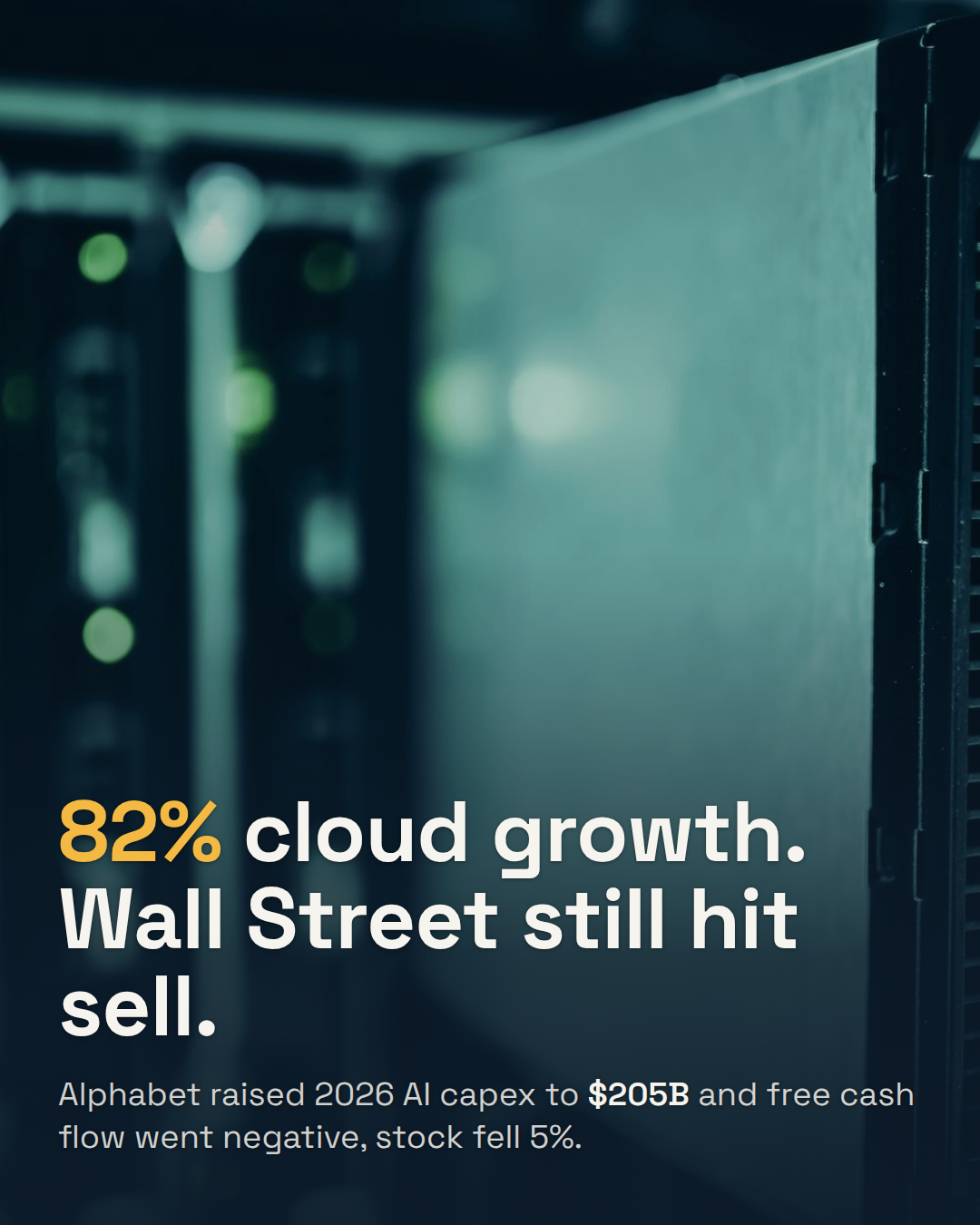
Alphabet beat Q2 estimates and Google Cloud surged 82% to $24.8B, but a $205B capex hike and negative free cash flow sent the stock down 5%.
Fiscedge Academy
Contributing Faculty & Practitioner
News Breakdown · FiscEdge Academy
Alphabet just posted one of the best cloud quarters in the industry's history, and the market punished it anyway. Q2 2026 revenue hit $119.8 billion, up 24% year over year, beating Wall Street's estimate. Google Cloud, the number investors actually care about, surged 82% to $24.8 billion, with cloud operating income jumping from $2.8 billion to $8.8 billion, more than tripling. Cloud's backlog of signed, not-yet-recognized contracts now stands at $514 billion. None of that stopped the stock from falling roughly 5% in after-hours trading, from about $375 to around $357, after Alphabet raised its 2026 capital expenditure guidance to $195 billion to $205 billion, up from $180 to $190 billion just one quarter ago.
Free cash flow went negative, to -$5.9 billion, down from $10.1 billion in Q1, as Q2 capex alone hit a record $44.9 billion. Search revenue, still Alphabet's core engine, grew a healthy 17% to $63.3 billion. But the headline story wasn't the beat. It was that a company growing its most AI-exposed business by 82% still couldn't convince the market that the spending behind it will pay off fast enough.
The number that matters isn't the beat, it's the backlog
A $514 billion cloud backlog means enterprises have already signed contracts locking in that much future Google Cloud spend, more than half of it recognized within 24 months. That is real, committed enterprise demand for AI infrastructure and services, not a forecast or a hope. It is also Alphabet's justification for spending up to $205 billion this year building the data centers, chips and networking to deliver on it.
The signal under the headline is that public markets are no longer grading AI infrastructure investment on revenue growth alone. They're grading it on cash conversion. Alphabet's free cash flow going negative for the first time in this cycle, even with record bookings, is what moved the stock, not the 82% growth number. Investors are asking a sharper question than they were six months ago: how long before this capex turns into distributable cash, and is that timeline getting longer or shorter?
What this changes for founders and operators
- The AI infrastructure arms race just got another year longer, and more expensive. Alphabet, alongside Microsoft, Amazon and Meta, is now committing to capex levels that assume multi-year AI demand growth. If your product runs on GPU-backed inference, cloud compute, or any hyperscaler API, budget for pricing pressure and capacity constraints to persist well into 2027, not ease off.
- A $514 billion backlog is a demand signal, not just a Google story. Enterprises are signing multi-year AI contracts at scale right now. If you sell into enterprise and your pitch touches AI adoption, this is hard evidence to cite that budget committees are already approving this category of spend, it de-risks your own sales conversations.
- Cash conversion, not growth rate, is now the metric that gets punished. Alphabet grew cloud 82% and still sold off on a capex raise and negative free cash flow. If you're raising or building toward an exit, expect the same scrutiny applied to your own numbers: investors increasingly want to see a credible path from revenue growth to cash generation, not just the growth line.
- "Picks and shovels" spending is still accelerating, even as its financiers get nervous. The capex figures Alphabet, Microsoft and Amazon are posting each quarter are the clearest available proxy for how much real enterprise AI adoption is happening beneath the hype. Founders building anything adjacent to AI infrastructure, tooling, or observability are still selling into a market that is visibly, measurably growing.
Why this is bigger than one earnings call
This is the same tension playing out across every hyperscaler right now: revenue and bookings are validating the AI buildout, while free cash flow bends under the weight of paying for it. Alphabet is the biggest, most cash-rich of the group, and even it couldn't spend $205 billion without spooking investors. Smaller cloud and AI-infrastructure players on thinner margins face the same pressure with far less room to absorb it. Watch this metric, not the growth headline, as the tell for how long the current AI capex cycle can run before revenue catches up or spending has to slow.
If you remember one thing
Growth numbers get you the beat, cash flow gets you the stock price. Alphabet's 82% cloud growth was real and enterprises are backing it with $514 billion in signed contracts, but the market cared more about the fact that free cash flow just turned negative to pay for it. Model your own numbers the same way: if you're pitching investors, show them the path from growth to cash, not just the growth rate, because that's the line the market is now watching hardest.
We teach how to read earnings and capex signals like this one, and turn them into pipeline forecasts, in FiscEdge's financial modeling course. If your product sits anywhere near the AI infrastructure stack, our AI for entrepreneurs track covers where enterprise budgets are actually flowing this year. Building your own SaaS on top of this compute wave? Start with building SaaS with AI and cost to build a SaaS to keep your own unit economics honest. Browse the full blog for more breakdowns like this. Follow @fiscedge for daily Business & AI analysis.
Topics & Categorization:
How interesting did you find this article?