Amazon Wants to Sell Its Own Nvidia Chips. Then Lease Them Right Back.
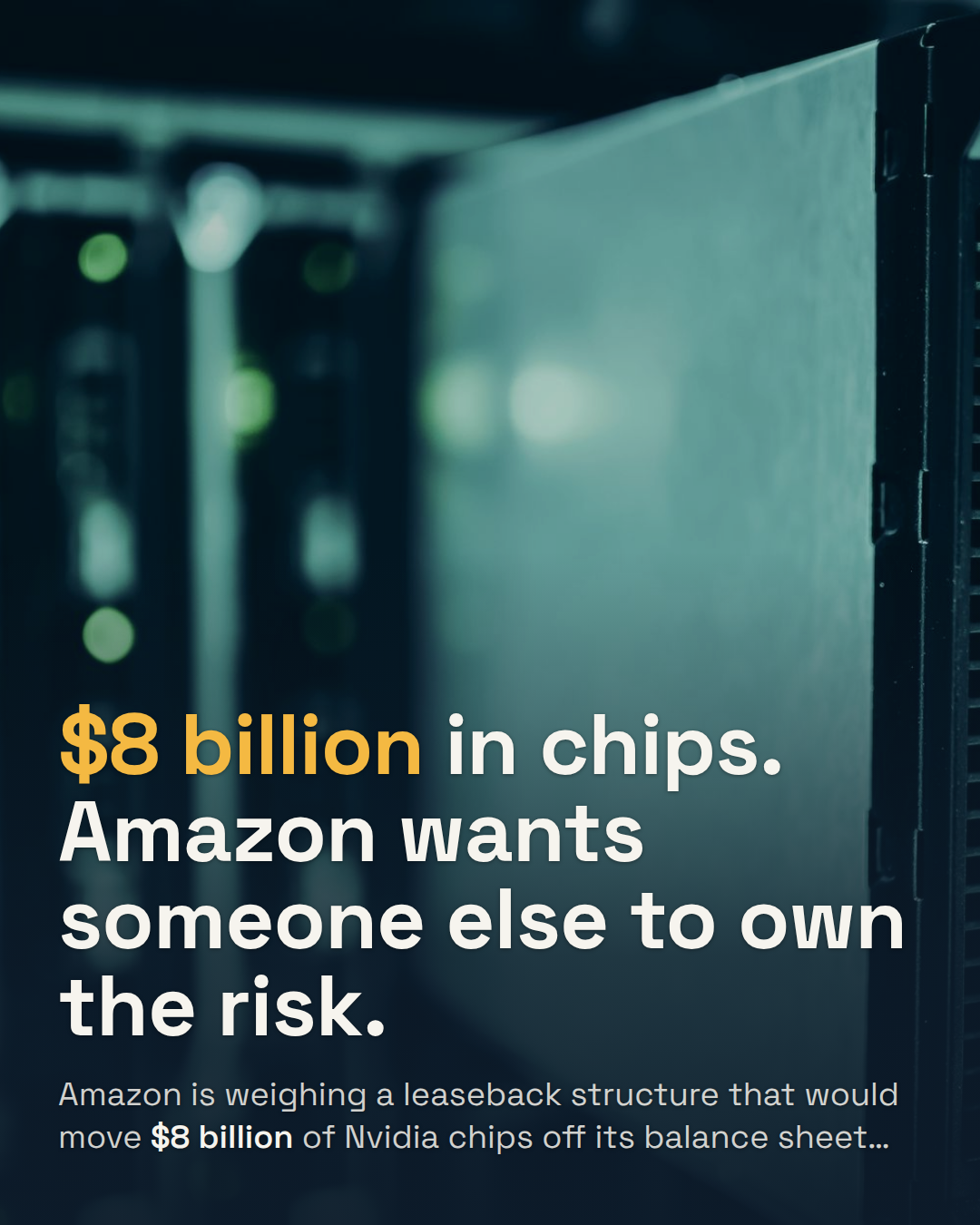
Amazon is exploring a special-purpose vehicle to move $8 billion of Nvidia chips off its balance sheet, then lease them back for AWS. The risk, not the cash, is what's actually moving.

Fiscedge Academy
Contributing Faculty & Practitioner
News Breakdown · FiscEdge Academy
Amazon is in talks to move about $8 billion of Nvidia Grace Blackwell chips off its own books, into a newly created special-purpose vehicle, and then lease them straight back for AWS to keep using. The Financial Times broke the story on October 2, with Bloomberg and Reuters confirming the structure within hours.
The mechanics matter more than the headline number. Amazon would transfer thousands of GPUs, spread across more than a dozen US data centers, into the SPV. That vehicle would then raise money from outside investors in two ways: debt, targeted at an investment-grade rating tied to Amazon's own AA credit, and up to a 10% equity stake. Amazon keeps none of the equity. It just keeps the chips running inside AWS, under a lease, while someone else's balance sheet absorbs the financing and the risk of what those GPUs are worth when the lease ends.
Here's the signal under the headline: this isn't about Amazon needing cash. It's about what counts as "capex" versus "lease expense," and who eats the loss if a Blackwell-generation chip is worth a fraction of its price in three years.
The pattern is now bigger than one company
Amazon isn't improvising. It's following a template Big Tech has been building all year. Meta financed its $30 billion Hyperion data center through an SPV called Beignet Investor, 80% owned by Blue Owl Capital, with roughly $27 billion in loans from Pimco, BlackRock and Apollo. Oracle has said it will raise $45-50 billion in debt and equity in 2026 to fund its own AI buildout, and it already carries over $100 billion on its books with negative free cash flow. Across the top five US hyperscalers, 2026 bond issuance has run close to $159 billion, and Morgan Stanley puts the private-credit need for AI infrastructure through 2028 at roughly $800 billion.
Amazon's own numbers explain the urgency. The company raised its 2026 capex guidance to $220 billion, up from $200 billion, citing higher memory costs, and CEO Andy Jassy has said that even at that level, AWS still won't have enough capacity to meet demand through 2027. Spending more while keeping it off the balance sheet is the only way to square that circle without wrecking the leverage ratios public investors watch.
The part nobody has priced correctly yet
The open question is how long a Grace Blackwell chip stays worth anything. Big Tech generally depreciates servers over five to six years. Skeptics inside the industry put the real economic life closer to two or three, given how fast Nvidia ships new generations. Amazon has already moved in that direction: it shortened the depreciation schedule on a subset of its own servers from six years to five, citing explicitly "the increased pace of technology development" in AI. An SPV investor buying into this structure is effectively betting that leased-out silicon will still be worth leasing, or reselling, long after Nvidia has moved two generations ahead. If that bet is wrong, the loss lands on whoever bought the debt or the equity, not on Amazon.
That's the real shift: AI infrastructure risk is being repackaged and sold to insurers, pension funds and private-credit vehicles, the same institutional money that chases yield in good times and gets blamed for systemic risk in bad ones.
What this changes for founders
If your roadmap depends on cheap, abundant GPU capacity in 2027 or 2028, don't read this as reassurance. Jassy's own comment, that demand will outstrip $220 billion in Amazon capex, says the base case is still scarcity, financial engineering or not. Budget compute costs with a margin for both price swings and outright availability gaps.
If you're negotiating equipment financing or venture debt for your own AI infrastructure, this is now the template lenders will compare you against: lease-back structures, investment-grade tranches, residual-value assumptions. Know the vocabulary before you're in the room, something we cover in FiscEdge's financial modeling course, which walks through exactly this kind of off-balance-sheet structuring.
And if you're raising capital of any kind right now, understand that the capital chasing AI infrastructure debt is largely yield-seeking, not conviction-seeking. That changes what terms are available to you depending on whether your story reads as "growth" or "yield." For the broader playbook on reading a capital market like this one, FiscEdge's startup strategy course covers how to position a raise against the macro backdrop, not just your own metrics.
If you remember one thing
When a hyperscaler starts selling its own chips to outside investors and leasing them straight back, that is not a sign of comfort about AI capacity. It's a sign the capex bill got too big for one balance sheet to hold, and the risk just moved to whoever was willing to buy the yield.
We cover the financial mechanics behind AI's biggest capex bets in FiscEdge's financial modeling course and AI for entrepreneurs track. Browse the full blog for more breakdowns like this one. Follow @fiscedge for daily Business & AI analysis.
Topics & Categorization:
How interesting did you find this article?