Anthropic's Credit Line Just Quadrupled to $10 Billion. It Still Hasn't Gone Public.
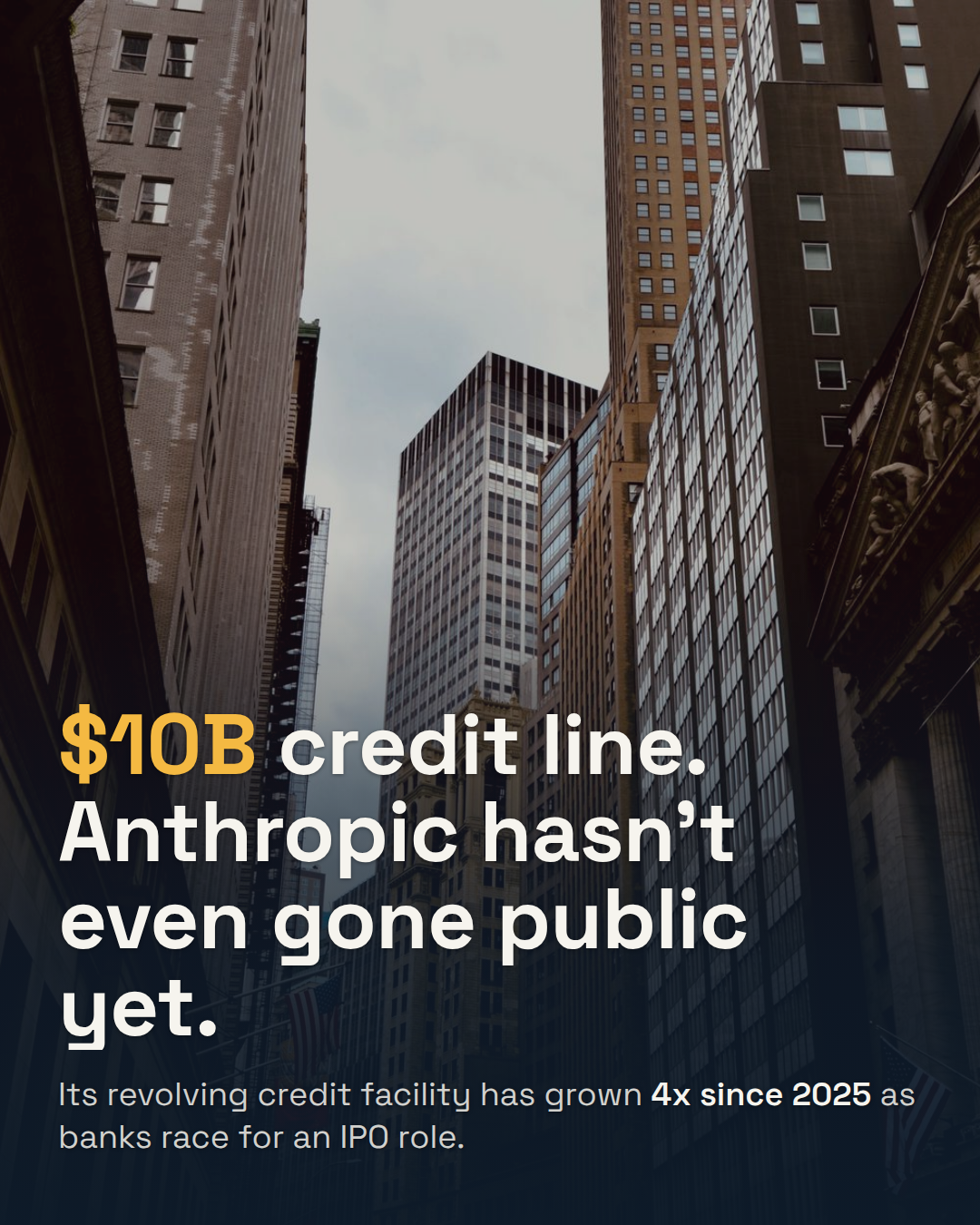
Anthropic is expanding its pre-IPO credit facility past $10 billion, four times last year's $2.5 billion line, as top banks compete for a role in what could be 2026's biggest IPO.

Fiscedge Academy
Contributing Faculty & Practitioner
News Breakdown · FiscEdge Academy
Anthropic is lining up a revolving credit facility set to exceed $10 billion, according to Bloomberg News, corroborated by Reuters wire pickups and multiple trade outlets. That's roughly four times the $2.5 billion, five-year revolving line the company closed in May 2025, when its annualized revenue was just crossing $2 billion.
The banking mechanics are the tell. Anthropic has asked its most active arranging banks to commit around $1.25 billion each, a second tier of active lenders about $1 billion, and less active participants $750 million or less. Morgan Stanley, Goldman Sachs and JPMorgan, all reportedly working on the IPO itself, are among the banks jockeying for a bigger slice of the credit line specifically because it strengthens their pitch for an underwriting seat.
The number is the least interesting part
A bigger revolver isn't news on its own, every fast-growing company wants more standby cash. What makes this one worth reading closely is the timing. Anthropic confidentially filed a draft S-1 with the SEC on June 1, closed a $65 billion Series H in May at a $965 billion valuation (up from $380 billion just three months earlier at the February Series G), and is reportedly targeting a listing as early as October, one that could rank among the largest IPOs on record. A credit facility built out this aggressively, months before a prospectus even goes public, isn't balance-sheet housekeeping. It's a pre-IPO capital structure being assembled in full view of the banks who want to run the deal.
Why banks are competing to lend, not just to underwrite
Normally a revolving credit facility is a quiet, defensive instrument, insurance against a bad quarter. Here it's being used as a relationship play: banks are willing to commit nine and ten figures of standby credit, money Anthropic may never draw, purely to be in the room when the IPO mandate gets decided. That inverts the usual leverage. It signals Wall Street believes the Anthropic listing will be lucrative enough in fees that competing for a lending role, typically the less glamorous side of a bank's relationship with a client, is worth real balance-sheet exposure months in advance.
What this tells founders about the AI capital cycle
For anyone building in or around AI right now, this is a data point about where we are in the cycle, not just about one company. Anthropic already posted its first-ever positive operating quarter in Q2, detailed in our recent breakdown on its $11.5 billion quarter, and now it's stacking debt capacity on top of equity capacity on top of profitability, three financing levers most startups only ever pull one at a time. That combination is only available to a company banks are certain will still be standing, and growing, in five years. It is not a template most Series B or C companies can copy, but the sequencing is instructive: raise equity to fund growth, layer in debt once revenue de-risks the balance sheet, then use both to negotiate from strength when you finally go to public markets.
The read-through for anyone raising right now
Venture debt and revolving credit lines have quietly become a bigger part of how growth-stage AI companies fund compute, not just equity rounds. If you're modeling your own runway, a revolver you can draw against receivables or contracted revenue is a materially different instrument than a term loan against assets you don't have, and getting that distinction right in your own financial model is the difference between a credit facility that extends your runway and one that just adds a covenant you'll trip later. It's also worth building your fundraising sequencing, equity first, debt once you have revenue to point to, into your own startup strategy rather than defaulting to whichever capital is easiest to raise first.
Three things worth taking from this if you're building or fundraising in AI right now:
- Credit lines are becoming IPO signaling devices. When banks compete to lend, not just to underwrite, treat that as a market read on how the listing is expected to price.
- Debt capacity follows profitability, not the other way around. Anthropic could layer in $10 billion of revolving credit because Q2 showed positive operating income first. Sequence your own fundraising the same way.
- The AI IPO calendar is getting real dates attached to it. An October target for the largest AI listing on record changes how every later-stage AI startup should think about its own 12 to 24 month capital plan.
If you remember one thing
Anthropic isn't raising a $10 billion credit line because it needs the cash today. It's building a pre-IPO capital structure so complete that the banks fighting to lend into it are the same ones fighting to take it public, and that alignment of incentives is a clearer signal about IPO timing than any leaked date.
We teach this playbook in FiscEdge's financial modeling course and startup strategy track. Browse the full blog for more breakdowns like this one. Follow @fiscedge for daily Business & AI analysis.
Topics & Categorization:
How interesting did you find this article?