Anthropic's IPO Filing Shows a $518 Billion Compute Bill. Most of It Is Already Owed.
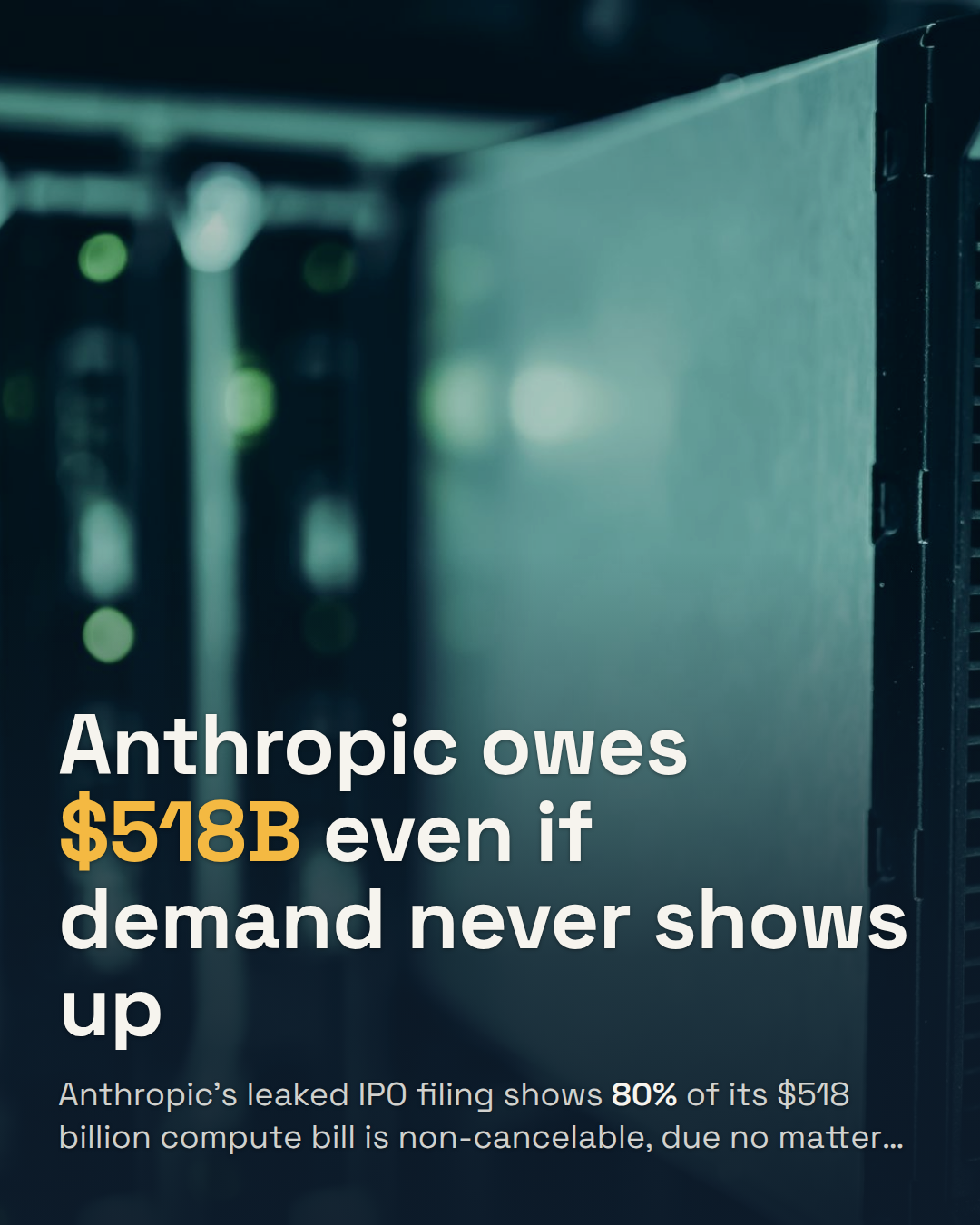
Anthropic's leaked IPO prospectus shows $518 billion in decade-long compute commitments, 80% owed regardless of demand. It's the clearest look yet at what backs frontier AI pricing.
Fiscedge Academy
Contributing Faculty & Practitioner
News Breakdown · FiscEdge Academy
Anthropic's confidential IPO prospectus, reviewed by Reuters and reported on September 28, puts a real number on what it costs to compete at the frontier of AI: $518 billion in infrastructure commitments over the next decade, spread across six partners. About 80% of that total is non-cancelable or payable regardless of how much compute Anthropic actually ends up using.
Break down the biggest line items: $161.2 billion in equipment leases with Broadcom, $111.1 billion with Google running April 2026 to July 2033, $110 billion with Amazon running May 2026 to April 2036, up to $84.5 billion with xAI for Nvidia-based capacity through 2029, $31.4 billion with Microsoft, cancelable only for an uncured material breach, and more than $20 billion in AMD compute, alongside AMD's own purchase of up to $5 billion in Anthropic stock.
The number everyone is repeating is the $42 billion net loss Anthropic posted in 2025. That's the least interesting part of the filing. Nearly $34 billion of it is a non-cash accounting charge tied to the rising valuation of convertible financing instruments, not cash out the door. The more useful figure is the $8 billion-plus operating loss on $4.6 billion in 2025 revenue, up roughly 12x from 2024, with $7.33 billion spent on compute alone, more than half of total operating expenses of $12.65 billion.
The real story is the contract structure, not the loss
Here's the signal under the headline: Anthropic didn't just spend money on compute in 2025, it signed away a decade of future spending, and most of it doesn't flex with demand. Google and Amazon's terms include "must-pay" clauses: if actual usage comes in under contract, Anthropic owes the difference anyway. Microsoft's deal can only be canceled if Microsoft itself breaches it. Only the xAI agreement, the newest and smallest of the six, carries a 90-day cancellation window, likely negotiated with the terms of the other five already in view.
This is what it costs to stay at the frontier: not just capital, but capital you can't take back once it's deployed. Anthropic is betting demand for Claude keeps compounding the way it has (its annualized revenue run rate reportedly crossed $100 billion in September, up from $14 billion in February). If that curve holds, $518 billion looks cheap. If it flattens, even briefly, Anthropic still owes most of the bill.
The circularity founders should actually worry about
Four of the six counterparties, Google, Amazon, Microsoft and AMD, are also Anthropic investors or equity partners. AMD is buying Anthropic stock with one hand and selling it compute capacity with the other. This loop, compute vendors funding the company that then spends that funding back on their own hardware, is now structural across the whole frontier AI stack, not unique to Anthropic. It inflates the revenue and backlog numbers every player in this market reports, and it means a slowdown anywhere in the loop, a pullback in enterprise AI budgets, a cheaper open-weight model eating margin, doesn't stay contained to one company's income statement.
What this means if your product sits on top of a frontier model
If you're building on Claude, GPT or Gemini APIs, this filing is the clearest public look yet at the cost structure underneath the price you pay per token. A company with $7.33 billion in annual compute spend and 80% of a $518 billion future bill already locked in has a strong incentive to keep API prices high enough to service that debt, not necessarily to pass savings through as hardware gets cheaper over time. Build your own model assuming today's API prices are a starting point, not a floor, and stress-test your margins against a 20-30% swing in either direction over the next two years. The founders who get hurt here aren't the ones using frontier APIs, they're the ones who never priced in how leveraged the vendor's own balance sheet already is.
If you remember one thing
A revenue run rate tells you where a company is headed; a $518 billion commitment schedule tells you what it already owes. Anthropic's prospectus shows both, and the gap between them, 80% of a decade of compute spend locked in against a business that's profitable on paper but burning billions in cash, is the risk every founder building on top of frontier AI inherits whether they read the filing or not.
We teach how to model vendor liabilities and contract risk into a real cap table in FiscEdge's financial modeling course, and how to build durable margins on top of someone else's API in AI for entrepreneurs. If "run rate" and "unit economics" still blur together, start with what are unit economics. Browse the full blog for more breakdowns. Follow @fiscedge for daily Business & AI analysis.
Topics & Categorization:
How interesting did you find this article?