Anthropic Starts Investor Meetings for a $965B IPO. Target: October.
Goldman Sachs, Morgan Stanley and JPMorgan are testing investor demand for an October Anthropic listing at a $965B valuation, racing OpenAI to Wall Street.

Fiscedge Academy
Contributing Faculty & Practitioner
News Breakdown · FiscEdge Academy
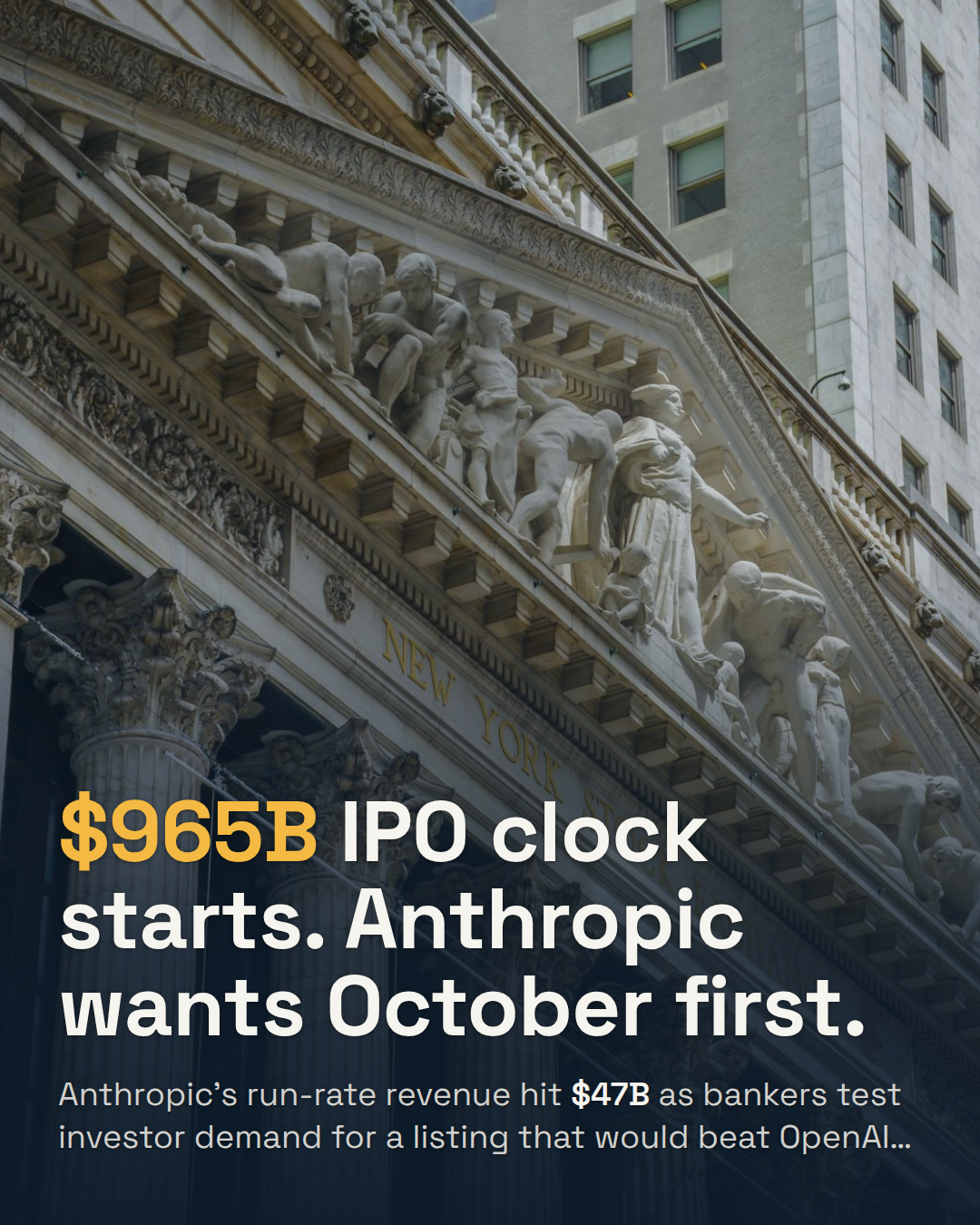
Anthropic's bankers have started "testing the waters" meetings with investors, the standard pre-roadshow step that comes after a confidential IPO filing, according to reports from CNBC and Bloomberg on July 15. Goldman Sachs, Morgan Stanley and JPMorgan Chase, the three banks leading the offering, are sounding out demand for a listing as soon as October. Anthropic filed its confidential S-1 with the SEC on June 1, three days after closing a $65 billion Series H round led by Altimeter Capital, Dragoneer, Greenoaks and Sequoia Capital at a $965 billion post-money valuation. Its run-rate revenue crossed $47 billion in May, up from $9 billion in January, roughly a 5x jump in five months.
The valuation number is the least interesting part of this story. The signal underneath it: Anthropic is racing OpenAI, which also confidentially filed for an IPO in June, to be the first frontier AI lab to actually price shares on a public exchange. Whoever gets there first sets the valuation benchmark the rest of the AI industry gets measured against for the following two quarters, and being first to list after SpaceX's blockbuster June debut means riding the same window of investor appetite rather than fighting a rival for it.
The race matters more than the ticker
Being "first" to IPO is not a vanity metric here. Public markets assign a multiple, and that multiple becomes the reference price every private AI round after it gets negotiated against. If Anthropic prices in October at anywhere near its last private mark, every founder currently raising an AI round, from foundation-model labs down to thin application-layer wrappers, inherits a comp that didn't exist a month ago. If it prices below that mark, the opposite happens: the "AI valuations are frothy" narrative gets a data point, and diligence on every subsequent AI raise gets harder, not easier. Founders building on Claude, GPT, or any frontier API should treat October as a date that will move their own fundraising conversations, whether or not they ever mention Anthropic in a pitch deck.
What a public frontier lab changes for the stack you build on
Right now, foundation model pricing, availability and roadmap decisions happen inside a private company answerable mostly to its board and a handful of institutional backers. A public Anthropic answers to quarterly earnings calls, analyst questions about margin per token, and shareholders who will scrutinize compute spend the way they scrutinize any capital-intensive business. That's a meaningfully different incentive structure than the one governing the API you're building your product on today. It's also the first real test of whether an AI lab's unit economics, run-rate revenue against the compute cost of serving it, hold up under public disclosure. Founders relying on frontier APIs as core infrastructure should read Anthropic's eventual S-1 the way they'd read a key vendor's balance sheet, because in practice that's what it is. We cover exactly this kind of vendor and infrastructure-risk thinking in FiscEdge's financial modeling course, where cap tables and dependency risk get modeled together, not separately.
What this means for how you raise and build
If you're raising an AI-adjacent round in the next two quarters, expect investors to reference Anthropic's actual public pricing, not its private mark, the moment it lists. That changes how you should frame your own valuation ask: anchor it to your revenue multiple and retention, not to the general "AI is worth X" mood, because that mood is about to get a hard public number attached to it for the first time. It's also a reminder that the tools you build with today, chat interfaces, coding agents, retrieval pipelines, all sit on top of a handful of labs whose economics you don't control. Diversifying model dependencies, or at minimum understanding the true unit economics of what you're paying per API call, stops being optional once the lab behind your stack has quarterly earnings to defend. FiscEdge's AI for entrepreneurs course walks through building that resilience directly into your product architecture, and our breakdown of what are unit economics is worth a re-read with Anthropic's compute costs in mind.
If you remember one thing
Anthropic's IPO isn't really a story about a $965 billion number. It's the moment the economics of the frontier model you build your product on stop being a private assumption and start being a public, quarterly-scrutinized fact, and every founder building on top of that model should start asking now whether their own unit economics can survive that scrutiny too.
We teach how to model valuation, cap tables and vendor risk together in FiscEdge's financial modeling course, and how to build resilient AI-native products in the AI for entrepreneurs course. Browse the full blog for more News Breakdowns. Follow @fiscedge for daily Business & AI analysis.
Topics & Categorization:
How interesting did you find this article?