A Federal Judge Just Struck Down the Pentagon's Blacklist of Anthropic. The Ruling Calls It Illegal Retaliation.
A federal judge ruled the Pentagon's six-month blacklist of Anthropic violated the First Amendment and was retaliatory. For founders selling to government, procurement risk isn't just financial anymore.

Fiscedge Academy
Contributing Faculty & Practitioner
News Breakdown · FiscEdge Academy
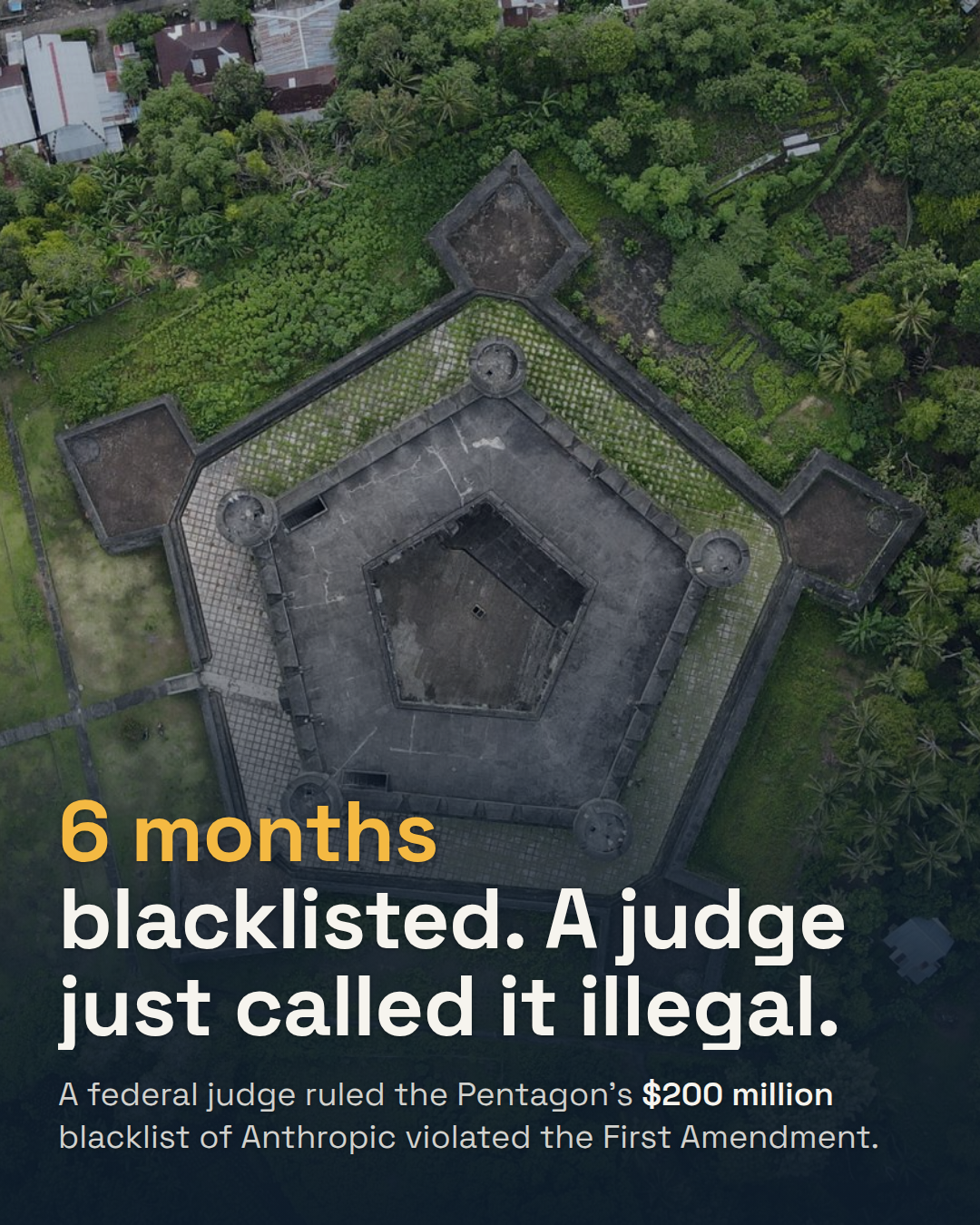
A federal judge in California ruled on August 28 that the Pentagon's decision to blacklist Anthropic as a "supply chain risk" was illegal, calling it retaliation dressed up as national security. U.S. District Judge Rita Lin's 59-page order strikes down a designation the Pentagon issued on February 27, exactly six months earlier, after Anthropic refused to let the military use Claude for domestic surveillance or fully autonomous weapons targeting.
The stakes are concrete. Anthropic held a $200 million Pentagon contract, awarded in 2025, that made Claude the first frontier model cleared for use on classified networks. The blacklist put that relationship, and any future federal business, at risk over a policy disagreement rather than an actual security failure. Judge Lin's ruling was blunt: "The empty invocation of national security is not a blank check to punish and retaliate against government critics." The government is expected to appeal.
The signal under the headline
The dollar figure is not what should worry founders here. The mechanism is.
The Pentagon used an obscure procurement statute, designed to flag suppliers vulnerable to foreign sabotage, against a fully domestic company because it disagreed with that company's product decisions. That is a first. Until February, a "supply chain risk" label meant a factory with ties to a hostile government, not a startup that declined to build a surveillance feature. Judge Lin's ruling establishes, at least for now, that a federal agency cannot repurpose a national-security designation as a retaliation tool against a vendor that says no.
That precedent matters more than the specific $200 million contract. Any company selling into government, whether it's core revenue or a pilot deal you're chasing to pad your logo wall, now has one data point suggesting courts will police this kind of pressure. It also matters that Anthropic had the balance sheet and legal team to fight a six-month blacklist and win. Most vendors facing the same threat would have folded, changed the product, or quietly lost the contract long before a judge ever saw the case.
What this changes for founders
- Government contracts carry political risk you can't model in a spreadsheet. Anthropic's exposure here wasn't credit risk or default risk, it was a cabinet official's opinion about product policy. If federal or state contracts are part of your revenue plan, know that a designation like this can appear with no warning and no due process, and budget legal reserves for it, not just working capital.
- Product refusals have a price, and sometimes a payoff. Anthropic said no to a lucrative use case on principle and got blacklisted for it. The ruling suggests that holding a line, if you can survive the retaliation, is legally defensible and can become a trust asset with customers who care how you handle pressure. Most founders will never face a fight this size, but the underlying lesson, know your red lines before a big customer tests them, applies at any stage.
- A win in court doesn't restore lost time. Six months of blacklist happened before the ruling landed. Whatever revenue, hiring, or partnership decisions were paused or lost during that window don't come back just because the designation was reversed. If your business has a single point of political or regulatory exposure, that exposure is a real cost even when you eventually win.
If you remember one thing
A federal judge just confirmed that a national-security label cannot be used to punish a company for refusing a customer's request, but Anthropic still spent six months and a real legal fight recovering ground the Pentagon took without due process. If government revenue is any part of your plan, treat political risk as a line item, not a footnote, long before you're big enough for a court case to matter.
We cover the regulatory and political risk that comes with government revenue in FiscEdge's startup strategy course, and how to build a defensible product roadmap around your own red lines in AI for entrepreneurs. For the fundamentals of assessing risk before you take on enterprise or government customers, start with business fundamentals. Browse the full blog for more breakdowns like this one. Follow @fiscedge for daily Business & AI analysis.
Topics & Categorization:
How interesting did you find this article?