Apple Hits $5 Trillion, Dethrones Nvidia as World's Most Valuable Company
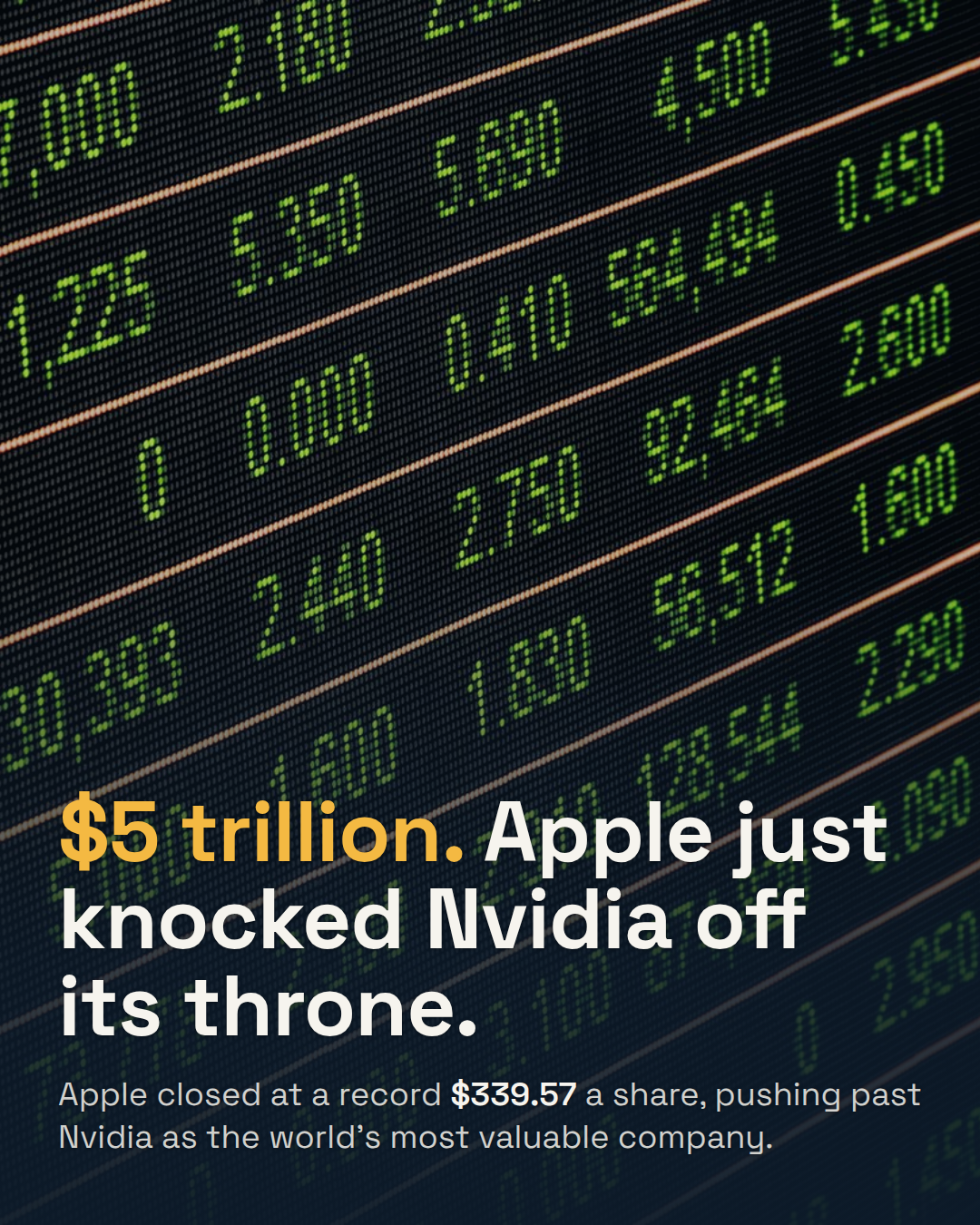
Apple's stock closed at a record $339.57 Monday, pushing its market cap to $5 trillion and knocking Nvidia off the top spot. The AI capex trade just cracked.

Fiscedge Academy
Contributing Faculty & Practitioner
News Breakdown · FiscEdge Academy
Apple closed Monday at a record $339.57 a share, lifting its market capitalization to roughly $4.96 trillion and pushing Nvidia out of the top spot as the world's most valuable public company for the first time since April 2025. A day later, on Tuesday, Apple briefly touched $5 trillion in market cap, becoming only the second company in history to reach that mark after Nvidia first got there in October 2025.
The scoreboard flip is the headline. The number is the least interesting part.
The 20-point gap that actually matters
Apple's stock is up more than 22% year-to-date in 2026, outpacing every other member of the so-called Magnificent Seven. Nvidia, by contrast, has added only about 7% over the same stretch. Nvidia had held the "most valuable company" crown since June 2025, when it overtook Microsoft, and it briefly stretched its own market cap to $5.5 trillion in May. Seven weeks later, the market has decided the AI chip giant's growth story is no longer worth the premium it once commanded.
That is the signal under the headline: investors are rotating out of the heaviest AI infrastructure spenders and into the company that spent the least.
Why capital discipline just beat compute intensity
The hyperscalers and chip suppliers that powered 2024-2025's AI rally have spent the past several weeks absorbing a very different reaction from the market. Alphabet's stock sold off on its own capex guidance in late July. Corning tumbled nearly 20% on the same day Apple hit its record, after warning that carrier capital spending was slowing. Sandisk dropped double digits on AI-memory competition fears. Across the board, the pattern is the same: companies raising debt and burning cash to build AI data centers are getting punished, while Apple, which has deliberately avoided a hyperscaler-style AI buildout in favor of on-device features and measured partnerships, is getting rewarded.
For founders, this is the part worth sitting with. The market spent two years pricing "more AI capex" as unambiguously good. It is now pricing capital discipline as the scarcer, more valuable trait, and Apple is the biggest possible proof point.
What this changes if you're building on AI
Three practical takeaways for SaaS founders and operators watching this from the outside:
- Compute spend is not a moat by itself. Apple's rerating shows that markets increasingly reward teams that ship AI as a tightly scoped feature with a clear return, not teams that treat infrastructure spending as the strategy. The same logic applies at startup scale when you decide how much of your burn goes to model calls versus product work.
- Cash flow discipline is back in fashion. Nvidia's stall and Alphabet's capex-driven selloff both happened because investors started asking harder questions about payback periods on AI investment. If you are raising right now, expect the same question from investors: what is the unit economics of the AI feature you are building, not just the demo.
- Concentration risk just got a reminder. Two companies now control roughly $10 trillion of combined market value on opposite bets about how AI infrastructure should be funded. Whichever way that resolves will move the capital markets your own fundraise depends on, even if you never touch a GPU.
If you remember one thing
The market did not just reward Apple's iPhone business, it punished everyone still treating AI compute spend as a story that sells itself. Build the AI feature that pays for itself, not the one that just proves you can afford the infrastructure.
We teach how to model this kind of spend-versus-return decision in FiscEdge's financial modeling course, and how to ship AI features without hyperscaler-sized budgets in building SaaS with AI. For the fundamentals behind why unit economics beat capex headlines, see our breakdown on unit economics and what it really costs to build a SaaS product. Browse the full blog for more News Breakdowns. Follow @fiscedge for daily Business & AI analysis.
Topics & Categorization:
How interesting did you find this article?