Apple Just Changed CEOs for the First Time in 15 Years. Ternus Inherits a $4.6 Trillion AI Problem.
Tim Cook handed the CEO title to John Ternus on September 1 after 15 years. The stock dipped, but the real question is whether an engineer can close Apple's AI gap.
Fiscedge Academy
Contributing Faculty & Practitioner
News Breakdown · FiscEdge Academy
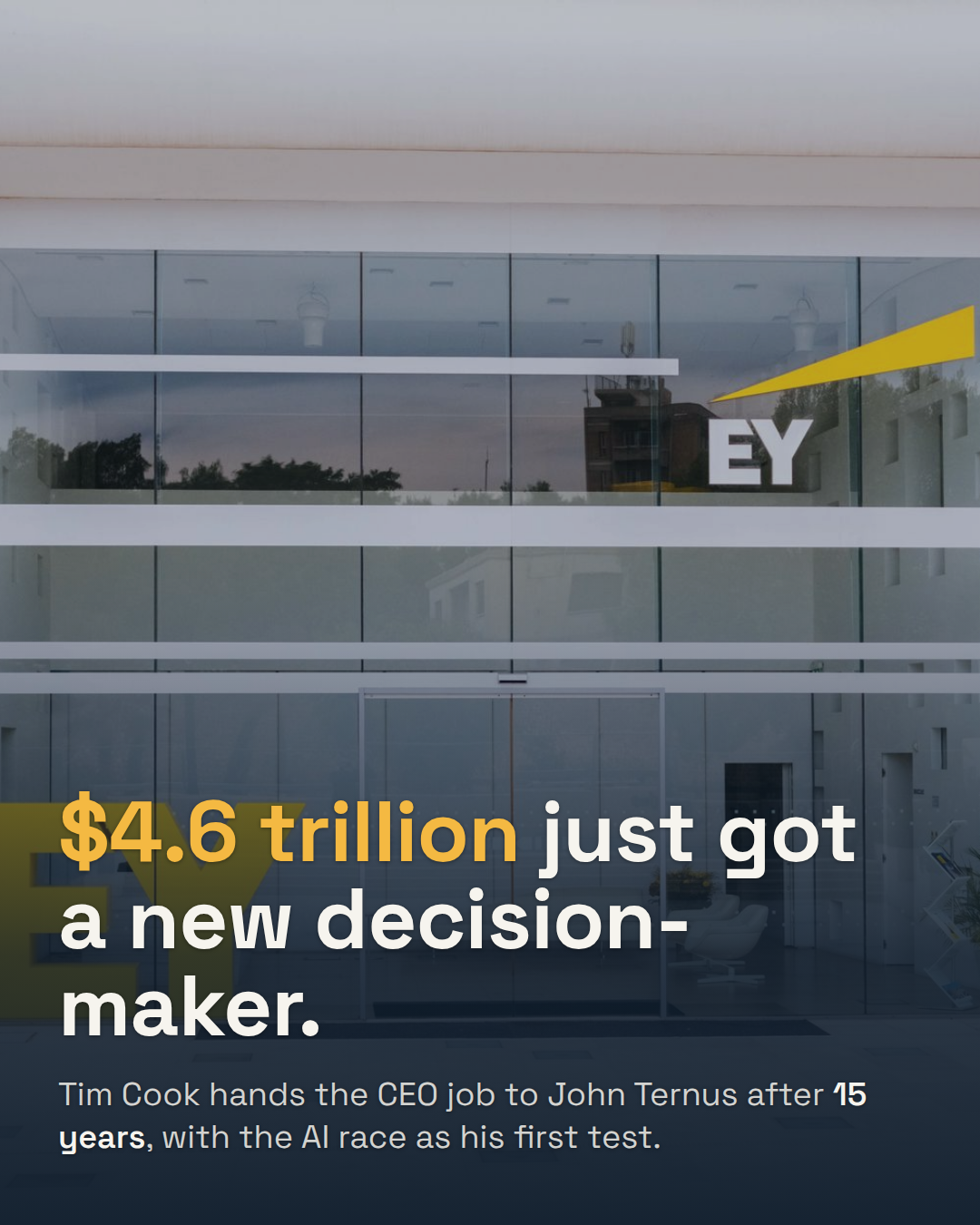
Apple has a new chief executive for the first time since 2011. Tim Cook handed the CEO title to John Ternus effective September 1, closing out a 15-year run and moving into the newly created role of executive chairman. The market's verdict was immediate and unimpressed: Apple shares slipped roughly 1.8% on the news, trading near $313 before paring losses, on a company still worth about $4.6 trillion.
Cook's tenure is the modern benchmark for operational discipline: he took Apple's market cap from roughly $350 billion in 2011 to multiples of that today, built the services business into a near-$100 billion annual line, and never had a down year that stuck. Ternus, 51, is the opposite kind of leader on paper: a mechanical engineer who joined Apple's product design team in 2001, ran hardware engineering since 2013, and was formally named SVP of Hardware Engineering in January 2021. He has never run a P&L, never faced investors on an earnings call, and inherits the job nine days before Apple's most consequential product launch in years.
The stock dip is the least interesting part of this story. Here's the signal under the headline: Wall Street isn't nervous about a leadership change, it's nervous about what the leadership change is for. Apple picked an engineer, not a strategist, at the exact moment it is losing the AI race. Siri has been publicly, repeatedly delayed while OpenAI, Google and Meta ship agentic assistants that actually book things, write things and reason across your data. Ternus's entire mandate, stated plainly by the board, is to fix that before the next iPhone cycle.
The handoff is a case study, not just a headline
Boards spend years on succession the way most startups spend zero. Apple's board began surfacing Ternus as the frontrunner in analyst notes as far back as 2024, formally announced the transition on April 20, and ran a four-month overlap where Cook and Ternus co-presented, co-signed filings and co-appeared with the board before the handoff actually happened. That is the opposite of the way most founder-led companies do it, where the CEO is also the only person who understands the cap table, the roadmap and the key customer relationships, and succession is a slide nobody has written.
If you are building a company you intend to still be running in 15 years, the lesson isn't "hire an engineer." It's that Apple treated the transition itself as a product: scoped, dated, rehearsed, and communicated months in advance so the market had already priced it before it happened. The 1.8% drop wasn't shock. It was the market's honest read of a known, well-telegraphed risk.
Why this matters if you build on Apple's platforms
Apple's fall event lands September 9, and IDC estimates Apple could ship more than 17 million foldable iPhones by 2027, roughly 40% of the global foldable market and worth an estimated $45.7 billion. That's Ternus's first real test, and it's a hardware bet, not an AI one, which tells you where his instincts default under pressure.
For any founder building on iOS, in the App Store, or against Siri and Apple Intelligence APIs, the practical read is: expect continuity on hardware cadence and App Store mechanics, and expect more volatility on the AI roadmap than Apple has shown in a decade. A slower, more engineering-led Apple on AI is an opening, not a threat, for SaaS teams building agentic features Apple hasn't shipped yet. Platform incumbents that are slow to move are exactly where independent software gets built.
If you remember one thing
The market didn't punish Apple for changing CEOs. It priced in the fact that the new CEO's real job, closing an AI gap against three well-funded rivals, is unproven, and that a $4.6 trillion company just bet on an engineer to solve a product-strategy problem. Whichever way that bet goes, it is a live reminder that succession planning is not an HR exercise, it's a governance decision investors will price the day it becomes real, so treat it as seriously in your own cap table as Apple's board did in theirs.
We teach governance and platform-risk thinking in FiscEdge's startup strategy course, and how to out-build slow-moving incumbents in AI for entrepreneurs. If you're shipping features on top of shifting platform APIs, building SaaS with AI covers how to de-risk that dependency. Browse the full blog for more news breakdowns. Follow @fiscedge for daily Business & AI analysis.
Topics & Categorization:
How interesting did you find this article?