China Clears Apple Intelligence After a Two-Year Wait. Alibaba and Baidu Get the Keys.
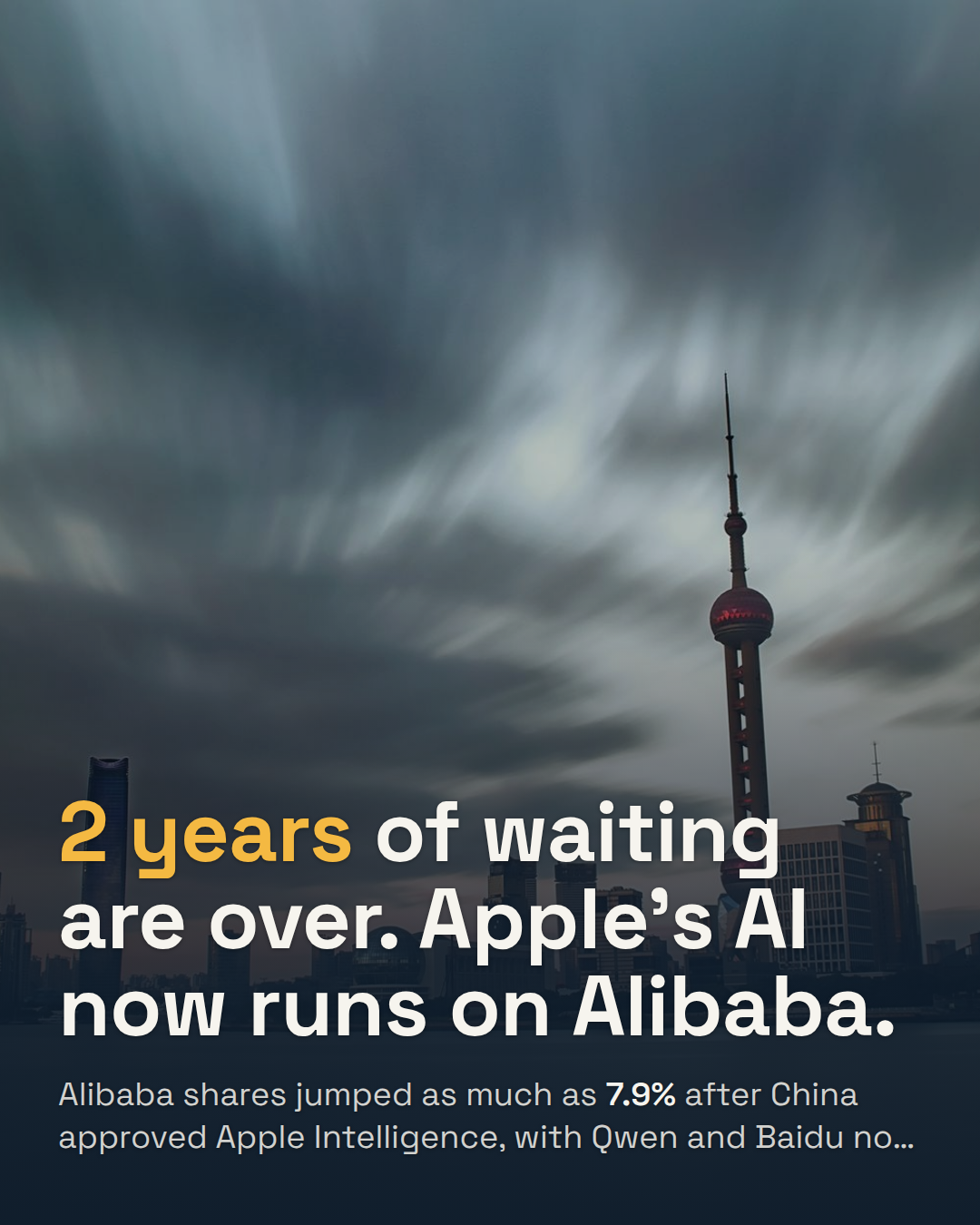
China approved Apple Intelligence after a two-year delay, handing the on-device AI layer to Alibaba's Qwen and search to Baidu. Alibaba shares jumped as much as 7.9% on the news.
Fiscedge Academy
Contributing Faculty & Practitioner
News Breakdown · FiscEdge Academy
China's internet regulator, the Cyberspace Administration of China (CAC), added Apple to its registry of approved generative AI service providers on July 15, clearing Apple Intelligence for launch in the country after a delay of more than two years since the feature debuted globally in 2024. Bloomberg and CNBC both confirmed the approval the same day: Alibaba's Qwen model will power the core on-device AI features across iOS, iPadOS, macOS and visionOS, while Baidu supplies the China-specific search and assistant capabilities Apple pairs with Google and OpenAI everywhere else. The market reacted within hours. Alibaba's US-listed shares jumped as much as 7.9%, Baidu's rose as much as 4%, and both stocks extended gains in Hong Kong trading the next day.
The valuation pop is the least interesting part of this story. The signal underneath it: the world's most vertically integrated consumer tech company just spent two years discovering it cannot ship AI in its second-largest market without handing the model layer to two local competitors it doesn't control.
The two-year wall China just knocked down
Apple unveiled Apple Intelligence in June 2024 alongside the rest of the world, but China's rules require any public generative AI service to complete a formal registration and pair with an approved local model, since data has to be processed inside the country. Apple spent over two years negotiating that requirement while iPhone AI features shipped everywhere else. That gap wasn't a rounding error: China is Apple's largest market outside the Americas, and shipping a materially worse product there for two straight years handed local rivals like Huawei, who had no such regulatory wait, a real feature advantage on their own home turf. The lesson for founders isn't about Apple's scale, it's about timeline risk: if your product depends on any capability that requires local government sign-off in a market you plan to enter, budget years, not quarters, and don't announce a global launch date that assumes uniform regulatory access.
Why Apple needed two partners, not one
Apple didn't just find a Chinese model and swap it in. It split the job: Qwen handles the on-device intelligence layer that used to be Apple's own, and Baidu handles search and assistant duties, mirroring the Google-plus-OpenAI split Apple already runs in the US and EU. That's a deliberate diversification, not a convenience choice, built to avoid a single point of failure with any one vendor, political or technical, inside a market where Beijing can revoke an approval as fast as it granted one. Any founder building an AI product that leans on a single foundation model API should read that structure as the playbook: redundancy across model providers isn't just a cost hedge, it's the difference between a two-year outage and a manageable one when a single vendor relationship breaks. FiscEdge's AI for entrepreneurs course walks through exactly this kind of multi-model architecture decision before you're forced into it by a regulator or an outage.
The market read: Alibaba wins the interface war
Alibaba's stock move matters more than Baidu's, and the gap tells you something. Qwen is getting the higher-value placement, the actual on-device intelligence layer running on hundreds of millions of iPhones, while Baidu gets the narrower search slot. For two years, the open question in Chinese AI was which lab would become the default model underneath the products people actually touch every day. Apple just answered it, and public markets repriced Alibaba's AI business overnight on the strength of a single distribution deal. That's the part worth remembering when you think about your own product: the model you pick isn't just a technical decision, it's a distribution decision, and being the default inside someone else's massive install base is worth more than almost any standalone consumer launch you could run yourself.
What this means if you build on someone else's platform
Apple is the platform here, and even Apple had to cede the model layer to survive a market's rules. If a $3 trillion company with its own silicon, its own OS and its own App Store still ended up dependent on two external AI vendors to compete in China, assume your own product will face the same tradeoff wherever you can't control the regulatory or infrastructure layer underneath you. Map out now which pieces of your stack, payments, AI models, cloud regions, data residency, would force a similar compromise if a market you're targeting tightened its rules tomorrow. That's a strategy conversation, not an engineering one, and it's the kind of platform-dependency mapping we cover in FiscEdge's startup strategy course, alongside the broader build-vs-integrate tradeoffs in Building SaaS with AI.
If you remember one thing
Apple just proved that even the most closed, most vertically integrated tech company on earth cannot out-negotiate a national AI regulator alone. It needed two local partners to ship a feature it already owned everywhere else. If your roadmap assumes uniform global access to your core AI capability, this is the two-year counterexample to plan around before a regulator hands you the same bill.
We cover platform-dependency risk and multi-model architecture in FiscEdge's AI for entrepreneurs course, and the market-entry strategy behind stories like this one in startup strategy and Building SaaS with AI. Browse the full blog for more News Breakdowns. Follow @fiscedge for daily Business & AI analysis.
Topics & Categorization:
How interesting did you find this article?