Apple's iPhone Duo Costs $1,999, Not the $2,500 Wall Street Modeled. That Gap Is the Whole Story.
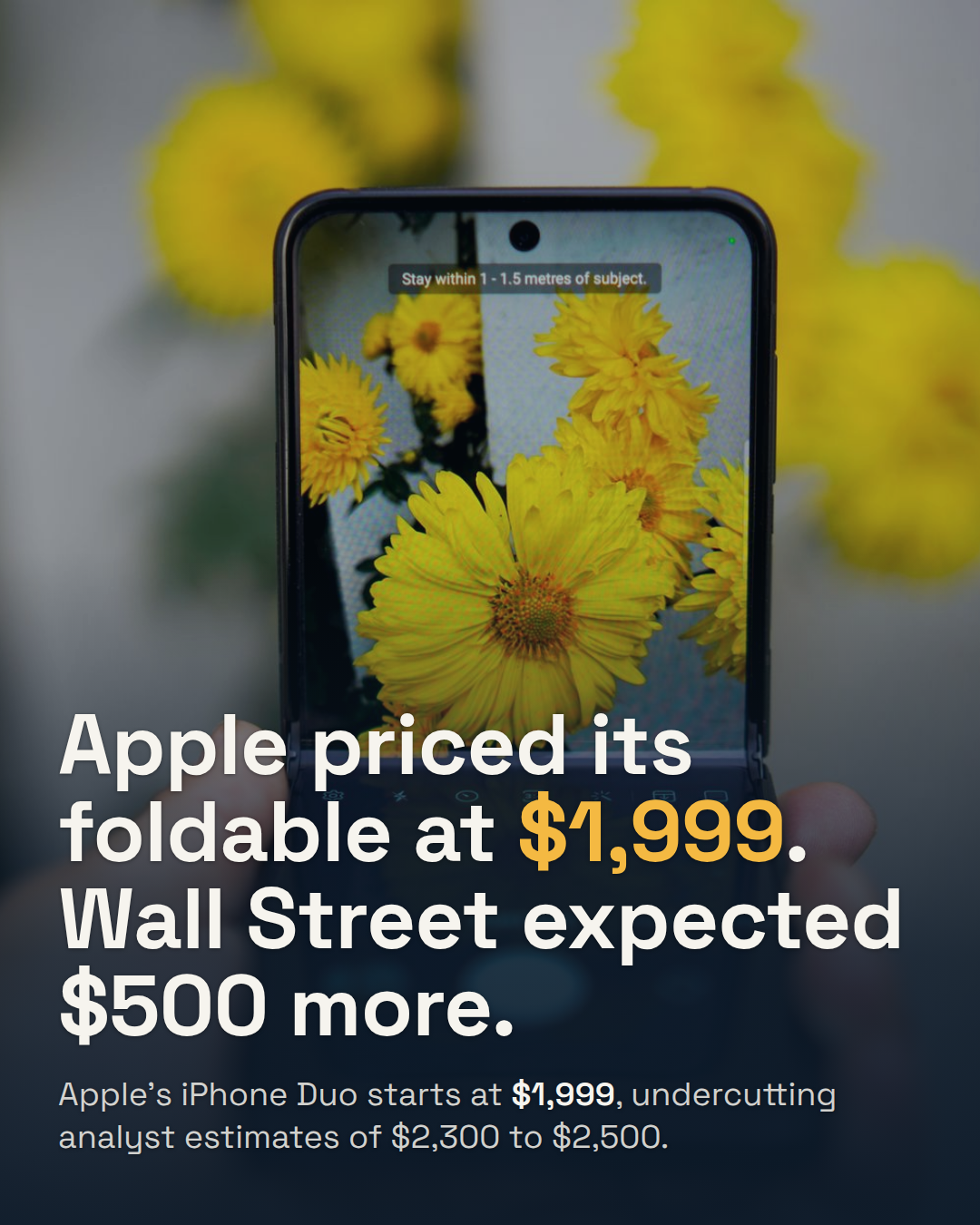
Apple launched its first foldable iPhone at $1,999, well below the $2,300 to $2,500 Wall Street expected. Shares dipped at the keynote, then jumped 3.6% once analysts read the play.

Fiscedge Academy
Contributing Faculty & Practitioner
News Breakdown · FiscEdge Academy
Apple's first foldable phone, the iPhone Duo, starts at $1,999 for 256GB, scaling to $2,199, $2,599 and $3,199 for its 2TB top tier, the most expensive iPhone Apple has ever sold. It was unveiled Wednesday at a "Surprise and Shine" event alongside the iPhone 18 Pro line, with preorders opening October 16 and the device shipping October 23 in the US and more than 70 other countries.
The price is the least interesting number in this story. The interesting one is $2,300 to $2,500, roughly what Wall Street had modeled Apple would charge. Apple came in $300 to $500 under its own market's expectations, and undercut Samsung's Galaxy Fold7 by a dollar in the process. Apple stock closed down 0.28% to $315.34 on the day of the announcement itself, then jumped 3.56% to $326.57 the next session once analysts finished reading the pricing.
What Apple actually shipped
The Duo runs a 7.6-inch inner display and a 5.4-inch outer one, a grade-5 titanium frame that's 85% recycled, dual 48MP rear cameras with 4K Dolby Vision video at up to 120fps, and two colors, Star White and Night Sky. It's a genuine flagship, not a cautious first draft. Apple also raised the iPhone 18 Pro and Pro Max by $100 each, to $1,199 and $1,299, which JPMorgan's Samik Chatterjee called "in line" with the firm's base case for how Apple would offset rising memory costs. The foldable, in other words, absorbed the pricing risk so the mainline phones wouldn't have to.
The gap Wall Street didn't expect
Foldables are still a small category, about 2% of global smartphone shipments, on track to cross 100 million cumulative units by the end of 2026 after 20%+ year-over-year growth. Samsung leads with roughly a third of that market; analysts expect Apple to claim close to a quarter of it in its first year alone, just by showing up. That's the calculation behind the below-consensus price: Apple isn't trying to protect margin on a niche category, it's trying to win share in a category before it stops being niche. Chatterjee's note called the Duo "attractively priced" specifically because it "opens up an opportunity for switchers" from other foldables, not because it will move volume comparable to the standard iPhone line.
Why the stock dipped, then jumped
Day one, the market read a $1,999 to $3,199 phone as a demand question: how many people actually pay four figures for a folding screen. That's why AAPL closed slightly negative on keynote day, a fairly muted reaction to what was otherwise Apple's biggest hardware category launch in years. Day two, once analysts at JPMorgan, TD Cowen and Citi had run the math on switcher economics, share targets and the margin trade-off against the Pro line, the stock repriced sharply upward. The company didn't change anything about the product between Wednesday and Thursday. The market just needed a full trading session to understand the strategy it had just watched.
What this means if you're not selling phones
Two transferable lessons sit inside this launch. First, price against what your market has already modeled, not just against your cost base or your closest competitor. Apple's $1,999 only reads as aggressive because Wall Street had priced in $2,300 to $2,500; the same sticker price against a $1,500 expectation would have read as expensive. If you're setting price for a new tier or a new product line, the number that matters most is the one your buyers and investors are already carrying in their heads. Second, a muted first-day reaction to a launch is not a verdict. Apple's own stock dipped on the day everyone was watching and only moved once the market had time to work through the strategic logic. If your own product launch or pricing change gets a shrug on day one, that's often a data problem, not a demand problem: the market hasn't finished pricing the story yet.
There's a platform angle here too. A new form factor is also a new interaction surface, and new surfaces create new app categories the way the original App Store did for touch and Apple Watch did for glanceable data. Nobody needs to build a Duo-specific app in October, but founders building consumer or productivity tools should watch what Apple's design guidelines say about dual-display and continuity behavior once developer documentation lands. That's usually where the second wave of value shows up, months after the keynote everyone remembers.
If you remember one thing
Price against expectations, not against cost. Apple's foldable wasn't cheap in absolute terms, it was cheap relative to the number analysts had already built into the stock, and that gap, not the $1,999 itself, is what moved the market a full day later.
We cover pricing and positioning strategy like this in FiscEdge's business fundamentals course, including how to price against competitor and analyst expectations rather than just cost. For platform bets and multi-year land grabs, our startup strategy course walks through the playbook. For the math behind pricing decisions, read what are unit economics. Browse the full blog for more daily breakdowns. Follow @fiscedge for daily Business & AI analysis.
Topics & Categorization:
How interesting did you find this article?