Apple Sues OpenAI for Trade Secret Theft. The Complaint Names a $6.4B Hardware Unit.
Apple filed a federal lawsuit accusing OpenAI, its $6.4 billion io Products unit, and two former Apple employees of systematically stealing hardware trade secrets. For founders, it's a hiring playbook warning.
Fiscedge Academy
Contributing Faculty & Practitioner
News Breakdown · FiscEdge Academy
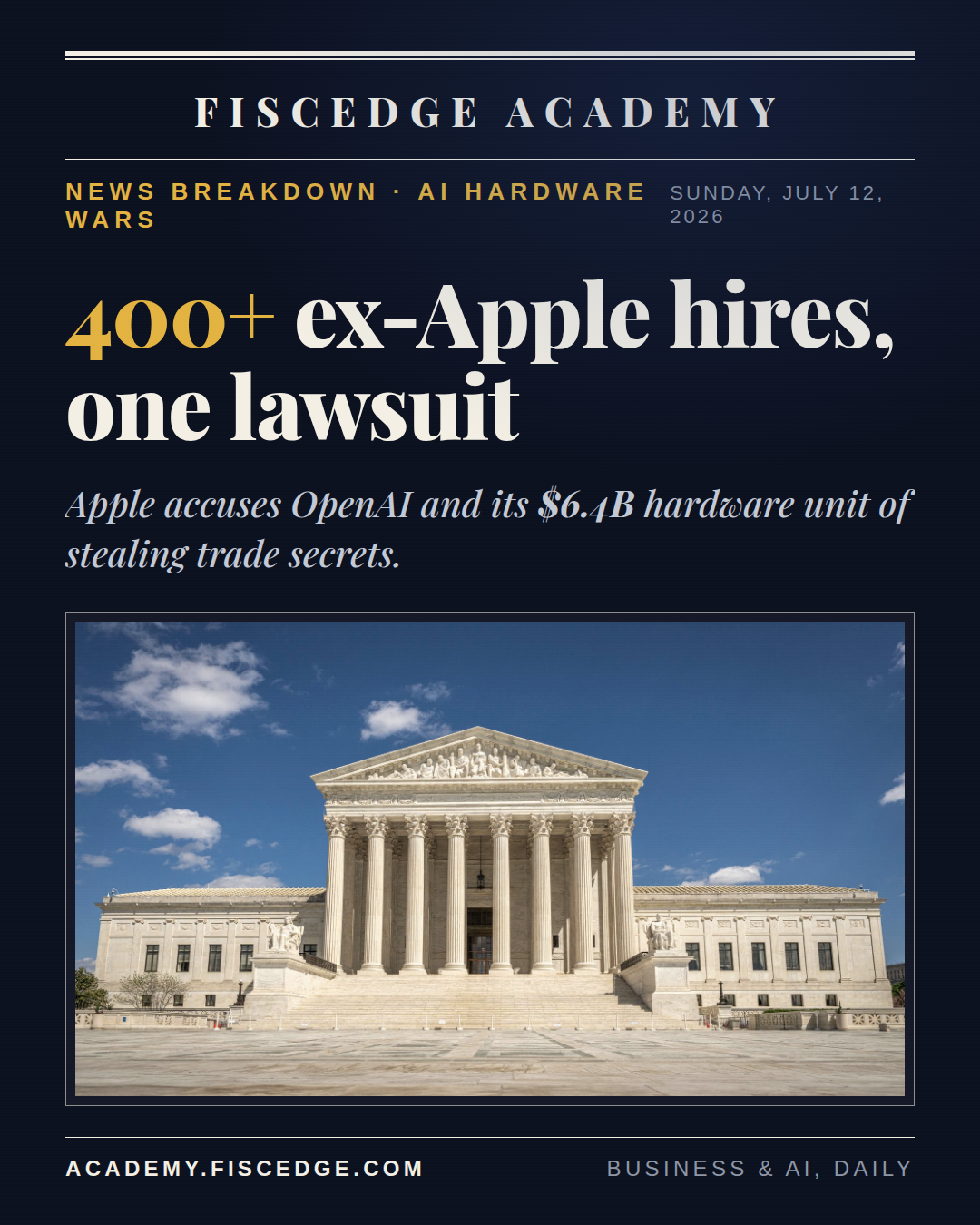
Apple sued OpenAI on July 10 in federal court in the Northern District of California, accusing the ChatGPT maker, its $6.4 billion hardware unit io Products, and two named former Apple employees of running a systematic trade-secret theft scheme the complaint describes as operating "at every level" of the company. The suit names Tang Tan, OpenAI's chief hardware officer and a former Apple vice president, and Chang Liu, a former Apple engineer, as individual defendants alongside OpenAI and io Products.
The numbers in the filing are specific. Apple says more than 400 of its former employees now work at OpenAI, and alleges Tan used confidential Apple project codenames during recruiting, told candidates still employed at Apple to bring physical hardware components to interviews for "show and tell," and coached departing staff on how to evade Apple's exit security checks. Liu, the complaint says, failed to return an Apple-issued laptop after leaving for OpenAI and used it to download dozens of confidential technical documents. Apple also alleges OpenAI misled one of Apple's own manufacturing partners into demonstrating a proprietary metal-finishing technique, believing it had Apple's blessing to share it.
The lawsuit itself is the least interesting part. The interesting part is what it says about where the AI hardware race has landed.
What actually broke down
Apple and OpenAI were commercial partners as recently as 2024, when ChatGPT was integrated directly into iOS through Siri. That relationship cooled fast after OpenAI acquired io Products, the hardware startup co-founded by Apple's former design chief Jony Ive, for $6.4 billion in 2025, and began building its own consumer AI device. Ive isn't named as a defendant, but io Products is, which puts Apple in the position of suing a company it still partners with over a product line that competes directly with its own roadmap.
Apple is seeking injunctive relief, monetary damages, and a declaratory judgment, plus orders forcing defendants to return Apple materials and stop using anything derived from them. No damages figure has been made public yet, and OpenAI has denied wrongdoing, saying it has "no interest in other companies' trade secrets."
Why 400 hires isn't the real number
It's tempting to read "400 former Apple employees at OpenAI" as the headline stat, but Apple isn't suing over hiring volume. Poaching talent from a competitor is legal, expected, and has been Silicon Valley's operating model for decades. What Apple is suing over is far narrower: specific, documented instances where it says individuals took confidential materials and processes with them, and where a senior hire allegedly used inside knowledge to structure the recruiting pipeline itself.
That distinction matters more than the lawsuit's dollar value ever will, because it's the exact line every fast-growing company crosses without noticing. Hiring a competitor's engineer for their skills is normal business. Hiring them and expecting them to bring know-how, codenames, or supplier relationships that belong to their old employer is the thing that turns a hire into a lawsuit.
What this changes if you're building or hiring in AI
If you're a founder recruiting out of a company you compete with, three things follow directly from this filing.
First, your offboarding and onboarding paperwork matters more than you think. Apple's complaint leans heavily on Liu's failure to return a company laptop and on downloaded files with confidentiality markings still visible. Any company on either side of a competitive hire should be documenting device returns and access revocation the same day someone leaves, not weeks later.
Second, be explicit with new hires about what they can and can't bring. A verbal "don't share anything confidential" isn't a policy. Written guidance on what counts as a trade secret versus general professional know-how protects both the hiring company and the employee, and it's the kind of operating discipline covered in FiscEdge's startup strategy course.
Third, if you're building hardware or any physical AI product, your supply chain relationships are themselves a trade secret surface. Apple's allegation that a manufacturing partner was misled into sharing a proprietary process is a reminder that vendor and contractor confidentiality needs the same rigor as employee confidentiality, something worth building into your plan early if you're studying how to build AI-powered products rather than retrofitting legal protection after a leak.
This is also a preview of more litigation to come. As every major tech company races to ship its own AI hardware and poaches talent from the same small pool of people who've actually shipped consumer devices at scale, expect trade-secret suits to become a standard cost of doing business in this sector, not an exception. Founders who treat IP hygiene as a basic operating fundamental, the kind covered in business fundamentals, will spend far less time and money defending against it than those who treat it as legal department overhead.
If you remember one thing
Hiring a competitor's talent is normal. Letting a new hire bring their old employer's codenames, files, or supplier playbooks with them is what turns a routine hire into a federal lawsuit, so document the line before you cross it, not after someone else's lawyer draws it for you.
We teach the operating fundamentals that keep hiring and IP decisions defensible in FiscEdge's startup strategy course and business fundamentals course. Browse the full blog. Follow @fiscedge for daily Business & AI analysis.
Topics & Categorization:
How interesting did you find this article?