Apple Beat Every Estimate. Wall Street Erased 7% Anyway.
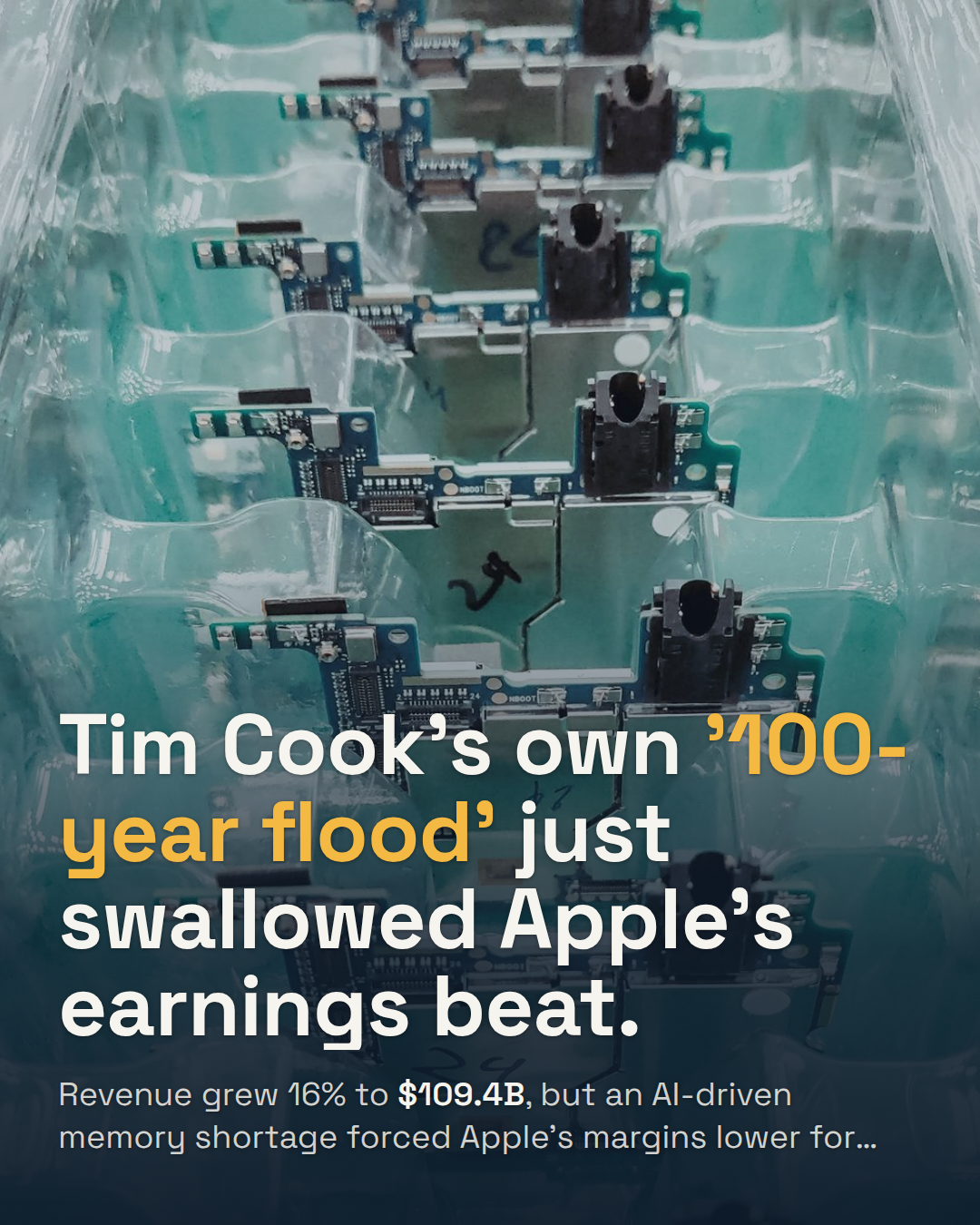
Apple's revenue grew 16% to $109.4B and profit jumped 27%, but shares fell 7% after Apple blamed an AI-driven memory shortage for weak margin guidance.

Fiscedge Academy
Contributing Faculty & Practitioner
News Breakdown · FiscEdge Academy
Apple just delivered the best June quarter in its history, and Wall Street punished it anyway. Revenue hit $109.4 billion, up 16% year-over-year, with iPhone sales climbing 22% to $54.3 billion and net profit jumping 27% to $29.8 billion. Every headline number beat Wall Street's forecast.
Shares still fell as much as 7% in Friday's session, extending an already-negative after-hours reaction to Thursday's report. The reason wasn't demand. It was Apple's own guidance: revenue growth of just 9-11% for the September quarter, below the 12% Wall Street had modeled, and gross margin guided down to 47-48% from the 50.1% Apple just reported.
The revenue and profit numbers are the least interesting part of this story. The real signal is why a company that just posted record everything is telling investors margins are about to compress: it can't get enough memory.
The "100-year flood" nobody priced in
On the earnings call, outgoing CEO Tim Cook described the current memory market bluntly, calling it "a 100-year flood on memory pricing, with exponential increases in memory prices." Apple already raised Mac and iPad prices in June because of it, and Cook told analysts to expect the pain to continue, not ease, warning Apple expects to pay even higher memory costs ahead.
This isn't an Apple-specific problem. AI data centers are projected to consume 70% of all high-end DRAM production in 2026, up from roughly 20-30% just a few years ago. On the logic side, TSMC's advanced-node capacity, the fabs that make the chips inside every iPhone and every AI accelerator, is reportedly sold out through 2027. Apple has more purchasing power and supplier leverage than almost any company on earth, and it still couldn't buy its way around the shortage. It raised prices and lowered its own margin guidance instead.
Why this matters even if you don't sell hardware
If Apple, with its balance sheet and its supplier relationships, is telling Wall Street to expect thinner margins because of chip and memory costs, smaller companies further down the supply chain have far less leverage. That shows up in a few concrete ways for founders:
- Hardware and edge-AI products get more expensive to build. Any startup shipping a physical device, IoT hardware, or on-device AI inference is competing with hyperscalers and Apple for the same constrained memory and advanced-node capacity.
- Cloud and inference costs stay sticky. The same DRAM and advanced-node scarcity squeezing Apple's margins is the input cost behind every GPU server your AI vendor runs. Expect compute pricing to stay firm, not fall, through 2026-2027.
- "Beat and guide down" is becoming the standard AI-era earnings pattern. Apple joins a growing list of companies posting record top-line numbers while warning that AI infrastructure costs are compressing margins. If you're modeling a hardware-adjacent or infrastructure-heavy business, build in rising input costs now rather than reacting after they hit your own margin.
The other story buried in the same call
Thursday's call was also Cook's 90th and last as CEO; John Ternus takes over September 1, with Cook moving to executive chairman. Markets largely shrugged at the transition itself, which is arguably the bigger compliment: a 15-year CEO handoff didn't move the stock at all. The memory shortage did. That's a useful reminder of what investors are actually pricing right now, and it isn't leadership risk.
If you remember one thing
Revenue beats don't protect margins when your input costs are structurally scarce. Apple just showed that even the company best positioned to absorb an AI-driven supply shock is raising prices and lowering guidance instead. If your business touches hardware, devices, or GPU-backed inference, model rising input costs into your unit economics now, not after your own margin guidance disappoints.
We break down margin math like this in FiscEdge's financial modeling course, and cover how infrastructure costs ripple into pricing in what are unit economics. Founders building AI-powered products should also look at AI for entrepreneurs. Browse the full blog for more daily breakdowns. Follow @fiscedge for daily Business & AI analysis.
Topics & Categorization:
How interesting did you find this article?