VC Funding Jumped 122% in August to $42 Billion. Almost None of It Reached Seed-Stage Startups.
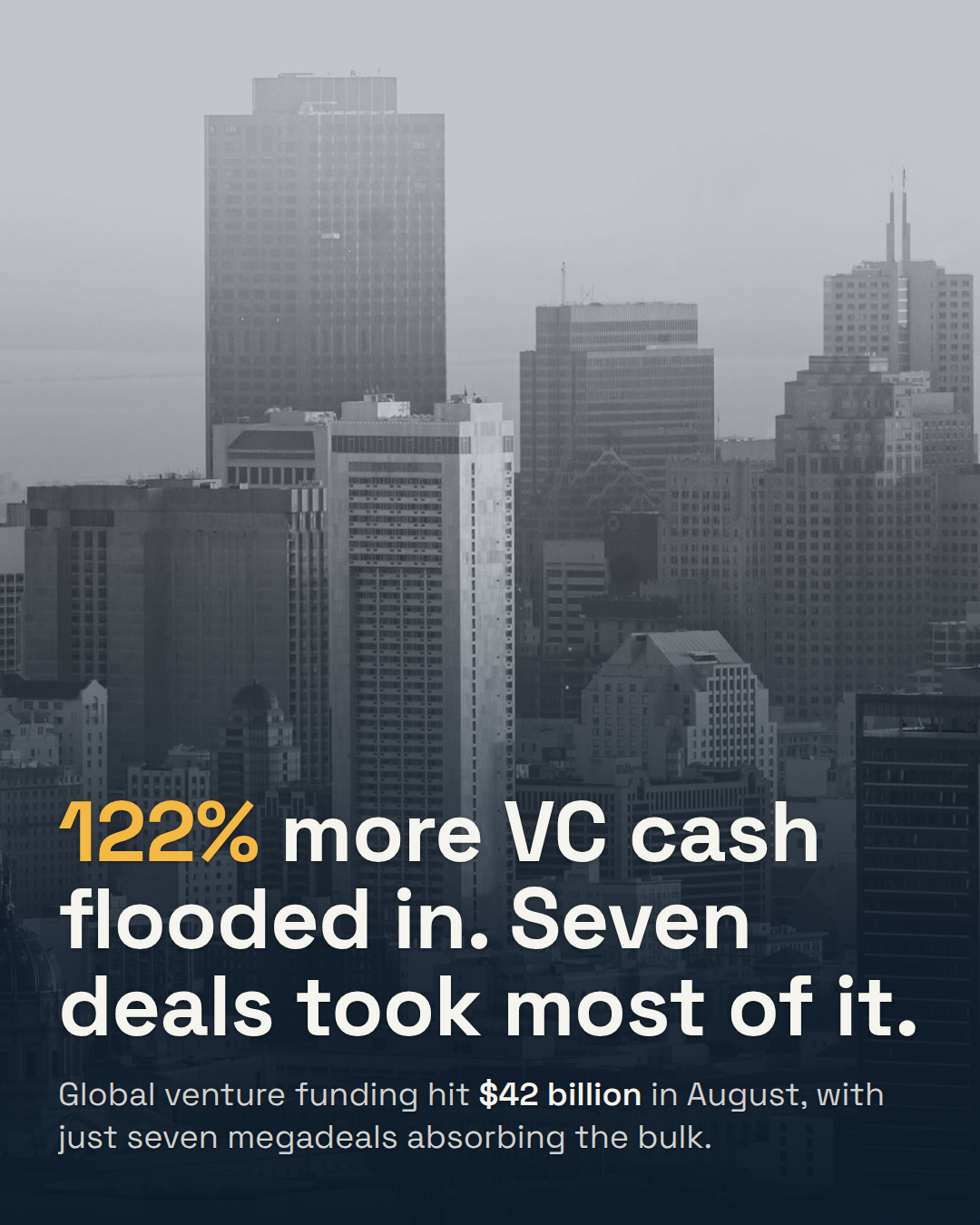
Global venture funding hit $42 billion in August, up 122% year over year, but seven mega-rounds took most of it, leaving early-stage founders further from the money than ever.

Fiscedge Academy
Contributing Faculty & Practitioner
News Breakdown · FiscEdge Academy
Global venture investors put $42 billion into just over 1,500 startups in August, according to Crunchbase data, a 122% jump from the same month last year. Seven companies closed rounds of $1 billion or more, the second-highest monthly count of the year behind July's 13. That sounds like a boom. It's really a story about how few doors are actually open.
The single biggest August check went to Databricks, which raised $5 billion at a $190 billion valuation, roughly $56 billion higher than the $134 billion mark it hit just six months earlier. Bloomberg and TechCrunch both reported the same detail worth sitting with: Databricks wanted to raise about $1 billion. Investors pushed for as much as $15 billion. The company settled on $5 billion, backed by Coatue, Blackstone, MGX and T. Rowe Price, on the back of a $7 billion annualized revenue run-rate and 80% year-over-year growth.
The headline growth rate is the least interesting part. Here's the signal under it.
The barbell is now the whole market
August funding actually fell 25% from July's $56 billion, so the year-over-year spike says less about a broadening recovery than about how thin the same month was in 2025. And the money that did move split into two piles, with almost nothing in between. On one end: proven scale. Databricks isn't a bet on a story, it's a check written against $7 billion of run-rate revenue growing 80% a year. On the other end: proven pedigree. River AI, a two-month-old startup building open-weight AI infrastructure, raised $1.1 billion across seed and Series A in a round led by General Catalyst, with Nvidia, AMD Ventures, Y Combinator and Temasek all participating, largely on the strength of founder Igor Babuschkin's résumé as an xAI co-founder.
Crunchbase's data adds one more detail that founders should sit with: five of the seven billion-dollar recipients in August had last raised capital less than 12 months earlier. This isn't new money finding new companies. It's the same small set of already-funded, already-known names getting marked up again, fast.
What "record funding" actually means if you're not one of the seven
The PitchBook-NVCA Venture Monitor puts a number on how narrow this has gotten: more than 81% of U.S. venture dollars in the first half of 2026 went into rounds of $100 million or larger. That's not a description of the funding environment improving broadly, it's a description of the size of check you now need to be relevant to the data at all. If your round is a $2 million seed or an $8 million Series A, you are, statistically, invisible in the numbers driving every "VC funding is booming" headline this month, including this one.
That has a direct implication for how you should read your own fundraising process. A slow raise, a term sheet that doesn't materialize, an investor who goes quiet after a warm first meeting, none of that means the market is closed. It means capital is currently concentrated in checks written to companies with either Databricks-level revenue proof or River AI-level founder pedigree, and most founders have neither yet. The fix isn't a better pitch deck. It's the same discipline we walk through in financial modeling: build the retention, growth-rate and unit-economics story that makes a check defensible on numbers alone, because narrative-only rounds are exactly the middle of the barbell that's currently empty.
Fast follow-ons are becoming the default, not the exception
The pattern behind five of August's seven megadeals, a new round inside 12 months of the last one, is becoming how capital moves in AI-adjacent categories specifically. Investors aren't waiting for the next funding cycle to re-underwrite a company; they're marking up conviction bets in real time as usage and revenue data comes in. For founders building in AI or AI-adjacent infrastructure, that means the traditional 18-to-24-month runway-to-next-round assumption is already out of date for the fastest-growing names in your category, and your own investors will be comparing your pace to theirs whether that's fair or not. It's worth building your model, and your board updates, around a faster proof cycle even if your actual fundraising timeline hasn't compressed yet, a habit we cover in startup strategy.
If you remember one thing
"Global VC funding up 122%" is true and almost beside the point: the money is flowing to fewer, larger, faster-repeating checks, not to more startups. If you're not already inside that circle, the way in is hard revenue or growth proof, not a bigger raise ask. Model the numbers before you go out, not after a term sheet stalls.
We teach the fundraising math behind rounds like these in FiscEdge's financial modeling and startup strategy courses, and how unit economics drive investor conviction in what are unit economics. Browse the full blog for more news breakdowns. Follow @fiscedge for daily Business & AI analysis.
Topics & Categorization:
How interesting did you find this article?