Autodesk Pays $3.575 Billion for MaintainX. It Is the Largest Deal in the Company's History.
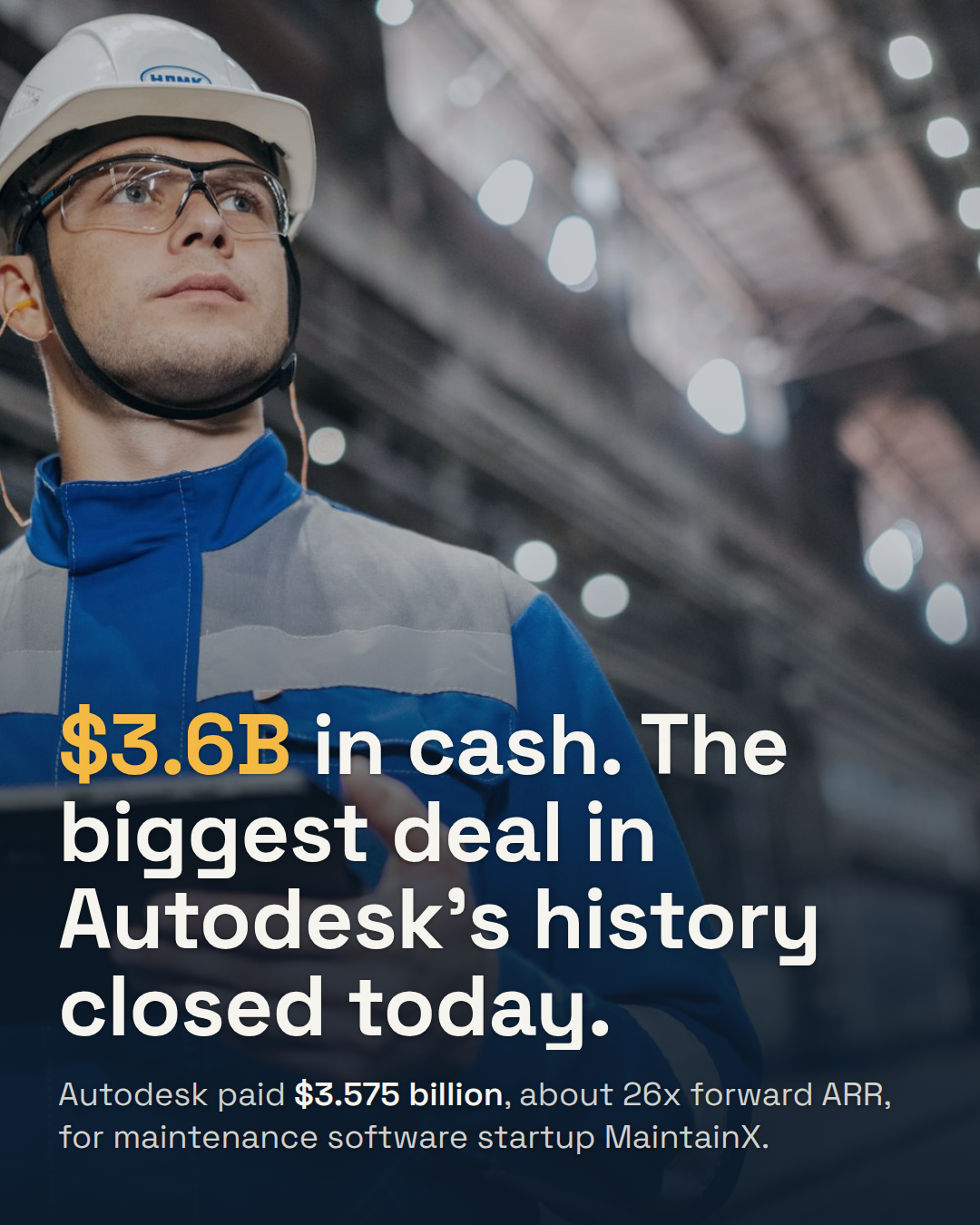
Autodesk closed a $3.575 billion all-cash deal for maintenance software startup MaintainX today, its biggest acquisition ever and a premium exit above its last private valuation.
Fiscedge Academy
Contributing Faculty & Practitioner
News Breakdown · FiscEdge Academy
Autodesk closed its acquisition of MaintainX today, paying $3.575 billion in cash (widely rounded to $3.6 billion) for the mobile-first maintenance software startup. It is the largest deal in Autodesk's history, and it closed on the earliest date the two companies had written into their merger agreement back in May.
The math behind the price is the real story. MaintainX raised a $150M Series D just over a year ago, in July 2025, at a $2.5 billion valuation. Autodesk is paying roughly 1.44x that mark, for a company expected to post north of $135 million in ARR for calendar 2026, growing better than 50% year over year. Do the division and Autodesk just paid about 26x forward revenue for a 13,000-customer vertical SaaS business that manages upkeep on more than 11 million physical assets, everything from HVAC units to factory conveyor belts.
The number is the least interesting part. Here's the signal under the headline.
A design company just bought the real world's maintenance log
Autodesk makes the software that designs buildings, factories and products (AutoCAD, Revit, Fusion). MaintainX makes the app frontline technicians use to log a broken valve or complete a safety checklist on a phone. Autodesk is folding MaintainX into a new unit called Autodesk Operations Solutions, explicitly framed as closing the loop between "design," "make" and "operate." The pitch to investors: every work order MaintainX logs is training data on how a designed thing actually breaks down in the field, data Autodesk's AI models have never had access to before. For SaaS founders, this is the acquisition thesis to study: incumbents with strong design or planning software are increasingly paying up for the operational, real-world data layer they're missing, not just the seat count.
The exit math founders should actually copy
A 1.44x step-up from a private mark to an acquisition price in about 13 months is a modest multiple by 2021-era standards, but it is a real, cash exit at a premium, not a down-round rescue. MaintainX's founders and early backers are being paid out at roughly 14x the company's total $254 million in funding raised to date. If you're building vertical SaaS today, this is the shape of a good outcome in the current market: durable 50%+ growth, real ARR (not just usage metrics), and a strategic buyer who needs your specific data, not just your customer list.
Retention is priced in, and that's a tell
Autodesk is granting $150 million in restricted stock units to MaintainX employees who stay on, on top of the purchase price. Buyers only pay meaningful retention premiums when the acquired team, not just the software, is the asset. If you're negotiating an acquisition of your own SaaS company someday, a large RSU pool for your team is a sign the buyer has done its homework on what actually breaks post-close: the people who understand the codebase and the customers.
How Autodesk is paying for it says something too
Roughly $1.6 billion of the price comes from cash on hand, with the rest financed through a new 364-day term loan and Autodesk's revolving credit facility, rather than issuing new equity. Autodesk chose to lever up for this rather than dilute shareholders, a sign of how confident the board is that MaintainX's ARR growth clears the cost of that debt. Founders raising debt-backed growth capital today are increasingly in good company, not just adjacent to it.
What this means if you're building AI-native vertical SaaS
The lesson isn't "raise at $2.5B and hope for a buyer." It's that the acquirers paying real premiums right now are the ones who can point to a specific, defensible reason: proprietary operational data, a distribution channel they can't build in-house, or a workflow that's genuinely hard to replicate. Building a thin AI wrapper on top of a general-purpose model is not that. A system of record for a physical, high-friction workflow, the kind your customers touch every single day and would be painful to switch away from, is exactly that. That's the layer strategics keep paying up for.
If you remember one thing
Autodesk didn't buy MaintainX for its chatbot or its dashboards. It bought thirteen thousand customers' worth of real-world operating data at a 26x ARR multiple, because that data is the one input its own AI roadmap could not otherwise get. If you're building vertical software, the defensibility that gets you acquired at a premium is the data your customers generate by using your product every day, not the AI features bolted on top of it.
We teach the exit math behind deals like this in FiscEdge's financial modeling course, and how to build a defensible vertical SaaS business in Building SaaS with AI. For the fundamentals of reading a cap table and a term sheet, start with business fundamentals. More on how ARR multiples actually work: what are unit economics. Browse the full blog for more breakdowns like this one. Follow @fiscedge for daily Business & AI analysis.
Topics & Categorization:
How interesting did you find this article?