Amazon's AWS Backlog Doubled in a Year to $578 Billion. Margins Hit a Record Too.
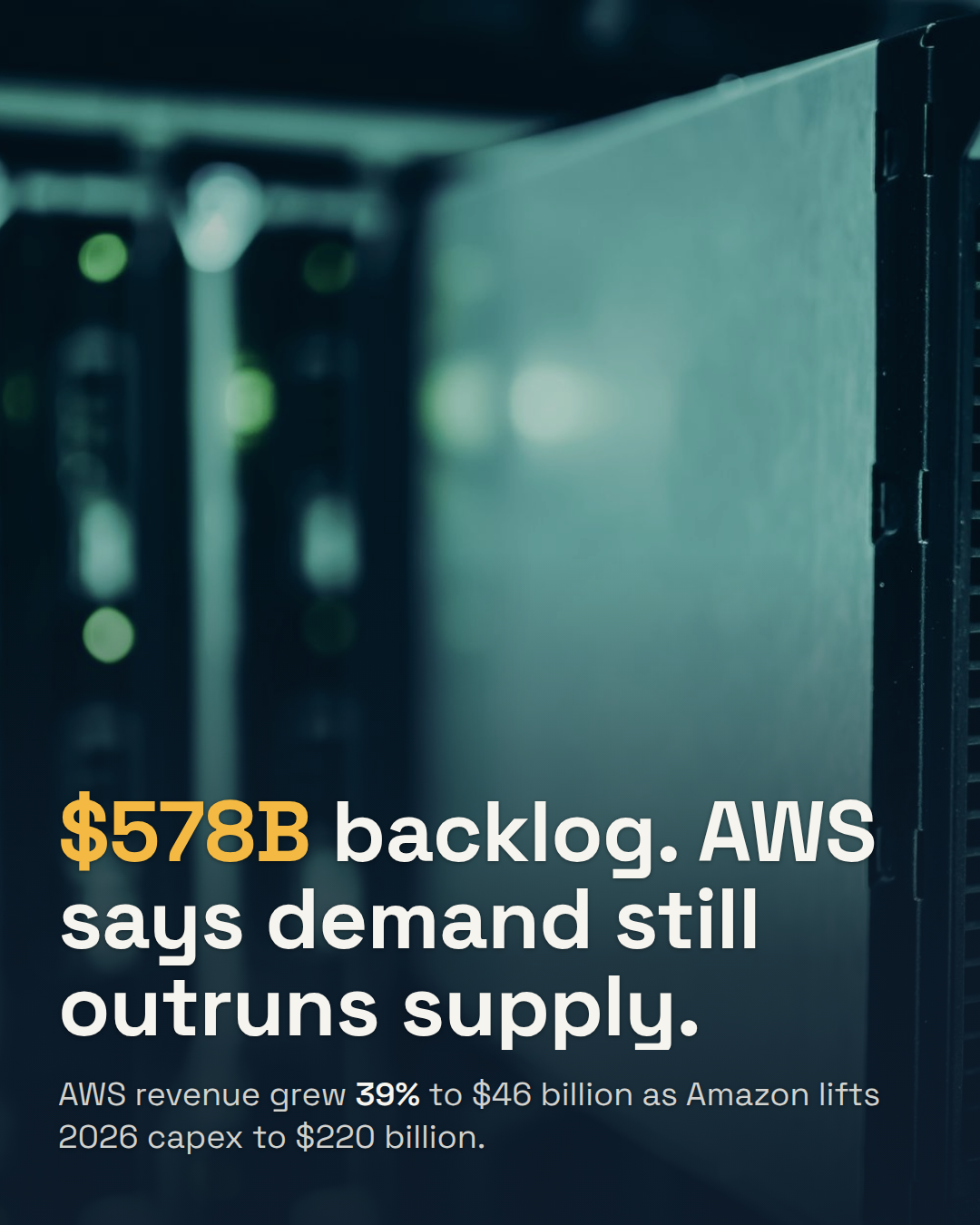
AWS revenue grew 39% to $46 billion in Q3, its fastest pace in years, while operating margin hit a record 38.7%. Amazon is raising 2026 capex to $220 billion and says demand still outstrips supply.

Fiscedge Academy
Contributing Faculty & Practitioner
News Breakdown · FiscEdge Academy
Amazon Web Services grew revenue 39% year over year in the third quarter, its fastest growth rate in years, to $46.0 billion. AWS operating income rose 55% to $17.77 billion, pushing the segment's operating margin to a record 38.7%, up from 34.6% a year ago. Amazon's total operating margin hit 13.9%, the highest in the company's history.
Amazon is now raising its 2026 capital spending plan to roughly $220 billion, up from the $200 billion it guided to earlier this year, and CEO Andy Jassy told analysts on the October 29 call to expect "meaningfully more" in 2027. The reason he gave: AWS's backlog, the contracted revenue not yet booked, hit $578 billion, up from $496 billion in Q2 and $364 billion at the start of the year. That is more than double where it stood twelve months ago.
The number everyone will quote is the 39% growth rate. It is not the most interesting part of this report.
The signal under the headline
For two years, the market's nervousness about AI capex has had a simple shape: hyperscalers raise spending every quarter, and investors wait to see if the revenue shows up to justify it. Meta's October quarter leaned the other way, with a 14% profit drop and a capex range investors are still digesting. CoreWeave's credit default swaps hit distress levels last week on exactly this worry: that the AI buildout is running ahead of paying demand.
Amazon's Q3 is the clearest counterexample so far. AWS margin did not compress under the capex load, it expanded, by over 4 points year over year. Revenue growth accelerated rather than decelerated, from roughly 35% a year ago to 39% now. And the backlog, which is Amazon's own forward-looking signal of contracted demand, grew faster than the capex did. If AWS were simply building ahead of demand and hoping, you would expect margins to compress as idle capacity sat on the balance sheet. Instead the opposite happened.
That does not mean every hyperscaler's AI spending is equally justified. It means the "all AI capex is a bubble" framing that founders have been hearing since CoreWeave's debt trouble needs a company-by-company read, not a sector-wide verdict. Demand for compute is not evenly distributed, and right now it is concentrating on the providers that can actually deliver it at scale.
What this means if you build on AWS
Three things are coming, and they are coming regardless of how the AI capex debate resolves elsewhere:
Pricing power is shifting toward AWS, not away from it. A segment growing 39% with margin expansion has very little reason to discount. If your SaaS gross margin model assumes falling compute costs over the next two years, re-run it with the opposite assumption built in, at least for GPU and managed AI services.
Capacity constraints are real, not just a negotiating story. Jassy's "meaningfully more in 2027" line, paired with a backlog growing faster than supply, is a signal that reserved-capacity and committed-use discounts are going to matter more than on-demand pricing for anyone running AI workloads at scale. Founders who lock in committed spend now, even at a modest discount, are buying a hedge against a tighter 2027.
The AI infrastructure trade has a second winner besides Nvidia. Most of the "AI capex pays off" conversation over the past year has been about chipmakers. This quarter is Amazon's evidence that the cloud layer sitting between chips and applications is capturing real, expanding margin too, not just reselling compute at cost. For founders raising on an AI thesis, that changes who the comparable companies are when you're building a pitch deck.
The part that still matters for your own numbers
None of this is a reason to stop interrogating your own cloud bill. Amazon's margin expansion is a company-level story about AWS's cost structure and pricing discipline, not a signal that your unit economics are fine by association. If anything, a cloud provider operating from a position of strength is less likely to pass savings down the stack. Model your compute costs as a rising line item, not a falling one, and build pricing that can absorb it.
If you remember one thing
AWS just posted accelerating growth and expanding margin in the same quarter it raised capex again, with a backlog growing faster than the spending. That is the opposite of an AI capex bubble signature. Treat the next hyperscaler earnings call as company-specific evidence, not sector-wide proof of anything.
We teach how to model infrastructure costs into a defensible SaaS pricing strategy in FiscEdge's Advanced AI Product Manager masterclass, and how to prototype AI features without overbuilding your stack in AI Agents & Prototyping for Non-Technical Builders. For the underlying math on margins and burn, see does it cost a fortune to build a SaaS. Browse the full blog. Follow @fiscedge for daily Business & AI analysis.
Topics & Categorization:
How interesting did you find this article?