AWS Tripled Its Nvidia GPU Order to 3 Million Chips. It Ran Out Early.
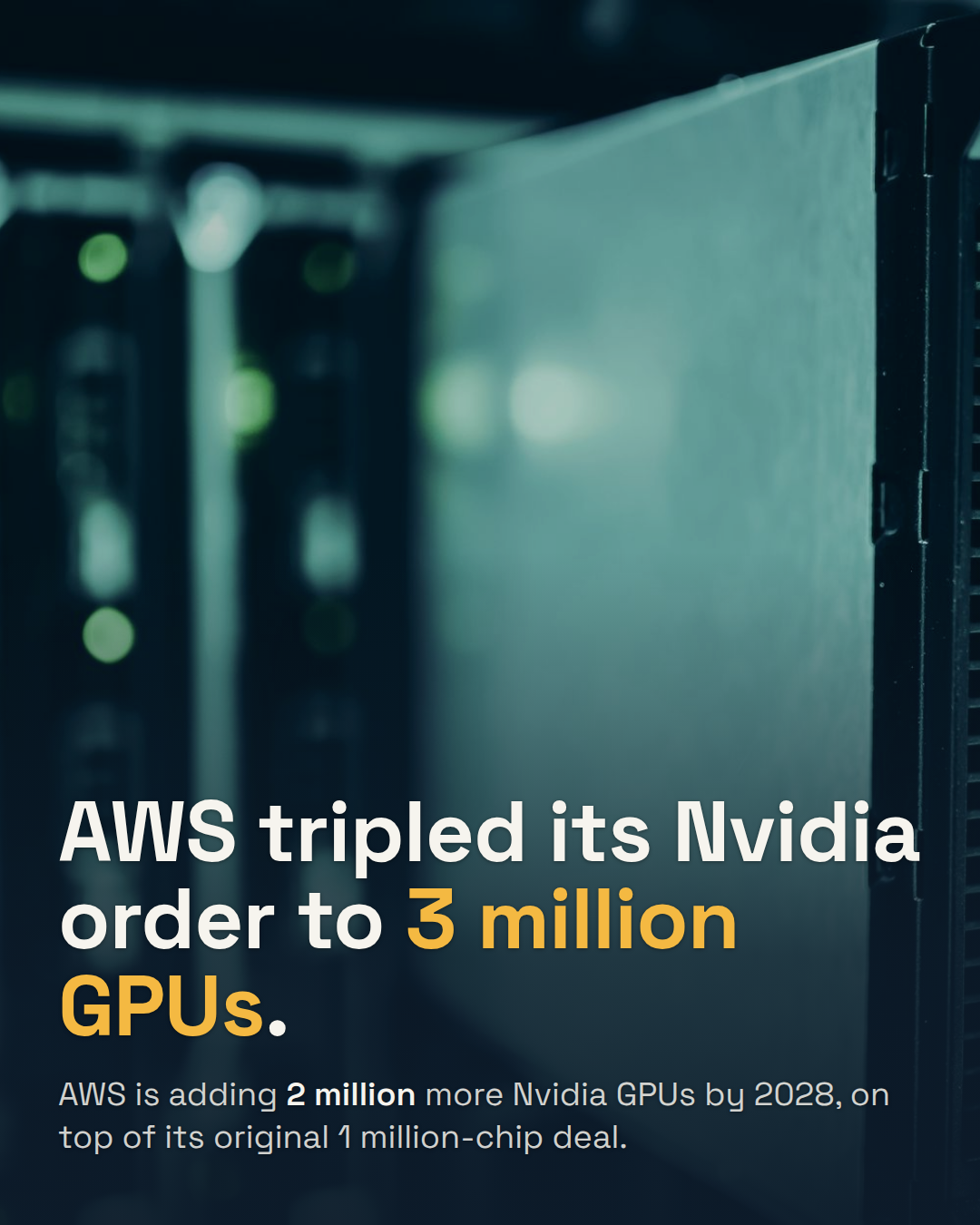
AWS is adding 2 million more Nvidia GPUs for 2027-2028, tripling its original 1 million-chip commitment after demand blew through the plan ahead of schedule.

Fiscedge Academy
Contributing Faculty & Practitioner
News Breakdown · FiscEdge Academy
Amazon Web Services just tripled the largest chip order in its history, and it did so before the original order had even finished shipping.
AWS and Nvidia announced this week that AWS will deploy 2 million additional Nvidia GPUs across its global infrastructure in 2027 and 2028, stacked on top of the roughly 1 million chips AWS committed to at Nvidia's GTC conference earlier this year. That brings AWS's total Nvidia GPU commitment to 3 million chips, a threefold jump in a matter of months. Multiple reports on the deal note that the original 1-million-chip commitment ran through its capacity faster than either company had planned for. Neither side disclosed a price, but at current GPU unit economics, industry estimates put the expansion at "tens of billions of dollars."
The GPU count is the headline. It is not the story. The story is a company tearing up its own multi-year infrastructure roadmap and rewriting it upward, in public, less than a year after signing it.
The signal under the headline
Every AI capex number this earnings season has pointed the same direction, but this one is different in kind. Nvidia's own quarter (up 106% year over year, data center revenue up 117%) is a look-back number: it tells you what already got bought. AWS tripling a forward order for chips that will not even ship until 2027 is a look-forward number: it is Amazon, the most capacity-disciplined operator in cloud computing, betting tens of billions of dollars that demand for AI compute two years from now will still be rising, not plateauing.
Jensen Huang framed it plainly: "demand is running ahead of every forecast." AWS CEO Matt Garman's framing was more revealing: customers want the freedom to run any AI workload on AWS and confidence it will "just work" with Nvidia's stack. Translation: enterprise customers are no longer piloting AI, they are provisioning for it, and AWS does not want to be the constraint.
What's actually in the order
The 2 million additional GPUs span Nvidia's Blackwell Ultra, Rubin, and Rubin Ultra generations, alongside new Nvidia Vera CPUs for agentic-AI workloads, plus expanded networking and robotics collaboration. This is not a single SKU reorder; it is AWS locking in Nvidia's entire forward roadmap, generation by generation, years before those chips exist in volume.
One detail founders should not skip past: 100,000 of those GPUs are earmarked for dedicated "AI factories" built for the U.S. government, cleared to run workloads at Impact Level 6, the classification tier covering SECRET-level Department of Defense work. It is the first publicly disclosed commitment of GPU-accelerated AI at that scale and classification. A meaningful new government AI budget line just opened, and it now runs through AWS and Nvidia's stack specifically.
What this changes if you build on AI infrastructure
- Compute cost relief is not coming soon. If your model was "GPU prices ease as supply catches up in 2026-2027," revise it. The two biggest buyers in the industry are still racing to secure more capacity, not less, which keeps reserved-instance pricing power with the cloud providers.
- Vertical lock-in is compounding. AWS is not diversifying away from Nvidia; it is deepening the relationship across chips, CPUs, networking and software. If your product depends on being the "neutral" alternative to hyperscaler AI infrastructure, the gap between you and the incumbents just widened, not narrowed.
- Government AI is now a real go-to-market lane. IL-6-cleared infrastructure did not exist at this scale a year ago. If you sell into public sector, defense, or regulated industries, there is a new, credible compute layer to build compliance-ready AI products on top of.
- Demand forecasting just got a real data point. When the buyer with the best visibility into enterprise AI adoption triples its own two-year-old forecast, that is a stronger signal than any survey. Bake faster-than-expected AI adoption into your own planning, not slower.
If you remember one thing
The clearest signal of real AI demand isn't a usage chart or a chatbot survey. It's Amazon tripling a multi-year, multi-billion-dollar chip order before the first version of that order was even finished shipping. Plan your compute costs, your competitive positioning, and your go-to-market timing as if that acceleration is real, because the two companies with the best data on it just bet tens of billions of dollars that it is.
We teach founders how to model infrastructure and unit economics before they scale in FiscEdge's financial modeling course, and how to build AI-native products without getting locked into a single vendor's stack in Building SaaS with AI. For the underlying cost math behind every AI feature you ship, read what it actually costs to build a SaaS product. Browse the full blog for more News Breakdowns. Follow @fiscedge for daily Business & AI analysis.
Topics & Categorization:
How interesting did you find this article?