Brent Crude Crosses $100 a Barrel. The Iran War Just Billed Every Founder.
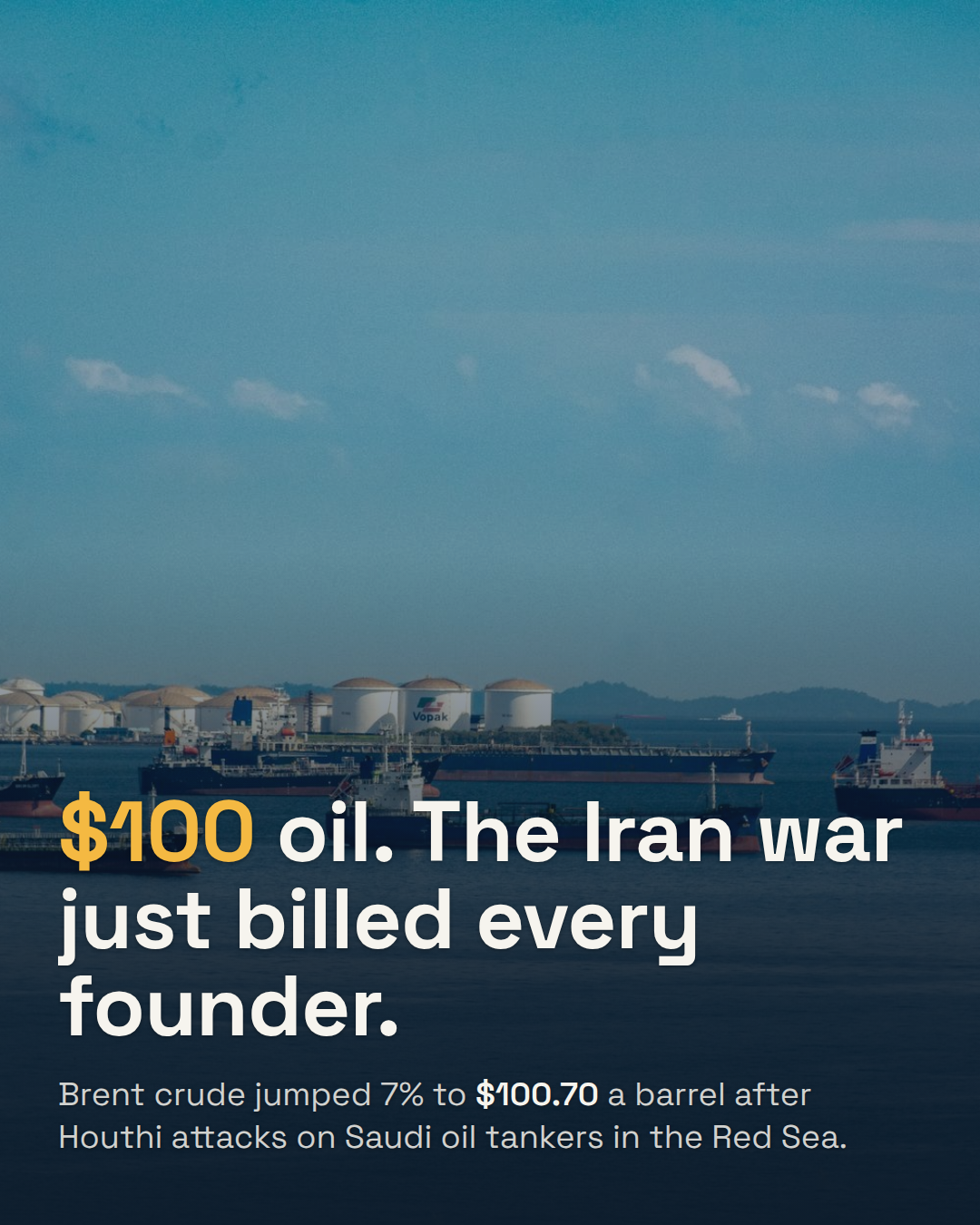
Brent crude jumped 7% to $100.70 a barrel, its highest since May, after Houthi attacks on two Saudi oil tankers pushed Treasury yields to 2026 highs.

Fiscedge Academy
Contributing Faculty & Practitioner
News Breakdown · FiscEdge Academy
Brent crude jumped as much as 7% on Thursday, crossing $100 a barrel for the first time since May 26 and touching $100.70 intraday. U.S. benchmark WTI broke above $90. The trigger: Iran-aligned Houthi forces in Yemen said they struck two Saudi oil tankers in the Red Sea with drones and missiles, part of a maritime blockade they declared against Riyadh earlier this week.
The move pushed 10-year Treasury yields to their highest levels of 2026. Oil is now up more than 30% this month alone, and Goldman Sachs has flagged Brent above $120 by the fourth quarter if the disruption in shipping lanes continues.
The barrel price is the least interesting part. The signal under the headline is that a war most founders have been mentally filing under "geopolitics, not my problem" just repriced the cost of running almost any business, in three separate ways at once.
Three channels, one shock
Input costs, directly. Fuel surcharges ripple into freight, shipping, packaging and anything plastic-adjacent within days, not quarters. If your COGS has a logistics or manufacturing component, this quarter's margin assumptions are already stale.
Cost of capital, indirectly but harder to dodge. Treasury yields at their highest point this year mean higher discount rates on every DCF, higher hurdle rates at every fund, and a less forgiving multiple on your next round. Growth-stage and late-stage pricing in particular gets set off the risk-free rate; when that rate moves, term sheets move with it, even for SaaS companies that never touch a barrel of oil.
Inflation expectations, structurally. This is an oil-supply shock layered on top of an already jumpy rate environment. The Red Sea attacks widen a conflict that has already forced a near-halt in shipping through the Strait of Hormuz and seen Iran target Gulf infrastructure directly. Each escalation resets the market's assumption of how long the premium sticks around, and "how long" is exactly the variable that determines whether it shows up in your customers' willingness to pay.
Why this is different from a normal commodity wobble
Oil spikes from demand (a hot economy, a cold winter) usually mean-revert fast, because they're self-correcting: high prices choke off demand, which brings prices back down. A supply shock driven by an active war in a chokepoint region doesn't have that stabilizer. It resolves on political and military timelines, not economic ones, which is exactly why Goldman's downside case ($120) is treated as plausible rather than alarmist.
For founders, that distinction matters more than the headline number. A demand-driven spike is noise you can ignore in a model. A supply-driven, war-driven spike is a variable you have to actually plan around, the same way you'd plan around a Fed hike or a customer concentration risk.
The scenario-planning gap most startups have
Most seed and Series A models still treat input costs, cloud spend and the discount rate as static line items. Very few have a "war risk premium" toggle. That's the gap this week is exposing: teams that stress-test their financial modeling for a 20-30% input cost swing and a 100bps move in the risk-free rate will know within a day whether their runway assumption still holds. Teams that don't will find out the hard way at their next board meeting, or their next term sheet.
This is also a good moment to revisit your unit economics with a wider band of assumptions rather than a single point estimate. If your margin only works at today's input costs, it isn't a margin, it's a bet on the Red Sea staying calm. Founders who treat cost structure as one of the business fundamentals worth stress-testing, not a static spreadsheet input, are the ones who won't be surprised by the next headline like this one.
If you remember one thing
Model the war risk premium the same way you model a rate hike: as a scenario you run in advance, not a surprise you react to. Oil at $100, and the yield move that came with it, just moved the cost of both goods and capital for almost every founder reading this, whether or not a single barrel ever touches your business.
We teach founders how to stress-test cost structure and cost of capital in FiscEdge's financial modeling course and business fundamentals course. Browse the full blog for more breakdowns like this one. Follow @fiscedge for daily Business & AI analysis.
Topics & Categorization:
How interesting did you find this article?