New York Just Beat San Francisco on Tech Headcount. The AI Money Never Moved.
CBRE's 2026 report finds New York overtook the Bay Area in tech jobs for the first time in 13 years, while 80% of AI venture capital stayed exactly where it was.

Fiscedge Academy
Contributing Faculty & Practitioner
News Breakdown · FiscEdge Academy
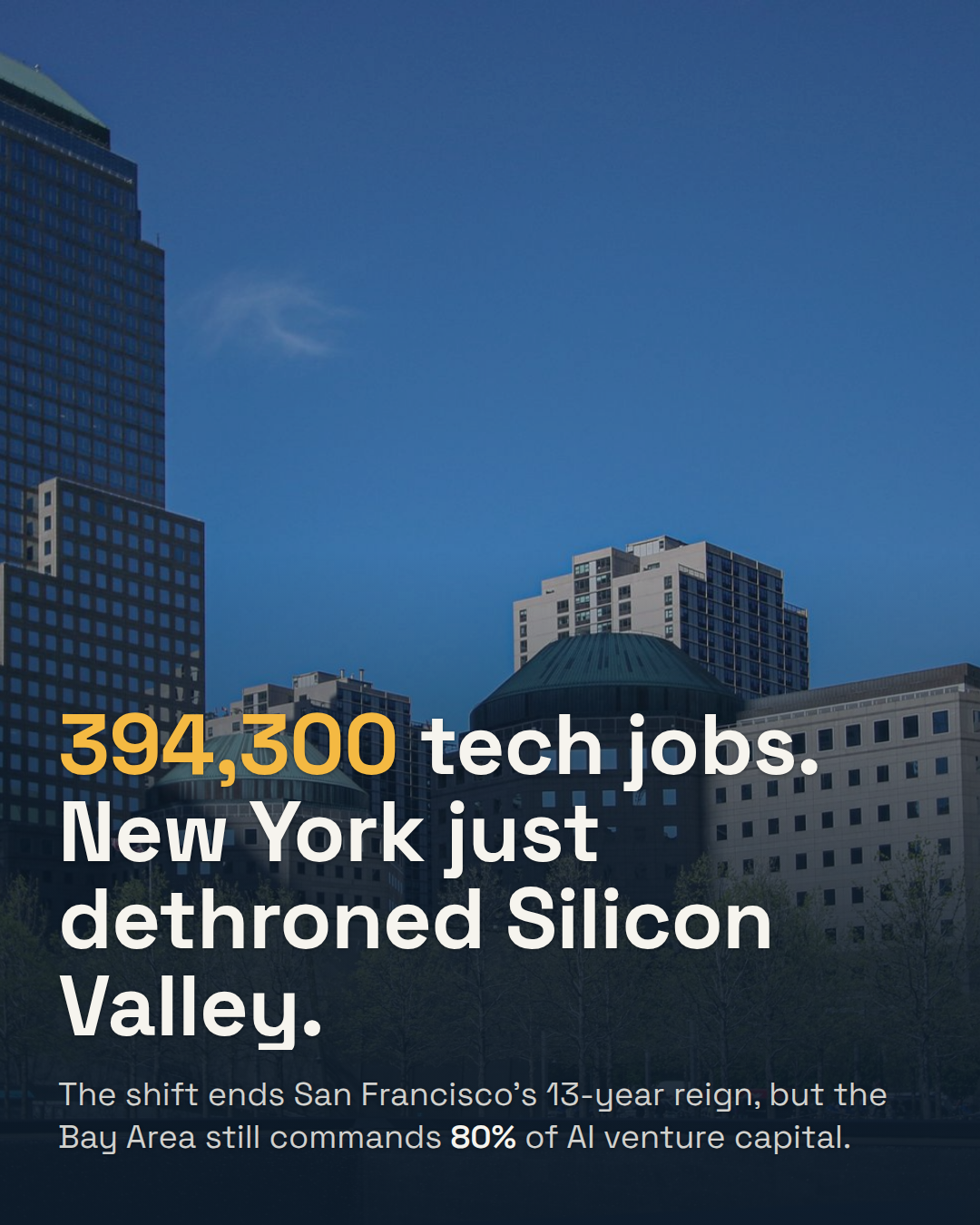
New York Metro now has 394,300 tech workers, ahead of the San Francisco Bay Area's 375,730, according to CBRE's 2026 "Scoring Tech Talent" report released Friday. It is the first time in the 13 years CBRE has run this analysis that New York has taken the headcount lead. Between 2022 and 2025, the Bay Area's tech workforce shrank 6% while New York's grew more than 8%.
The mechanism is just as telling as the milestone. Finance, insurance and real estate firms added 90,530 tech jobs across the US since 2022, mostly technologists hired by banks and asset managers, not startups. Over the same stretch, the core high-tech industry cut a net 21,262 positions. New York didn't out-recruit Silicon Valley. Wall Street absorbed the headcount that Big Tech let go.
The number is the least interesting part
A headline flip after 13 years is a good hook, but it is not the signal. CBRE also runs a weighted, 13-metric scorecard covering talent depth, concentration, wages, rents and graduate supply, and on that measure the Bay Area is still comfortably first: 81.98 points against New York's 70.38, with Seattle (74.37) and Toronto (72.73) also ahead of New York on quality-adjusted terms. San Francisco lost the raw jobs count and kept everything that actually compounds.
The clearest evidence is AI-specific. The Bay Area has 98,699 AI-skilled workers versus New York's 67,949, and it still pulls roughly 80% of all US AI venture capital deployed since 2020. Both metros added more than 20,000 AI jobs since mid-2025, so this isn't the Bay Area standing still while New York catches up. It's two different labor markets growing at once: a generalist tech workforce diffusing toward wherever finance and enterprise demand is, and a narrow, capital-intensive AI workforce staying exactly where the money and the model labs already are.
Why this matters more than a headcount ranking
If you're deciding where to build, "New York overtook San Francisco" is the wrong takeaway to act on. The right one is that the market has quietly split into two tiers with different economics. General software, fintech and ops-adjacent engineering roles are now genuinely competitive to hire for outside the Bay Area, at lower comp and rent, with New York, Seattle, Toronto and Austin all fielding real benches. But if your company is building or fine-tuning models, competing for scarce ML research talent, or trying to raise from AI-focused funds, the concentration hasn't loosened at all. Four out of five AI VC dollars are still finding their way to the same square miles they always have.
What founders should actually do with this
Treat headcount and hiring cost as separable decisions from your fundraising and research strategy. A founder building a vertical SaaS product on top of existing model APIs can now credibly build a lean, cheaper engineering team in New York, Austin or remote-first without paying a Bay Area talent tax, and that math should show up explicitly in your financial model rather than being assumed away. A founder building AI infrastructure, a foundation model, or anything that needs to be inside the Bay Area's investor and research density still has a real reason to pay the premium, and pretending otherwise is a strategy mistake, not a cost-saving one. Get this distinction into your own startup strategy before you sign a lease or extend an offer letter.
The other read-through is on burn. Total headcount cost is one of the few levers founders fully control, and this data is a reminder that "where we're based" is no longer a single answer for every function on your team. Engineering, support and ops can go where the labor is cheap and available; the two or three roles that actually touch your model or your AI roadmap are worth paying Bay Area rates for. Building that split intentionally, instead of defaulting to one city for the whole company, is the kind of operating decision that shows up directly in your unit economics two years from now.
If you remember one thing
San Francisco didn't lose the AI race, it lost the headcount race, and those are different contests with different consequences. Hire generalist talent wherever it's cheapest and most available; keep your AI-critical roles and your fundraising relationships where 80% of the capital already lives.
We teach this playbook in FiscEdge's startup strategy course and AI for entrepreneurs track. Browse the full blog for more breakdowns like this one. Follow @fiscedge for daily Business & AI analysis.
Topics & Categorization:
How interesting did you find this article?