Chinese AI Models Make 10% of OpenAI and Anthropic's Combined Revenue. Their Valuations Tell a Different Story.
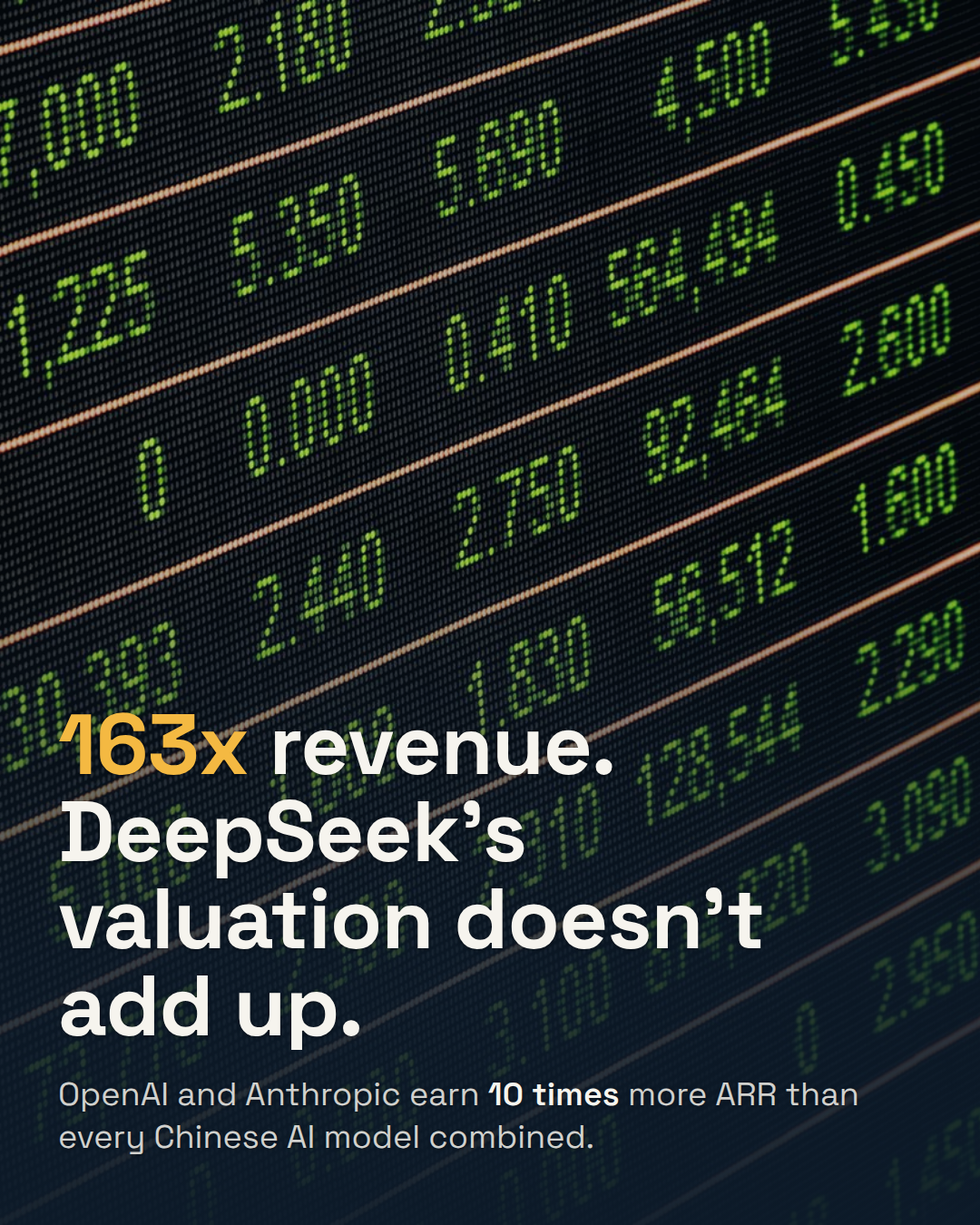
A Rhodium Group report puts OpenAI and Anthropic's combined ARR at $105B versus $10.7B for every major Chinese AI model. DeepSeek still trades at 163 times revenue.

Fiscedge Academy
Contributing Faculty & Practitioner
News Breakdown · FiscEdge Academy
OpenAI and Anthropic together generate roughly $105 billion in annual recurring revenue, $40 billion for OpenAI and $65 billion for Anthropic, according to a new Rhodium Group analysis reported by CNBC on September 17. Every major Chinese AI model combined, ByteDance's Doubao, Alibaba's Qwen, Z.ai, Moonshot and DeepSeek, generates about $10.7 billion. That's roughly a tenth of what the two US leaders pull in on their own.
The individual breakdown is just as lopsided. ByteDance leads the Chinese cohort at an estimated $4 billion in ARR, Alibaba trails at $2.4 billion, Z.ai sits at $1.8 billion, Moonshot at $1 billion, and DeepSeek, the model that spooked the entire US AI industry into a one-day selloff back in early 2025, is the smallest of the group at roughly $500 million.
The revenue gap is the least interesting number here. It's a plausible headline: American labs charge more per token, run closed models, and monetize enterprise contracts the way Chinese labs mostly don't. The signal under the headline is what happens when you divide each company's private valuation by that same revenue figure.
The multiple gap runs the opposite direction of the revenue gap
Rhodium estimated OpenAI is being valued at 34 times its ARR and Anthropic at 21 times. Moonshot, on a tenth of the revenue, is priced at 50 times. DeepSeek, on the smallest revenue base of the group, is priced at 163 times, the report calling that ratio "exorbitant." Put another way: the company with the least revenue in this entire comparison has the richest valuation relative to that revenue.
Moonshot's own trajectory shows how fast this moved. Its valuation went from about $4 billion at the end of 2025 to roughly $50 billion by August 2026, a more than 12x jump in eight months, on ARR that grew nowhere near that fast. That's not a revenue story. It's a capital-availability story, and it's happening on both sides of the Pacific at once, just priced differently.
Two business models, two kinds of multiple
The mechanism isn't mysterious once you separate the two sides. OpenAI and Anthropic run closed models with premium API pricing and enterprise contracts they can point to as recurring revenue, which is exactly the kind of number a 21x-34x multiple is built on. Several of the Chinese labs distribute open-weight models that developers can download and run themselves, which drives adoption and mindshare but caps what the lab itself can bill for it. Thin, hard-to-verify revenue against large, state-linked and strategic capital pools produces exactly the kind of multiple Rhodium is flagging as detached from the underlying business.
If you're building on top of either kind of model, you're inheriting a piece of that economics. Route your product through a closed, premium-priced API and your COGS look like OpenAI's revenue model. Build on an open-weight model to cut inference cost and you get better margins today, but you're also betting that the lab behind it stays cheap, stays available, and doesn't get repriced or restricted out from under you. That's a real product decision, not just a vendor choice, and it's exactly the kind of build-versus-buy tradeoff we walk through in FiscEdge's AI for entrepreneurs course.
Your own comps just got messier
If you're raising a round for an AI-adjacent SaaS company in the next two quarters, expect investors to reach for whichever number makes their point. "AI companies trade at 30-plus times ARR" borrows OpenAI's multiple to justify your price. "Even DeepSeek only gets 500 million in real revenue" uses the same report to argue the opposite. Neither is really about your business. Know your own ARR quality (renewal rate, contract length, gross margin per customer) well enough to argue against a borrowed multiple in either direction, the kind of comp defense we cover in FiscEdge's financial modeling course.
What this changes for founders
Treat this report as evidence that "AI valuations are frothy" is not one story, it's at least two, with opposite mechanics. US frontier labs are expensive because they've proven they can bill for what they build. The priciest Chinese labs are expensive despite not having proven that yet. When you benchmark your own round, or evaluate an AI vendor's staying power, ask which side of that split they're actually on, not just what multiple gets quoted in the headline. That distinction, more than the size of any single number, is the kind of judgment call we build into the fundraising strategy work in FiscEdge's startup strategy course.
If you remember one thing
OpenAI and Anthropic earn ten times more revenue than every major Chinese AI model combined, but DeepSeek and Moonshot are priced at five to eight times richer multiples on that revenue. Both halves of that sentence are true at once, which means "AI is overvalued" or "AI is undervalued" are both too simple. Ask what a multiple is actually pricing before you borrow it for your own round.
We cover valuation benchmarking, AI build-versus-buy decisions, and fundraising comps in FiscEdge's financial modeling course, AI for entrepreneurs course, and startup strategy course. Browse the full blog for more news breakdowns. Follow @fiscedge for daily Business & AI analysis.
Topics & Categorization:
How interesting did you find this article?