Chip Stocks Just Entered a Bear Market. $1.3 Trillion Vanished in Three Weeks.
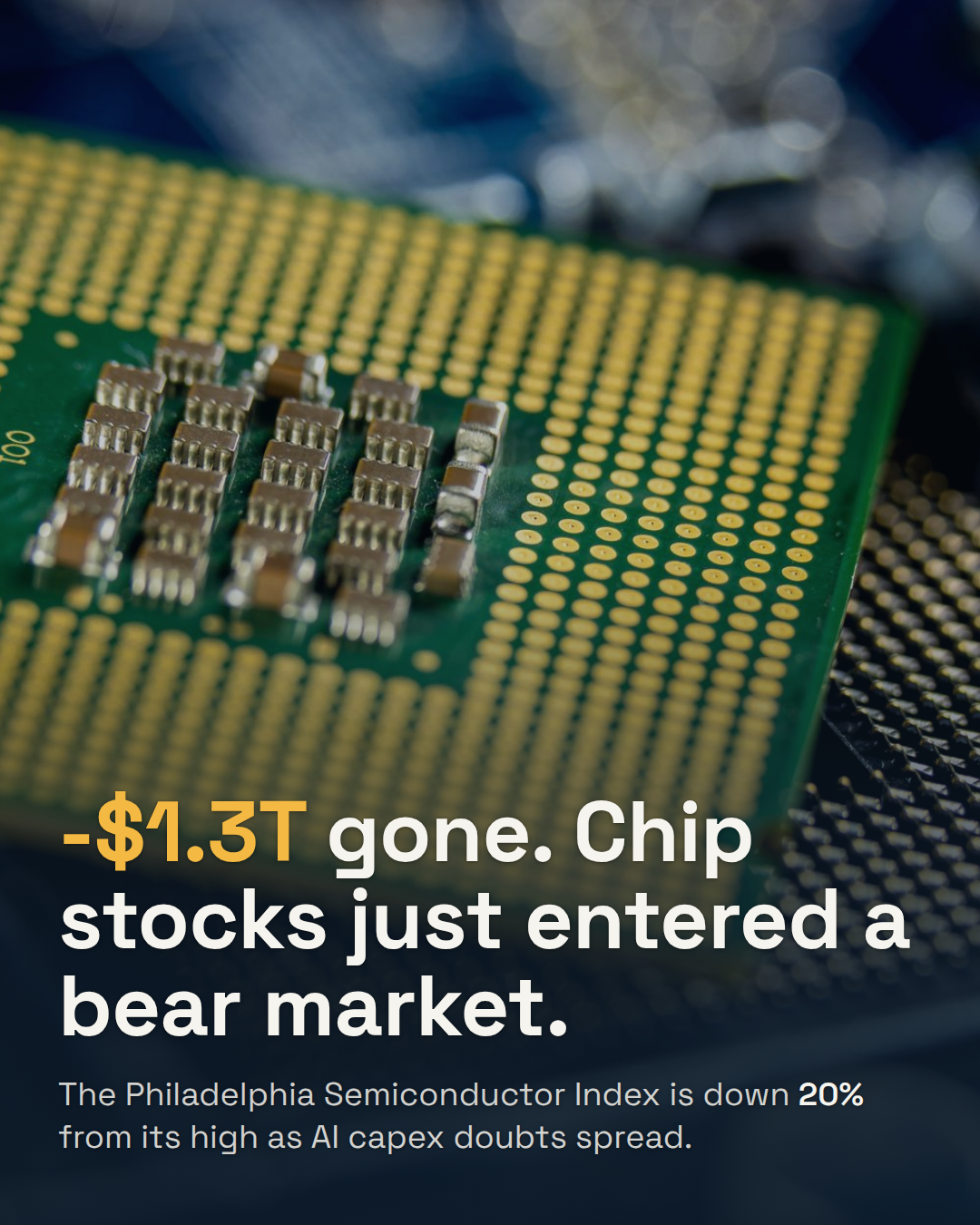
The Philadelphia Semiconductor Index fell 20% from its high as chip stocks shed $1.3 trillion in value. Founders building on AI infrastructure should read the repricing, not panic over it.

Fiscedge Academy
Contributing Faculty & Practitioner
News Breakdown · FiscEdge Academy
Chip stocks just crossed the line that defines a bear market. The Philadelphia Semiconductor Index (SOX) closed Friday, July 17 at 11,673.89, down roughly 20% from its 52-week high of 14,655.3, and Reuters estimates the broader sell-off has erased about $1.3 trillion in semiconductor market value since late June. Friday itself was ugly on its own: the S&P 500 fell 76.08 points (-1.0%) to 7,475.69, the Nasdaq dropped 361.70 points (-1.4%) to 25,520.24, and the Dow lost 406.55 points (-0.8%), capping a week where the S&P shed 1.6% and the Nasdaq 2.9%. Applied Materials, Lam Research, Intel, KLA and Arm Holdings each fell around 4% on the day; Intel is now down roughly 21% over the course of the selloff.
The trillion-dollar number is the least interesting part. Here's the signal under the headline: this isn't a demand problem. Micron's market cap crossed $1 trillion for the first time earlier this month on the back of a blowout print, $41.46 billion in quarterly revenue, and it still got dragged into the same sector-wide retreat. When the companies posting record numbers fall alongside everyone else, the market isn't repricing earnings. It's repricing the story.
What's actually driving the repricing
Three things are converging at once, and none of them is "AI demand slowed down."
First, a wave of custom AI silicon started shipping in late June and early July, Google's TPUs, Amazon's Trainium, and Meta's own chips, alongside reports that Meta plans to launch "Meta Compute," a unit selling surplus AI training and inference capacity to enterprise customers. That's a direct challenge to Nvidia's near-monopoly on AI compute, and investors are pricing in a future where GPU pricing power isn't guaranteed.
Second, sentiment took a separate hit from Moonshot's new Kimi model out of China, which the company claims performs on par with leading Western systems, feeding a broader narrative that frontier AI capability is getting cheaper and more commoditized faster than infrastructure spending assumed.
Third, and less talked about, a more hawkish Fed rate outlook is compressing the multiples investors are willing to pay for anything trading on a 2030 growth story rather than 2026 earnings. Stack dot-com-level valuations on top of AI ROI questions and a tighter rate path, and a 20% correction becomes the release valve, not the disaster.
What this changes for founders and operators
- Compute pricing may finally soften, but not immediately. If the market is right that custom silicon and cloud oversupply erode Nvidia's pricing power, GPU and inference costs could stop climbing over the next few quarters. Don't rebuild your unit economics around that yet, model it as a scenario, not a certainty, and revisit your unit economics assumptions once actual API and cloud pricing moves, not just stock prices.
- "AI infrastructure" is no longer a safe narrative to raise on. For most of 2026, telling investors you touch AI infrastructure was enough to inflate a round. That's now the exact category getting sold off hardest on valuation grounds. If you're fundraising, expect diligence to ask harder questions about unit economics and defensibility, not just TAM.
- Watch your own vendors' balance sheets. If you depend on a specific inference provider, cloud GPU reseller, or specialized chip startup, a 20%+ sector correction increases the odds some of them get acquired, repriced, or squeezed on runway. Diversifying compute vendors is now a business-continuity decision, not just a cost one.
- Cheaper frontier models are a founder tailwind. Kimi's emergence alongside DeepSeek and other lower-cost frontier models earlier this year reinforces a trend that directly benefits anyone building on top of these models rather than under them: your input costs keep trending down even as the underlying infrastructure market gets more volatile.
Why this is bigger than one bad week
A 20% drawdown in the sector that has powered most of 2026's market gains is not noise. It's the market openly debating whether the AI capex cycle is being paid for by real, durable demand or by a supply race that just got a lot more competitive. That debate will keep showing up as volatility in chip stocks for months, but the underlying trend, compute getting cheaper and more commoditized over time, is exactly what founders building AI products should want. The AI for entrepreneurs track exists precisely because the winners in this next phase will be the teams building on infrastructure, not betting their whole model on owning it.
If you remember one thing
A bear market in chip stocks is not a verdict on AI demand, it's the market repricing who captures the value, chipmakers or the founders building on top of their output. Model your costs assuming compute gets cheaper, not scarcer, and you'll be positioned for the winning side of this correction.
We teach how to read market corrections like this one, and build financial models that survive them, in FiscEdge's financial modeling course. For the fundraising and positioning playbook when "AI infrastructure" stops being an automatic pitch-deck win, see startup strategy. Follow @fiscedge for daily Business & AI analysis.
Topics & Categorization:
How interesting did you find this article?