Circle Wins a Federal Bank Charter. $73B in USDC Reserves Just Changed Custody.
The OCC gave Circle final approval to open Circle National Trust, a national trust bank. CRCL popped as much as 13% pre-market on the news.

Fiscedge Academy
Contributing Faculty & Practitioner
News Breakdown · FiscEdge Academy
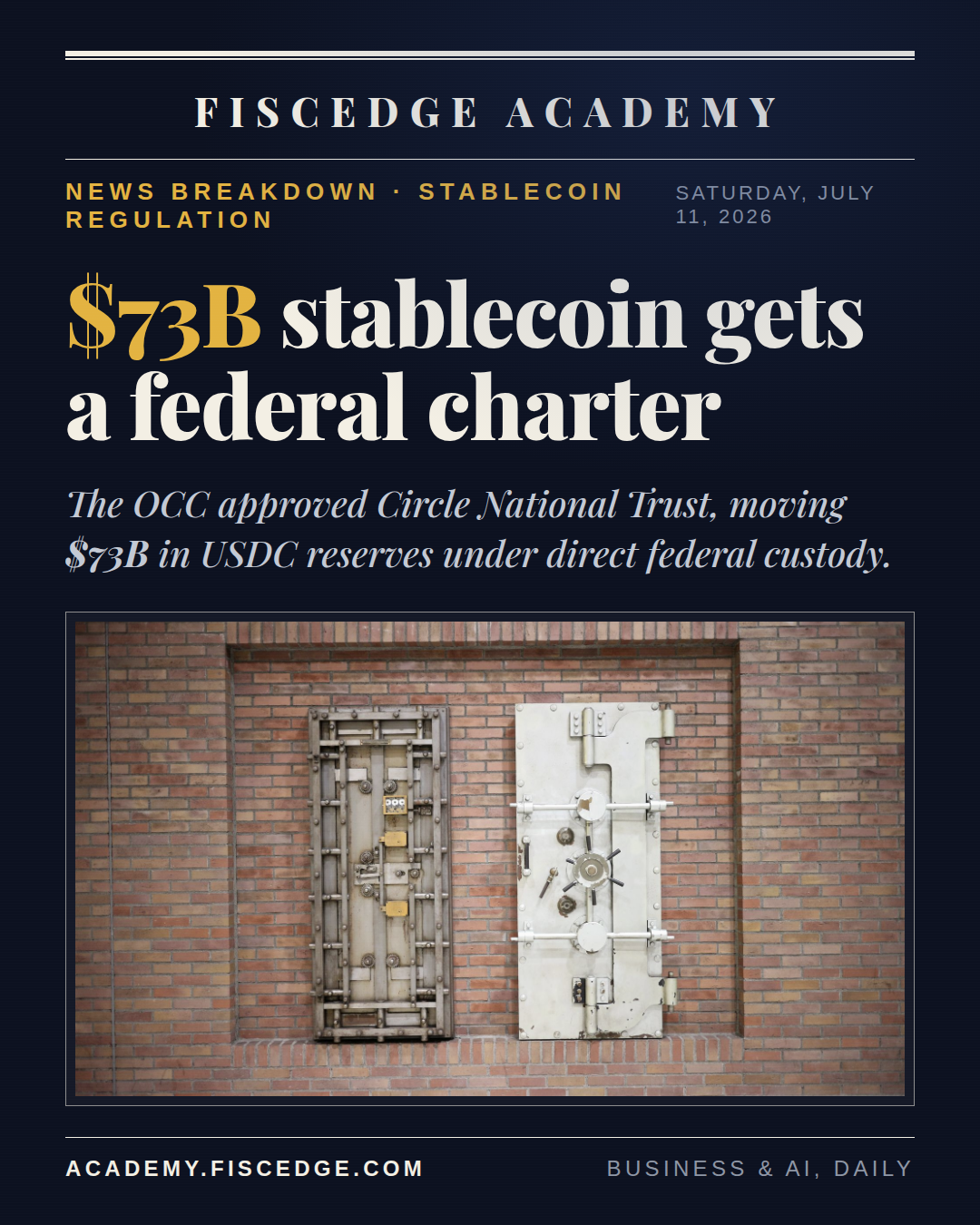
Circle Internet Group just became a bank. On July 10, the Office of the Comptroller of the Currency gave final approval for Circle to open First National Digital Currency Bank, N.A., operating as Circle National Trust, a federally chartered national trust bank. The stock reaction was immediate: CRCL shares jumped as much as 12-13% in pre-market trading before closing the day up roughly 4%.
The number that matters more than the stock pop is $73B, the current circulating market cap of USDC, the stablecoin Circle issues. Until now, the reserves backing that $73B sat with third-party banking partners under a patchwork of state money-transmitter licenses. With a national trust charter, Circle can bring custody of those reserves in-house, under direct federal oversight from a single regulator, the OCC.
The number is the least interesting part
A stock popping 4-13% on a regulatory headline is a one-day story. The signal under the headline is the timeline: Circle filed its application on June 30, 2025, got conditional approval in December 2025, and only now, more than a year later, cleared the final bar. That's roughly 12 months of sitting inside the federal chartering process for a company that already had a public listing, a Fortune-scale balance sheet, and a stablecoin used in trillions of dollars of annual settlement volume.
For any founder who has ever assumed "we'll deal with regulation once we're bigger," this is the counter-example. Circle started this process while it was still building product-market fit around USDC's institutional use cases. The charter didn't arrive because Circle got big enough to demand it; it arrived on a schedule set by the regulator, years after the underlying product was already market-leading.
What a trust charter actually buys you
Circle National Trust's initial mandate is narrow: fiduciary digital-asset custody for Circle and its affiliates. The bigger unlock is optionality. Per the business plan the OCC approved, the entity "may eventually offer its digital asset custody service to a limited number of institutional customers directly, focusing on banks and other financial institutions." That's the real prize, a federally regulated pipe that other banks and regulated derivatives organizations can plug into without each one needing to underwrite Circle's counterparty risk from scratch.
It also sets up USDC Reserve management as a future in-house capability, rather than something outsourced to partner banks. For a stablecoin issuer, that's the difference between being a fintech that rents banking infrastructure and being a bank that other fintechs rent from.
The founder takeaway: regulatory moats compound slowly, then all at once
Most SaaS and fintech founders treat compliance as a cost center, something to minimize until an investor or enterprise customer forces the issue. Circle's trajectory argues the opposite: a hard-won federal charter becomes a distribution moat that's nearly impossible for a competitor to replicate on a fundraising timeline. Coinbase, by contrast, is still waiting on its own trust bank approval, a gap that's now a live competitive story in the stablecoin custody market.
If you're building anything that touches payments, custody, or stored value, whether that's a vertical SaaS product with an embedded wallet or a marketplace holding customer funds, the lesson isn't "go get a national charter." It's that the regulatory path you start walking today, however slow, is a real asset by the time your product needs it. Founders who model that lead time into their fundraising and product roadmap show up to the moment of scale with an answer already in motion; founders who wait show up needing a partner bank's permission.
This also reframes how you should think about "boring" infrastructure decisions early on. Which payment processor, which custodial partner, which state licenses you pursue first, these choices look like plumbing in year one and look like moats or liabilities in year three.
If you remember one thing
A regulatory approval that takes 12+ months isn't a delay you route around, it's a moat you either start building now or watch a competitor build first: Circle filed in mid-2025 for a charter that's reshaping stablecoin custody in mid-2026, and the founders who treat compliance timelines as part of their roadmap, not an afterthought to it, are the ones still standing when the rules catch up to the product.
We break down capital markets and regulatory strategy like this in FiscEdge's startup strategy course, and teach the modeling behind decisions like Circle's in financial modeling for founders. If you're weighing early infrastructure and licensing tradeoffs, unit economics fundamentals is a good place to start. Browse more breakdowns like this on the FiscEdge blog. Follow @fiscedge for daily Business & AI analysis.
Topics & Categorization:
How interesting did you find this article?