Crypto's Biggest 2026 Bill Is About to Miss Its Deadline.
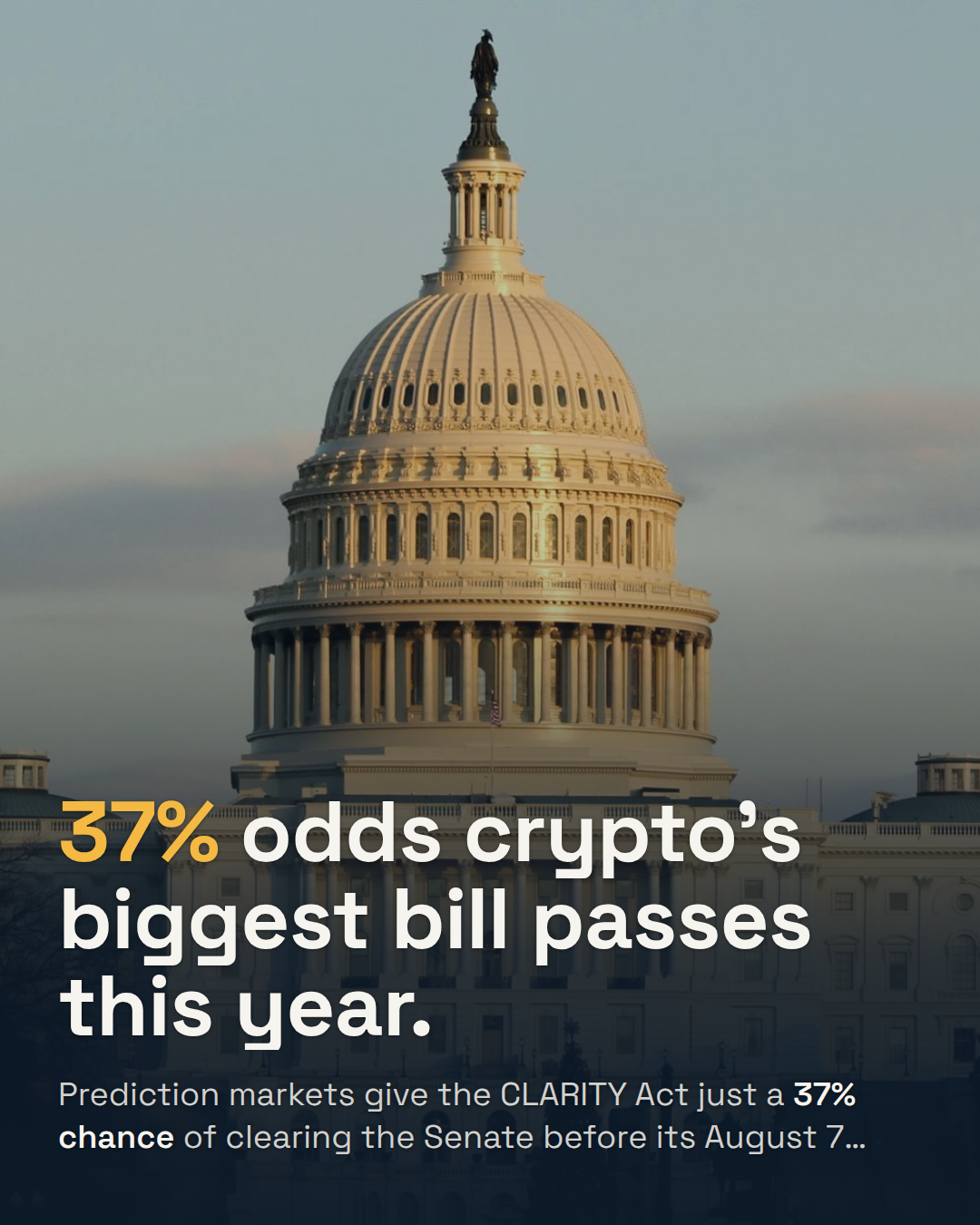
The CLARITY Act cleared the House and a Senate committee, but Polymarket now gives it just a 37% chance of passing before the Senate's August recess.

Fiscedge Academy
Contributing Faculty & Practitioner
News Breakdown · FiscEdge Academy
The CLARITY Act, the bill meant to finally tell US crypto and fintech founders which regulator has jurisdiction over their tokens, is on track to miss its 2026 window. The House passed its version, H.R. 3633, back in July 2025 by a lopsided 294-134 vote, and the Senate Banking Committee advanced its own version in May by 15-9. Since then: no floor vote, no cloture motion, no date on the Senate calendar. Prediction market Polymarket has traders pricing just a 37% chance the bill passes this year, down from over 80% odds this spring.
The bill's authors had circled August 7, the start of the Senate's summer recess, as the real deadline. Miss that, and the CLARITY Act likely doesn't come back until after November's midterms, when a more divided Congress makes any bipartisan deal harder, not easier. Senate Majority Leader John Thune has told reporters not to expect a floor vote before recess; floor time is going first to a backlog of federal nominations, then to a Russia sanctions bill that now carries the added weight of being tied to the late Senator Lindsey Graham's final legislative push.
The vote-count story isn't really the story, though. The interesting part is why a bill with this much bipartisan support keeps stalling.
What's actually blocking the vote
Republicans don't have the votes to pass this alone. The CLARITY Act needs 60 votes to clear a filibuster, so it needs real Democratic buy-in beyond the two senators who crossed over in committee, Ruben Gallego and Angela Alsobrooks. The sticking points aren't really about market structure anymore. They're about optics: how far to go on ethics restrictions covering senior officials' (including the President's) crypto holdings, and how tightly to write the bill's illicit-finance provisions. Neither is a technical drafting problem. Both are the kind of dispute that can sink a deal in its final week regardless of how much groundwork got done in committee months earlier.
The part that matters if you build in this space
For a founder building payment rails, tokenized assets, or anything touching stablecoins, CLARITY isn't abstract. It's the bill that would decide whether your product falls under the SEC's securities regime or the CFTC's commodities regime, the single biggest open question in US crypto law right now. Today, that line gets drawn ad hoc, through enforcement actions and no-action letters, not statute. Every month CLARITY doesn't pass is another month of building on a foundation that can shift with the next enforcement sweep or the next lawsuit.
That's a different kind of regulatory risk than, say, the EU AI Act's hard compliance deadlines. There's no fine for Congress missing a date. There's just prolonged uncertainty, which is in some ways the harder problem to plan around. A missed deadline is a known cost you can budget for. Ambiguity is an unknown one, and it compounds every fundraise, every partnership contract, and every state-by-state money-transmitter license you have to reason about in the meantime.
What this changes for founders
- Don't build your compliance roadmap around CLARITY passing this year. With odds under 40% and a midterm cycle on the other side of a miss, the safer planning assumption is that today's patchwork of state licensing and SEC/CFTC enforcement precedent is what you're operating under through at least 2027.
- Watch the ethics language, not the market-structure text. The parts of the bill actually holding up a vote have nothing to do with how your token or product gets classified. If you're tracking this bill for planning purposes, the ethics and illicit-finance provisions are the real leading indicator of whether a deal happens.
- Prediction markets are a faster signal than committee press releases. Polymarket's odds dropped from over 80% to 37% over a few months while the bill's public messaging stayed upbeat. If you need a fast read on whether Washington will actually act, markets pricing real money are worth checking alongside the headlines.
If you remember one thing
The CLARITY Act has already cleared the House and a Senate committee with real bipartisan votes, and it's still on track to miss its 2026 deadline over an ethics dispute that has nothing to do with market structure, a reminder that in Washington the hardest 10% of a bill can hold up the other 90% indefinitely, and founders building on the assumption of imminent regulatory clarity should plan for the wait to get longer, not shorter.
We cover how to plan around regulatory uncertainty like this in FiscEdge's startup strategy course, and go deeper on building a fundraising narrative that survives changing rules in financial modeling. For the fundamentals of a defensible business case regardless of what Congress does, see our explainer on unit economics. Browse the full blog for more news breakdowns. Follow @fiscedge for daily Business & AI analysis.
Topics & Categorization:
How interesting did you find this article?