Cloudflare Just Hit a Record High. Machine Traffic Officially Passed Human Traffic Online.
Cloudflare's Q2 revenue jumped 36% to $696 million and its stock hit an all-time high, but the real story is that AI agents now generate more web traffic than humans do.

Fiscedge Academy
Contributing Faculty & Practitioner
News Breakdown · FiscEdge Academy
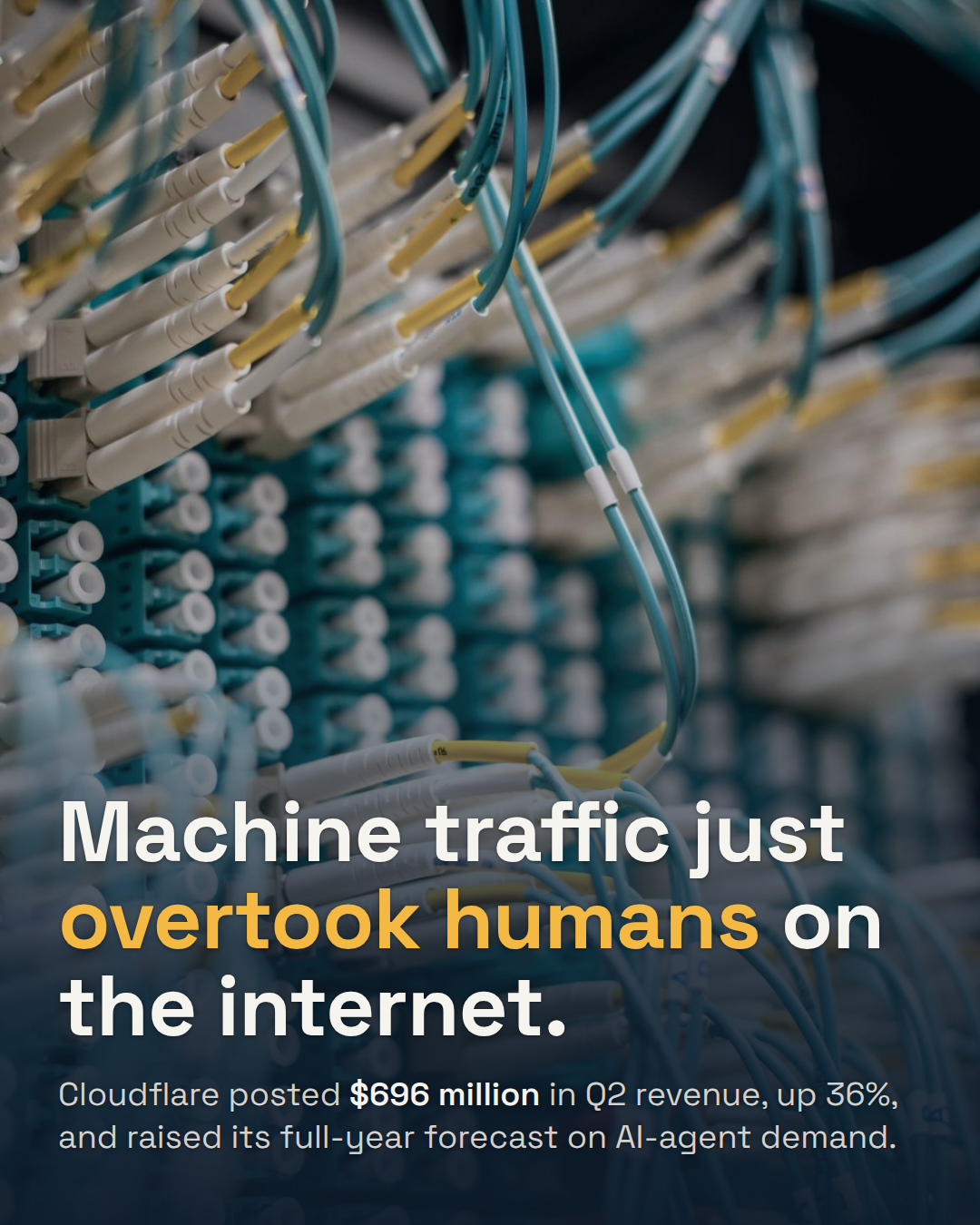
Cloudflare posted $696.1 million in second-quarter revenue, up 36% year over year and well ahead of the $664.7 million Wall Street expected. Adjusted earnings came in at $0.29 a share against a $0.27 consensus. The company raised its full-year 2026 revenue guidance to $2.864 billion to $2.870 billion, up from $2.805 billion to $2.813 billion, and lifted its adjusted EPS outlook to $1.25 to $1.26. Shares surged roughly 16% in the hours after the report, sending the stock to an all-time high.
That is the headline. It is also the least interesting part.
Buried in the same earnings call was a line that matters more to anyone building software right now: CEO Matthew Prince said machine-generated traffic has officially overtaken human traffic on Cloudflare's network for the first time. Not "is approaching." Passed it. The company that sits in front of roughly a fifth of the web just confirmed, with its own traffic logs, that bots, crawlers and AI agents now move more bytes across the internet than people do.
The numbers behind the beat
The revenue and guidance raise did not come from one lucky quarter. Cloudflare added customers spending more than $100,000 a year at a 27% clip, bringing that cohort to 4,698 accounts, and dollar-based net retention improved to 120%, meaning existing customers are spending materially more than they were a year ago. That is expansion revenue, not just new logos, which is the number investors trust most in a SaaS business.
The growth engine underneath all of it is Workers, Cloudflare's serverless developer platform, which added roughly 2 million new developers in the quarter alone. Prince called it a "fundamental rewrite of the internet for machine-to-machine traffic," and the guidance raise suggests the market believed him.
Why this is the real story
Every AI infrastructure earnings report this quarter has told some version of the same capex story: chipmakers spending more, margins under pressure, investors nervous about payback periods. Cloudflare's report is different because it is not a story about who builds the AI. It is a story about who serves it once it is out in the world, sending requests, scraping data and calling APIs on its own.
Workers succeeds because Cloudflare bet early on a consumption-based pricing model that happens to line up perfectly with how AI agents actually behave: bursty, unpredictable, running on a schedule no human sets. A seat-based SaaS pricing model breaks down when the "user" is a script calling your API a thousand times an hour. A metered, edge-native platform does not. That is the structural advantage Cloudflare is now cashing in on, and it is the same advantage a growing list of developer-infrastructure companies are chasing.
What it means if you are building on top of agents
Three things worth taking directly into your own roadmap and pricing conversations this week:
- If your product will be called by AI agents as much as by humans, price and architect for that now. Per-seat pricing and human-paced rate limits are already the wrong model for a meaningful slice of new usage.
- "More traffic" is not automatically good traffic. Cloudflare's own data implies a growing share of inbound requests to every website are bots and agents, not customers. If you run a SaaS product, your infrastructure costs and your analytics are both about to get noisier, and your funnel metrics need a second look at what counts as a real visitor.
- Net retention above 120% is still the best signal in venture-backed SaaS, capex headlines aside. When you're building your own model, don't let AI hype numbers distract from the unit economics that actually predict durability.
None of this means every infrastructure vendor wins simply by being "AI-adjacent." It means the ones whose pricing and architecture were already built for machine-scale, unpredictable usage are the ones getting rewarded first while others are still retrofitting.
If you remember one thing
The winners in this AI cycle are not just the model labs. They are the infrastructure layers whose business model already assumed the customer might be a piece of software, not a person, and priced accordingly.
We break down deals like this one in FiscEdge's AI for entrepreneurs course, and cover the pricing and margin math behind SaaS growth in building SaaS with AI. If net retention and expansion revenue are new terms, our breakdown of unit economics is a good place to start. Browse the full blog for more news breakdowns. Follow @fiscedge for daily Business & AI analysis.
Topics & Categorization:
How interesting did you find this article?