CodeRabbit Raises $143M at a $1.5B Valuation. AI Now Reviews the Code AI Wrote.
CodeRabbit tripled its valuation to $1.5B on 2 million weekly AI code reviews. For founders shipping with AI, review is now the bottleneck worth funding.

Fiscedge Academy
Contributing Faculty & Practitioner
News Breakdown · FiscEdge Academy
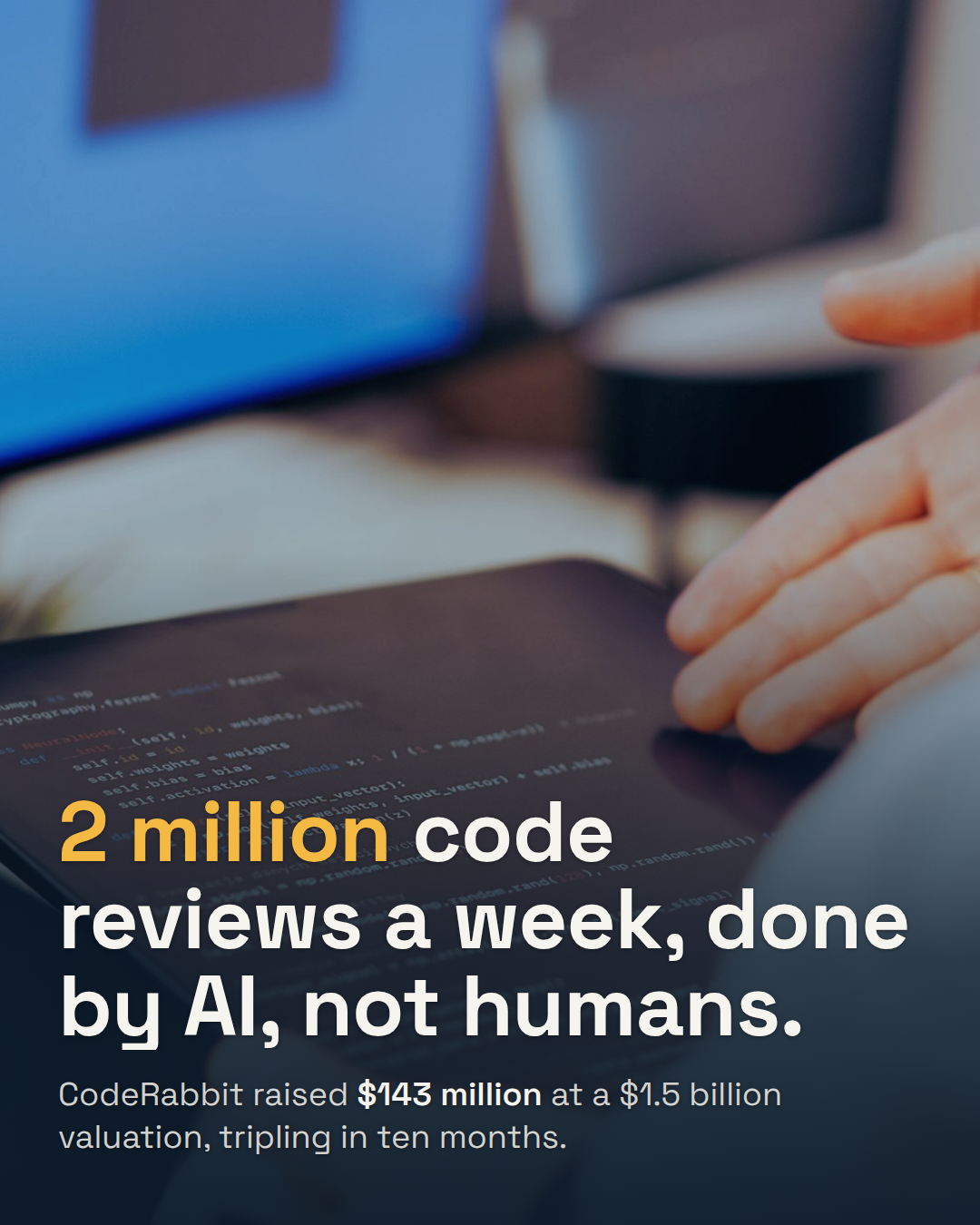
CodeRabbit just closed a $143 million Series C at a $1.5 billion valuation, tripling its worth in ten months. The round was co-led by Atomico and Smash Capital, with new money from BMW i Ventures and Datadog, alongside existing backers CRV, Scale Venture Partners and NVIDIA's venture arm, NVentures. It lands less than a year after CodeRabbit's $60 million Series B, when the company was valued at $550 million.
The valuation is the least interesting number in this raise. The one that matters is usage: CodeRabbit now runs more than 2 million automated code reviews a week for over 17,000 customers, including Nvidia, BMW and Adyen, with revenue up more than 5x year over year.
The signal under the headline
CodeRabbit's entire pitch exists because of a problem the AI industry created for itself: tools like Cursor, GitHub Copilot and Lovable let anyone ship production code in minutes, and almost nobody scaled their review process to match. Pull requests multiplied faster than the humans available to read them. CodeRabbit's product plugs directly into that gap, an AI reviewer that reads a diff, flags risk and leaves comments the way a senior engineer would, except it never sleeps and never gets bored on PR number forty of the day.
What makes this raise notable isn't that a code-review tool got funded. It's the direction CodeRabbit is expanding in. Alongside the Series C, the company launched what it calls Agentic Change Management, three products aimed less at catching bugs and more at governing an engineering org where AI agents are now writing a meaningful share of the code:
- Triage scores every incoming pull request on value, urgency, risk and reviewer fit, and routes the low-risk ones straight to automated workflows instead of a human queue.
- Change Stack replaces the old alphabetical file-diff view with a guided read of what actually changed: contracts, domain behavior, integrations, tests, migrations.
- CodeRabbit Security runs continuous, full-repository scans against code already in production, checking findings against real evidence rather than flagging every pattern match.
CEO and co-founder Harjot Gill framed it plainly: "We pioneered AI code review to give teams an independent system that validates the work before it ships. Agentic Change Management expands that layer to determine what deserves attention, explain each change's impact, and continue monitoring the codebase after it ships." Translation: the review step isn't a one-time gate anymore, it's becoming permanent infrastructure that watches code before, during and after it ships.
What this changes for founders
If you're running a SaaS company where AI tools now write a chunk of your codebase, the constraint has quietly moved. It used to be "can we ship fast enough." Increasingly it's "can we tell which of the ten features an agent shipped this week are actually safe to merge." That's a real cost most teams underbudget when they're excited about shipping fast with AI, and CodeRabbit's growth curve, 5x revenue in a year, is the market voting that the review layer is now a line item, not a nice-to-have.
The second lesson is about capital efficiency at this stage of the AI cycle. CodeRabbit tripled its valuation on 2 million weekly reviews, not on a hype cycle around a model release. Investors funding developer tools in 2026 want usage that compounds on its own, driven by every new AI-written pull request, not usage that has to be manufactured through marketing spend. If you're building a tool that sits inside another fast-growing habit (AI coding, in this case), that structural tailwind is worth more to a term sheet than almost anything else you can put in a deck.
Founders raising their own rounds should also note the pacing: Series B to Series C in ten months, valuation nearly 3x. That kind of velocity is becoming normal for AI-infrastructure companies with real usage metrics, and it resets the calendar other founders should plan fundraises around. If your own growth story leans on "AI made our core workflow 10x more common," this is the comp to point to.
If you remember one thing
The most valuable AI companies of this cycle are increasingly the ones that clean up after other AI tools, not the ones generating the first draft. If your SaaS product touches a workflow that AI just made 10x more frequent, that's the business to be building.
We teach how to scope and price a product like this in FiscEdge's building SaaS with AI course, and how to read a funding comp like CodeRabbit's in startup strategy. If your own product ships AI-generated code, our vibe coding masterclass covers the review and governance layer this story is really about, and our explainer on what vibe coding actually means is a good primer if the term is new to you. Browse the full blog for more. Follow @fiscedge for daily Business & AI analysis.
Topics & Categorization:
How interesting did you find this article?