Cognition Races to a $47 Billion Valuation in 14 Weeks. Its Revenue Multiple Barely Moved.
Cognition is closing a $1 billion round at a $47 billion valuation, nearly double where it stood in May. Revenue grew just as fast, which is the real story for anyone building on AI coding tools.

Fiscedge Academy
Contributing Faculty & Practitioner
News Breakdown · FiscEdge Academy
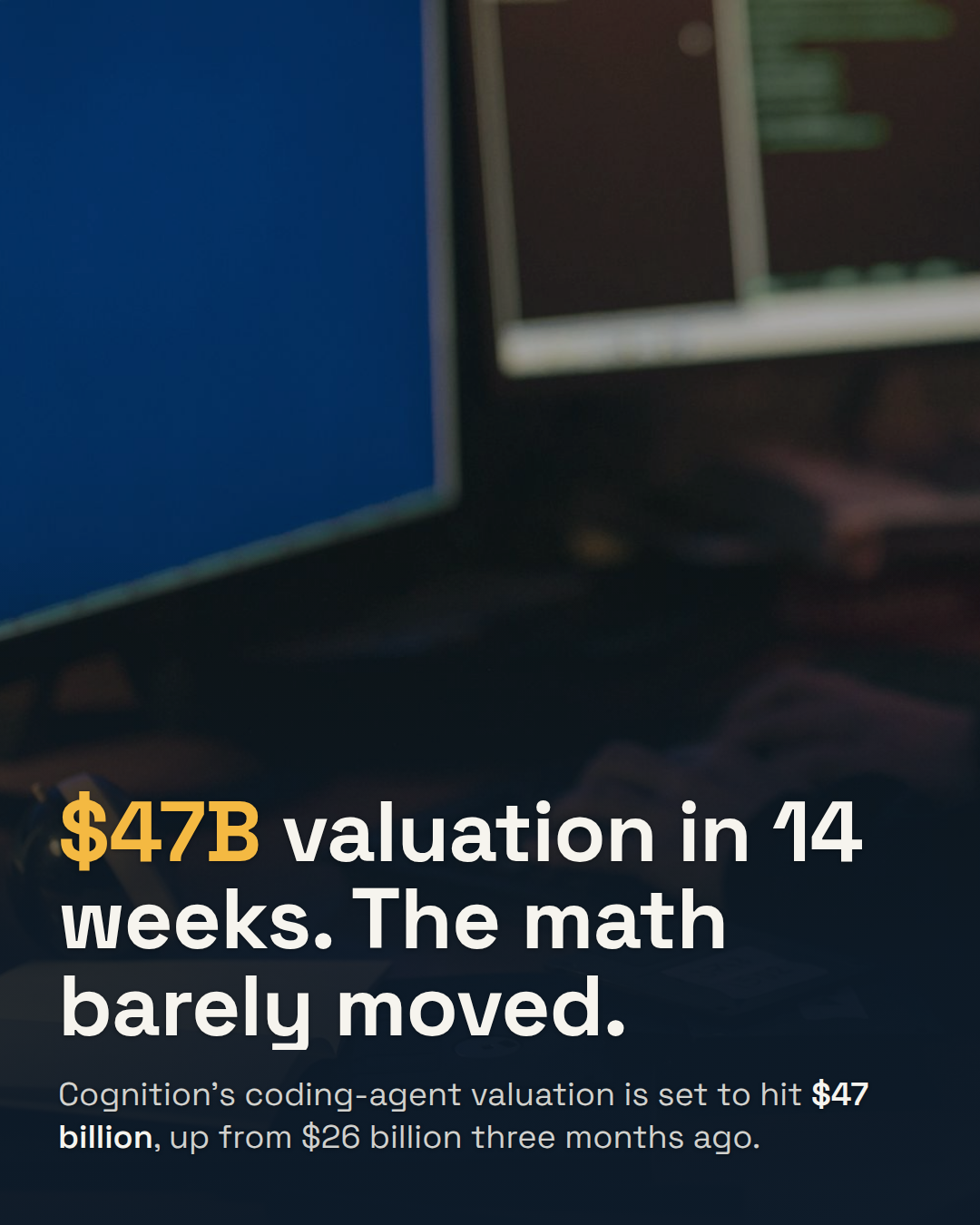
Cognition, the maker of the AI coding agent Devin, is closing a funding round of roughly $1 billion at a $47 billion valuation, according to Bloomberg. The company has drawn close to $10 billion in investor demand for the round, more than 10 times what it's actually raising. Three months ago, in May, Cognition raised that same $1 billion at a $26 billion valuation. A year earlier, in September 2025, it was worth $10.2 billion.
That's the headline: a coding-agent startup nearly doubling its valuation in fourteen weeks, and roughly quintupling it in a year. But the number that should actually interest a founder isn't the $47 billion. It's what happened to the price investors are paying for a dollar of Cognition's revenue while that valuation was exploding, because it barely moved at all.
The multiple that didn't move
In late May, Cognition's annualized revenue was about $492 million against a $26 billion valuation, a multiple of roughly 53x. By early September, revenue had grown to more than $900 million against the new $47 billion mark, a multiple of roughly 52x.
Revenue nearly doubled (+83%). Valuation nearly doubled (+81%). The multiple investors are willing to pay for Cognition stayed essentially flat, at a level that would be unthinkable for almost any SaaS company outside this specific pocket of the AI market. That is not the story of a bubble getting frothier. It is the story of a company whose growth is, for now, actually keeping pace with a valuation that already priced in years of expansion.
Why $10 billion chased a $1 billion round
Ten-times oversubscription on a private round at this size is a real signal, not just a headline number. Cognition acquired the coding startup Windsurf in mid-2025, days after Google poached Windsurf's CEO and much of its team in a $2.4 billion licensing deal, and folded Windsurf's product and customers into Devin. That consolidation, plus enterprise budgets shifting fast toward AI-native development tools, is what's driving revenue up this steep: a near-doubling in roughly three months is not organic seat expansion, it's land-grab economics in a market that is still being carved up between a handful of players.
For founders, the takeaway isn't "go raise at 50x revenue." It's that the AI coding category is consolidating around a small number of large, well-capitalized players faster than most software categories ever have. If your product sits downstream of AI coding tools, whether you're building on top of Devin, competing with it for developer attention, or simply paying for seats across your team, the vendor landscape you're planning around six months from now may not include the names you're planning around today.
What this changes for how you build and raise
Three practical takeaways follow. First, if AI-native development tooling is part of your stack or your pitch, expect pricing and API terms to keep shifting as a handful of well-funded players fight for enterprise contracts, so budget for that rather than locking into long-term vendor commitments. Second, if you're raising and a competitor in your category can point to revenue that grew 80%+ in a single quarter, investors will ask why yours didn't; know your own growth-to-valuation ratio cold before that conversation happens, the way you would when modeling a fundraise. Third, "fast" has been re-priced: a round like this resets what late-stage investors consider an acceptable growth rate for a company already worth tens of billions, and that expectation trickles down into how seed and Series A investors judge earlier-stage traction too.
If you remember one thing
The $47 billion number is not the story. The fact that Cognition's revenue multiple barely moved while its valuation nearly doubled is the story, because it means the market is still pricing this company on fundamentals rather than pure momentum. That discipline will not last forever in AI coding tools, so if you're building in or around that category, plan on the assumption that today's vendor map is temporary. Understanding the unit economics behind headlines like this one, not just the growth story, is what separates a founder who can defend a valuation from one who's just hoping the market stays generous.
We teach how to read a funding round and model your own growth-to-valuation math in FiscEdge's financial modeling course and AI for entrepreneurs track. Browse the full blog for more news breakdowns. Follow @fiscedge for daily Business & AI analysis.
Topics & Categorization:
How interesting did you find this article?