Cohere Raises Up to $3 Billion at a $20 Billion Valuation. Governments Are the New VCs.
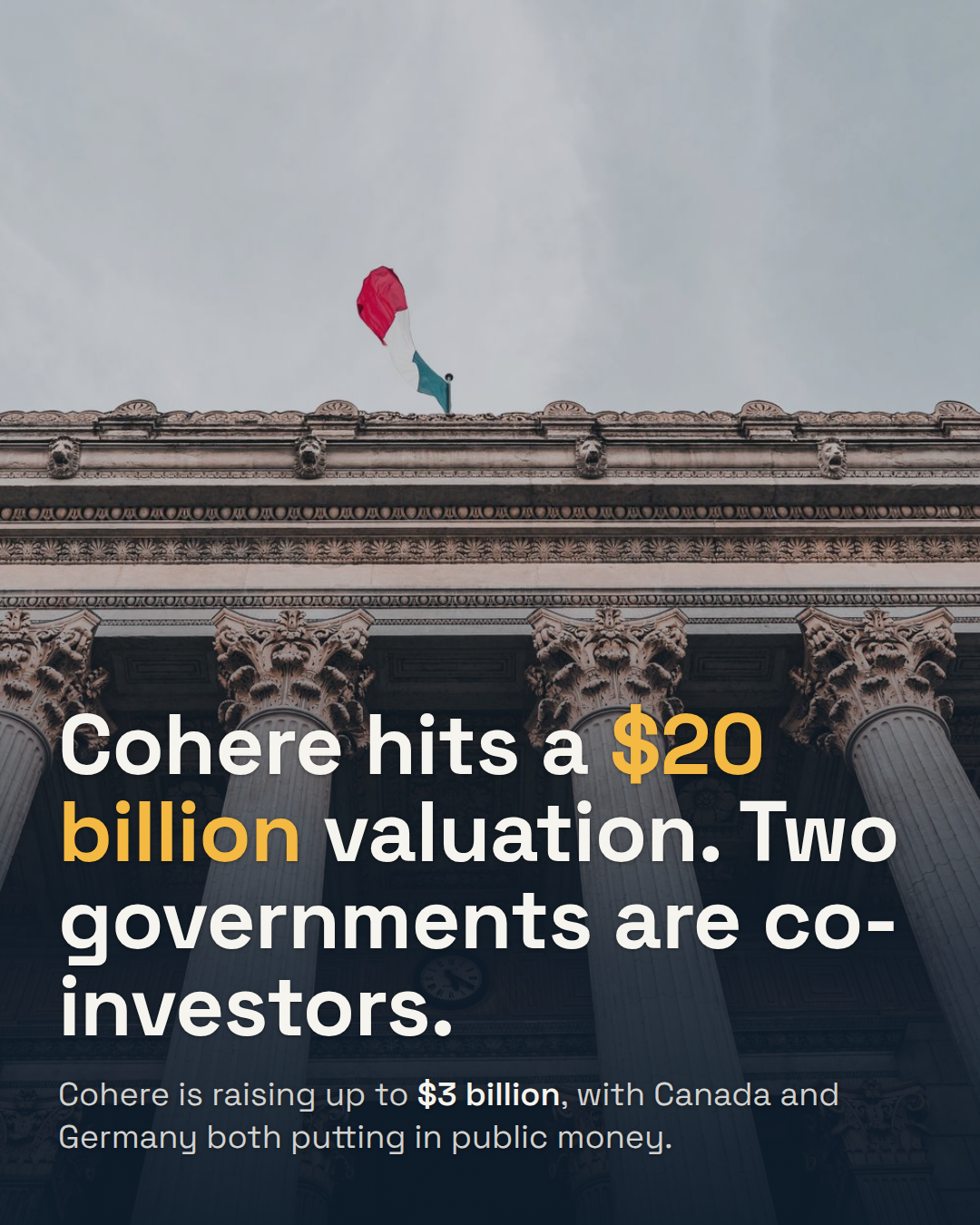
Cohere is in advanced talks to raise up to $3 billion at a $20 billion valuation, nearly triple last year's. Canada and Germany are co-investing directly, a new funding pattern founders should watch.

Fiscedge Academy
Contributing Faculty & Practitioner
News Breakdown · FiscEdge Academy
Cohere, the Toronto-based enterprise AI lab, is in advanced talks to raise up to $3 billion at a $20 billion valuation, according to reporting from The Globe and Mail confirmed by Bloomberg. That is close to triple the $7 billion valuation Cohere hit just twelve months ago, after an August 2025 Series D and a follow-on close. If the round closes at the reported terms, it would be the largest funding round ever raised by a private Canadian startup.
The unusual part is not the size. It is who is writing checks. The government of Canada is participating directly, layering fresh capital on top of the up to CA$240 million it already committed to Cohere in December 2024 through its Sovereign AI Compute Strategy. Germany's government is separately in talks to join the same round. Non-government investors are expected to supply the majority of the capital, but two G7 treasuries co-investing in one private AI lab, in the same round, is not something that happened in any prior Cohere raise.
The government money is the real story
Founders read funding rounds for the multiple. This one is worth reading for the cap table. Cohere has spent the past year positioning itself as the AI vendor that governments and regulated industries can run without routing sensitive data through a US hyperscaler's model. In April, it agreed to acquire the German AI lab Aleph Alpha in a deal both governments endorsed, creating a combined entity already valued near $20 billion, with Schwarz Group, the German retail conglomerate behind Lidl, committing $600 million toward this same funding round as part of that transaction.
Put the pieces together and this raise is not a normal late-stage AI round. It is Canada and Germany using direct equity, not just contracts or grants, to build a national and transatlantic alternative to OpenAI, Anthropic and Google's model layer. Sovereign AI has been a talking point at conferences for two years. This is the first time it has shown up as two governments' names on a term sheet for a single private company.
What this changes for founders
If you build anything adjacent to enterprise AI, the sovereign AI trend is no longer a niche RFP category, it is a funding source and a go-to-market lane on its own. Government-backed capital tends to come with strings that venture capital does not: data residency requirements, domestic infrastructure commitments, procurement preferences. If you sell into finance, healthcare, energy or government verticals in Canada, the EU or the UK, expect more buyers to ask whether your stack can run on a non-US model provider, and plan your architecture so switching the underlying model is a config change, not a rewrite. That flexibility is exactly the kind of build discipline we cover in FiscEdge's AI for entrepreneurs track and building SaaS with AI course.
There is also a valuation lesson here that has nothing to do with governments. Cohere's jump from $7 billion to a reported $20 billion in a single year happened without the kind of consumer traction or foundation-model dominance that justifies Anthropic or OpenAI's multiples. What changed was distribution: an acquisition that added a second home market, plus institutional buyers with a policy reason to pay up. When you model your own company's valuation trajectory, the mechanism, not just the growth rate, is what investors are underwriting, a distinction we walk through in FiscEdge's financial modeling course.
If you remember one thing
Two governments are now direct equity investors in the same private AI round, not just customers or regulators. That is a new category of capital for AI founders to understand, and a new category of buyer requirement to design for, well before you ever pitch a sovereign fund yourself.
We cover fundraising strategy and go-to-market design for regulated buyers in FiscEdge's startup strategy course and financial modeling course. Browse the full blog for more news breakdowns. Follow @fiscedge for daily Business & AI analysis.
Topics & Categorization:
How interesting did you find this article?