CoreWeave's Backlog Hit $104 Billion. Wall Street Cheered a $626 Million Loss.
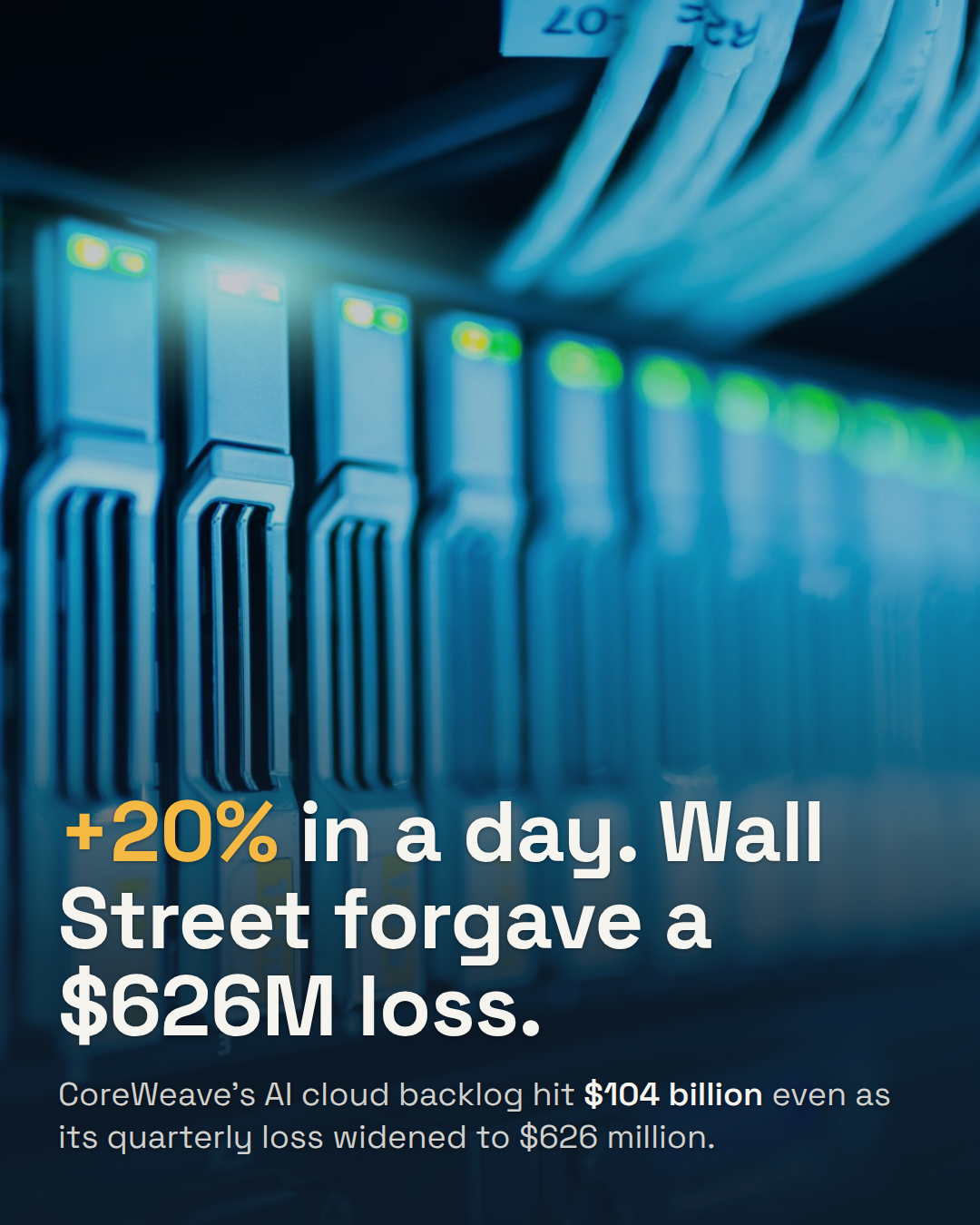
CoreWeave's revenue backlog surged to $104 billion and its stock jumped 20% in a single session, even though the AI cloud provider's quarterly loss widened to $626 million.

Fiscedge Academy
Contributing Faculty & Practitioner
News Breakdown · FiscEdge Academy
CoreWeave posted a $626 million net loss for the second quarter. Its stock jumped as much as 20% anyway.
The AI cloud provider reported revenue of $2.58 billion, up 112% year over year and slightly ahead of the $2.56 billion Wall Street expected. The headline number, though, was the backlog: $104 billion in contracted future revenue, excluding more than $25 billion in new commitments signed in the first weeks of the third quarter. That backlog figure is what sent shares sharply higher on Wednesday, even as the company's losses widened from $290 million a year earlier and its debt load sits at roughly $35 billion.
The quarter also included two of the largest customer commitments CoreWeave has landed to date: a new agreement with Meta worth $21 billion through 2032, stacking on top of an existing $14 billion deal, plus a fresh multi-year compute agreement with Anthropic and a $6 billion commitment from trading firm Jane Street.
But the loss and the stock pop are the least interesting part of this story. The real signal is what investors chose to reward: not profitability, not even revenue, but the size and duration of contracted future demand. CoreWeave is now being priced less like a software company and more like a utility with a very long order book, at a moment when the market badly wants proof that AI infrastructure spending has real customers on the other end.
The backlog is not cash
A $104 billion backlog is a promise, not a bank balance. It represents multi-year commitments from customers like Meta and Anthropic to buy compute capacity CoreWeave has to build, finance and operate first. Converting that backlog into recognized revenue requires CoreWeave to keep raising debt to build data centers, on top of the $35 billion it already carries, while margins stay compressed by depreciation and interest costs. Wall Street is betting the conversion happens cleanly. History with capital-intensive infrastructure buildouts says that bet is rarely free of surprises.
Why founders should care about backlog accounting
Backlog and bookings numbers are increasingly how AI-adjacent companies, public and private, tell their growth story instead of trailing revenue. If you run a SaaS or infrastructure business and you're raising, expect investors in this environment to ask for both: the contracted backlog and the cash conversion timeline. A founder who can show not just "we signed $50M in future ARR" but exactly when that becomes billable revenue, and what capital is required to deliver it, is going to out-negotiate one who leads with the bigger, softer number. This is the same discipline taught in FiscEdge's financial modeling course: model the delivery cost of a commitment, not just its headline size.
The concentration risk hiding in the good news
Two customers, Meta and Anthropic, now account for an outsized share of CoreWeave's forward book. That's not unusual for an infrastructure provider in a land-grab phase, but it is a structural risk that shows up in the fine print, not the press release. Any founder selling into a small number of large enterprise or AI-lab customers should read CoreWeave's quarter as a reminder to track revenue concentration explicitly and to price in what happens if even one anchor customer slows its build-out. It's a topic we cover directly in startup strategy when we talk about customer concentration and negotiating leverage.
The market's real message
Investors did not reward CoreWeave for being profitable. They rewarded it for proving that AI infrastructure demand from the largest labs and platforms is still accelerating, not slowing, which is the question every AI-adjacent founder's investors are quietly asking about their own pipeline right now. Growth-stage AI startups pitching infrastructure, tooling or compute-adjacent products should expect diligence to increasingly mirror this: less "how big is your TAM" and more "show me the signed commitments and the unit economics behind delivering them."
If you remember one thing
A backlog is only as good as the plan to deliver it profitably. When you pitch growth, pair the number with the delivery cost and the cash-conversion timeline, or an investor will do that math for you and price in the worst case.
We break down deals like this one in FiscEdge's financial modeling course and startup strategy tracks, and cover the AI infrastructure landscape in AI for entrepreneurs. For the fundamentals behind backlog, bookings and revenue recognition, read what unit economics actually means. Browse the full blog. Follow @fiscedge for daily Business & AI analysis.
Topics & Categorization:
How interesting did you find this article?