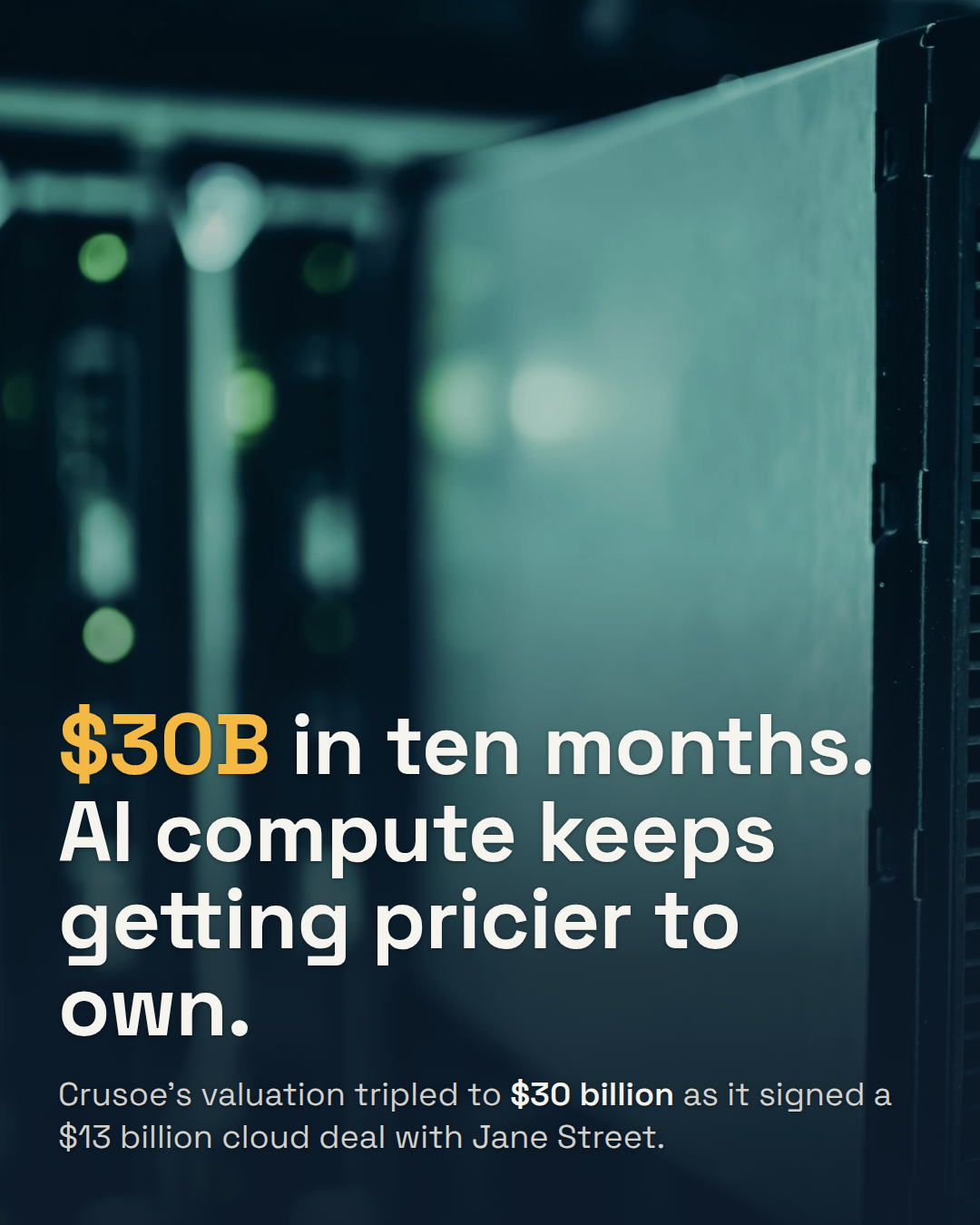
Crusoe Raises $3 Billion at a $30 Billion Valuation. Its Price Tripled in Ten Months.
AI data center operator Crusoe raised over $3 billion at a $30 billion valuation, up from $10 billion ten months ago. For founders, compute is now a vendor risk to model.

Fiscedge Academy
Contributing Faculty & Practitioner
News Breakdown · FiscEdge Academy
Crusoe, the AI data center operator, closed a Series F of more than $3 billion this week at a $30 billion valuation. Atreides Management and Valor Equity Partners co-led the round, with Mubadala Capital, the asset-management arm of Abu Dhabi's sovereign wealth fund, also putting in fresh capital.
Ten months ago Crusoe raised $1.38 billion at a $10 billion valuation. The price tag has tripled since then, which makes this less a funding round and more a read on how much investors still believe AI compute is worth paying up for.
The number that matters is not $30 billion
Valuations move on sentiment. What is harder to fake is a customer list, and Crusoe's includes Meta, Microsoft and OpenAI, plus a five-year, $13 billion cloud contract with the quant trading firm Jane Street. That is a single customer committing more money over five years than the entire company was worth a year ago.
Crusoe did not start as an AI company. It launched in 2018 flaring off wasted natural gas to run crypto-mining rigs, then pivoted the same trick, cheap, stranded, on-site power, into GPU data centers once the AI boom made compute the scarcer resource. The company is also reportedly meeting with bankers at Goldman Sachs and Morgan Stanley about a possible IPO, which would put it on a path that CoreWeave already walked and that several other GPU-cloud operators are lining up behind.
Why the neoclouds keep winning rounds this big
Crusoe is part of a category investors now call the "neoclouds": data center operators that exist to rent Nvidia GPUs by the hour to companies that do not want to build or lease their own infrastructure. AWS, Azure and Google Cloud are still the default, but they cannot build capacity fast enough, and a neocloud can move quicker because it is not managing thirty other product lines at the same time.
For a founder, that speed is the actual product. A $13 billion multi-year contract only makes sense if Crusoe can guarantee the racks, the power and the uptime on a timeline the hyperscalers cannot promise. Money is flowing to whoever can turn a signed contract into running silicon the fastest, not necessarily to whoever has the best long-term technology roadmap. That is a useful distinction to hold onto the next time a pitch deck leads with valuation instead of delivery speed.
What this means if AI compute is a line item on your P&L
If your product runs inference or training workloads, this round is a signal that GPU capacity is still being built out aggressively, which is generally good news for pricing and availability over the next 12-18 months. But concentration is the flip side: a handful of neoclouds, backed by a handful of the same sovereign and crossover funds, are becoming the plumbing that a large share of the AI industry depends on.
The founder-level takeaway is the same one we walk through when we cover vendor concentration in FiscEdge's financial modeling course: know which line items in your model depend on a vendor whose own balance sheet you do not control, and model what happens to your unit economics if that vendor's pricing changes, the same discipline covered in our breakdown of unit economics. Compute is quickly becoming as strategic a dependency as your payment processor or your cloud database, and it deserves the same scrutiny in a fundraising deck, a topic we go deeper on in FiscEdge's AI for entrepreneurs track.
If you remember one thing
A company's valuation tripling in ten months is not proof of a bubble or proof of a boom by itself, it is a bet that whoever controls the fastest path from signed contract to running GPU wins the next stage of the AI build-out. If your business depends on AI compute, the question is not whether prices will move, it is whether you have mapped which vendor's balance sheet your margins are quietly riding on.
We cover vendor concentration and infrastructure dependencies in FiscEdge's financial modeling course and AI for entrepreneurs track. Browse the full blog for more news breakdowns. Follow @fiscedge for daily Business & AI analysis.
Topics & Categorization:
How interesting did you find this article?