CuspAI Raises $450M to Design Materials With AI. Nvidia and Meta Just Joined In.
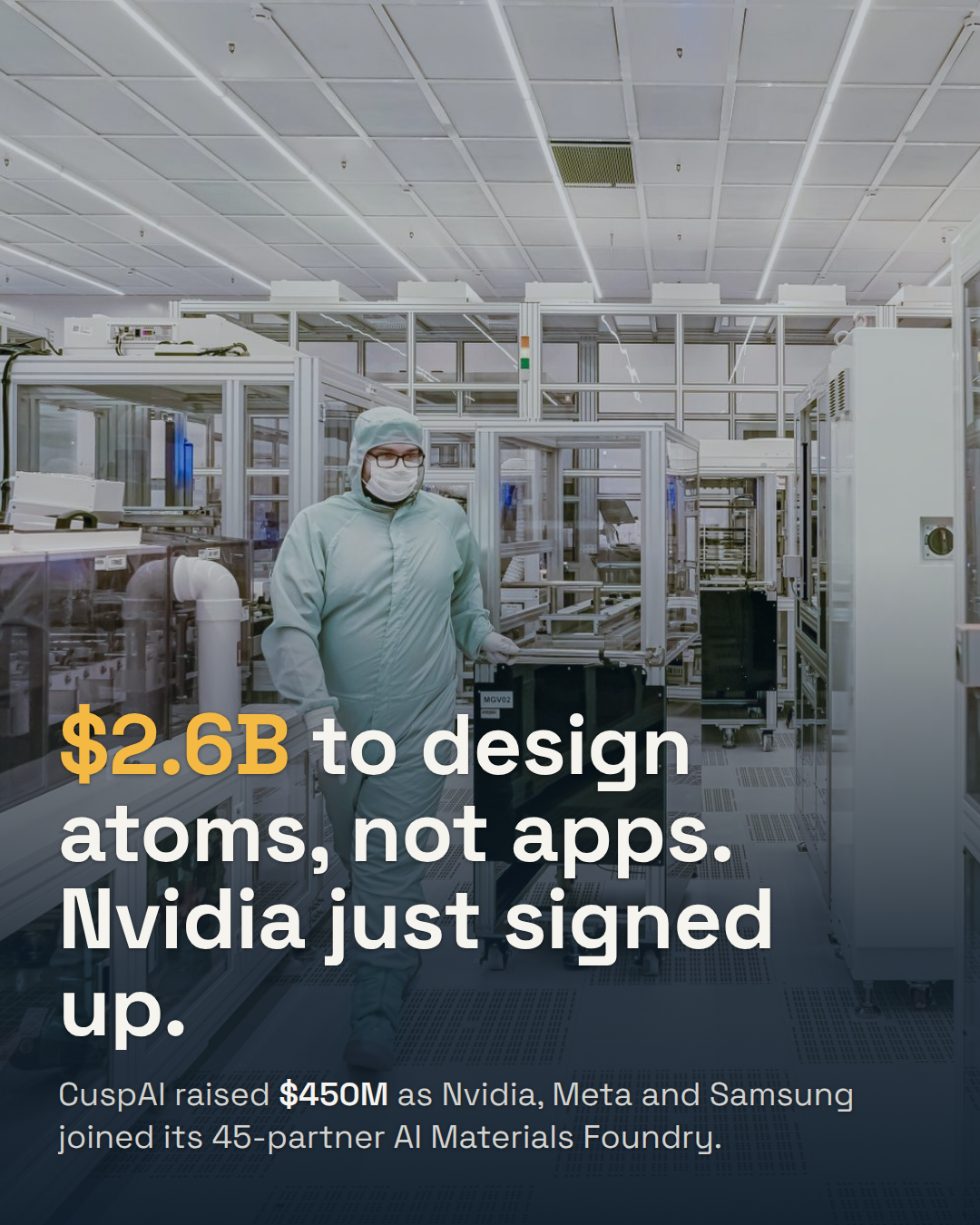
CuspAI raised $450 million at a $2.6 billion valuation as Nvidia, Meta and Samsung joined its 45-partner AI Materials Foundry, betting AI's next frontier is physical materials.

Fiscedge Academy
Contributing Faculty & Practitioner
News Breakdown · FiscEdge Academy
CuspAI, a Cambridge, UK-based startup that uses generative AI to design new physical materials, closed a $450 million Series B this week at a $2.6 billion valuation, co-led by Kleiner Perkins and NEA with Jeff Bezos' Bezos Expeditions as a headline backer. The round pushes CuspAI's total funding past $650 million and marks roughly a 5x jump in valuation in nine months, up from $520 million at its last raise.
Alongside the money, CuspAI launched the "AI Materials Foundry," a coalition of more than 45 companies and research labs, including Nvidia, Meta, Samsung, Hyundai Motor Group, Applied Materials, Tokyo Electron, Lam Research and 3M, pooling compute, lab access and proprietary data onto CuspAI's platform.
The funding number is the least interesting part. The interesting part is who signed up to use it, and why.
What CuspAI actually sells
CuspAI's platform, called MIRA, uses generative and agentic AI to design materials with specific target properties: a founder or researcher defines the characteristics they need, and the system generates, simulates and prioritizes candidate compounds before anything touches a lab bench. The pitch is that it compresses a materials-discovery cycle that used to take years into months. The company's stated focus is semiconductor materials, clean energy and advanced manufacturing, three sectors where a better material, not a better algorithm, is the actual bottleneck.
That's a meaningfully different bet than most of this year's AI funding headlines. Nvidia, Meta and Samsung aren't investors here chasing a return on a chatbot; they're founding partners in a coalition built to solve a supply problem that directly threatens their own roadmaps. Chip and hardware makers have spent 2026 warning that compute buildouts are running into physical constraints, not just capital ones: better substrates, coolants and packaging materials. CuspAI is positioning itself as infrastructure for the physical layer of the AI boom, not another layer of software on top of it.
The signal under the headline
Look at the two numbers together: a $2.6 billion valuation on a company that, by most accounts, is still under 100 people, and a customer coalition that includes three of the five largest AI infrastructure spenders in the world. That combination is the tell. Big strategics don't join a 45-partner data-and-compute-sharing coalition around a single startup's platform unless they've already concluded internally that the discovery problem is worth solving together rather than each building it alone.
It also tells you where late-2026 venture capital is actually rotating. After a year of software-layer AI funding rounds that increasingly compete on the same handful of benchmarks, investors are pushing money into AI applied to physical, scientific and industrial problems, the kind with long R&D cycles and real moats once solved, rather than another wrapper around a frontier model API. Bezos Expeditions backing a materials-discovery platform sits in the same category as his other bets on hard, capital-intensive science: it's a wager that AI's next defensible category is atoms, not tokens.
Why this matters if you're not building materials
Most SaaS founders will never touch a chip fab or a chemistry lab, but the underlying playbook here travels. CuspAI didn't just raise money, it converted its customers into co-owners of the roadmap before the product was fully mature. Getting Nvidia, Meta and Samsung to commit data, compute and lab time to a shared platform is a distribution strategy: it locks in the exact accounts a competitor would need to poach, and it means the product improves because the biggest players in the category are feeding it their hardest problems.
If you're raising a round in a crowded category, "we have five pilot customers" is a weaker story than "here's the coalition of category leaders who agreed to build the standard with us." The second one is much harder to replicate, and it's what turned a $520 million company into a $2.6 billion one in nine months.
The founder takeaway
- A funding round is a weaker signal than who is standing next to you when you announce it. CuspAI's valuation jump tracks its customer coalition, not just its cap table.
- Solve a physical or operational bottleneck, not just an information one. Categories with real R&D cycles and physical constraints (materials, energy, hardware) are harder to copy than another LLM wrapper, and investors are pricing that in.
- Turn your biggest prospective customers into design partners before you scale. A coalition of committed strategics is a moat a fast follower can't buy their way into.
If you remember one thing
The most telling AI funding round this week isn't about a chatbot or a coding agent, it's a $450 million bet that the next constraint on the AI buildout is physical materials, and that Nvidia, Meta and Samsung would rather co-invest in solving it than compete to solve it alone. If your fundraising story is "we have users," ask what it would take to make it "we have the category's leaders locked into our roadmap."
We cover how to structure a fundraise and read investor signals in FiscEdge's startup strategy course, and how to model a venture round's real impact on your cap table in financial modeling. If you're weighing how AI reshapes non-software industries, our AI for entrepreneurs track and our primer on what unit economics actually means are useful next reads. Browse the full blog. Follow @fiscedge for daily Business & AI analysis.
Topics & Categorization:
How interesting did you find this article?