China's CXMT Raises $8.6B in Asia's Biggest 2026 IPO. It's Now the World's Fourth-Largest Memory Chipmaker.
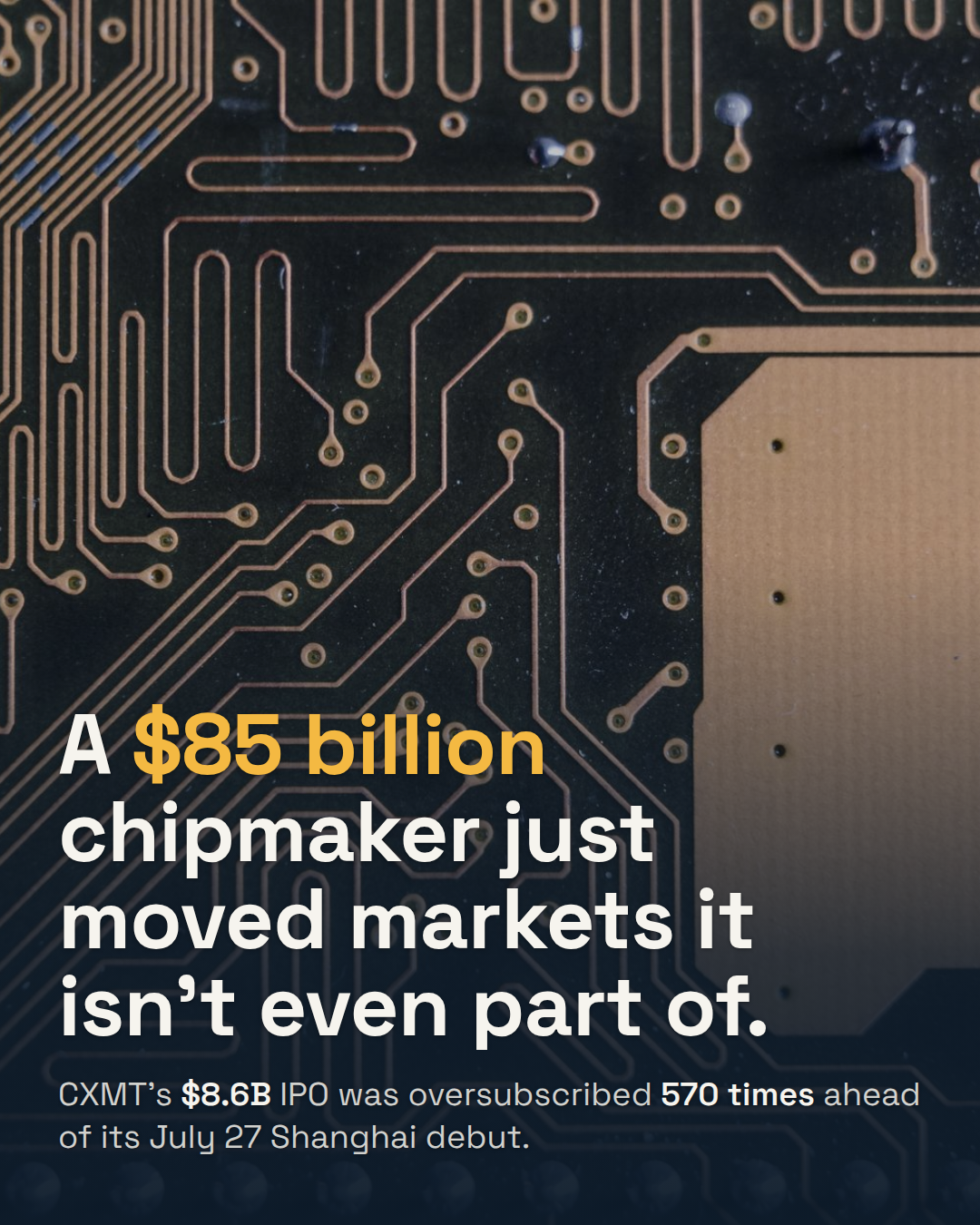
CXMT priced an $8.6 billion Shanghai listing at an $85 billion valuation, oversubscribed 570 times, ahead of its July 27 debut as the world's fourth-largest DRAM maker.

Fiscedge Academy
Contributing Faculty & Practitioner
News Breakdown · FiscEdge Academy
China's ChangXin Memory Technologies (CXMT) priced the largest chip IPO of the year and starts trading on Shanghai's STAR Market on July 27. The company raised 57.92 billion yuan (about $8.6 billion) by selling shares at 8.66 yuan apiece, valuing the newly public memory chipmaker at roughly 579 billion yuan, or about $85 billion. That makes CXMT the fourth-largest DRAM manufacturer in the world on day one, and Asia's biggest IPO of 2026.
The demand behind the number is even more striking. According to a Shanghai Stock Exchange filing, the institutional tranche of the offering was oversubscribed 569.8 times: investors bid for 1.24 trillion shares against just 2.17 billion on offer. That's real money chasing a memory chipmaker most founders outside hardware and infrastructure circles have never heard of.
The number that matters isn't the valuation, it's the "cash call"
An $85 billion valuation is a big headline, but the more consequential number is what CXMT's IPO is doing to everyone else's stock price. Chinese retail and institutional investors need cash on hand to bid for hot new listings, so a deal this size triggers what traders call a "cash call": investors sell existing positions, especially in adjacent semiconductor names, to free up capital for the subscription. That selling pressure hit memory and equipment stocks in the days before listing, even though nothing about their underlying businesses changed. Analysts now expect CXMT's valuation to blow past 1 trillion yuan (about $139 billion) within its first trading sessions, which would force index funds tracking China's STAR Market and semiconductor benchmarks to buy in and rebalance, pulling even more capital out of other names to do it.
Why memory chips are not a niche story right now
DRAM, the memory chip category CXMT makes, sits underneath nearly every AI server, GPU rack and cloud instance your product runs on. Micron and SK Hynix both sold off on the CXMT listing news, on fears that a fourth major global producer is adding capacity right as markets debate whether AI datacenter buildouts are outrunning near-term demand. At the same time, the AI boom has been the single biggest driver of DRAM demand this year, which is exactly why a chipmaker few outside hardware circles could name just became one of the most closely watched listings of 2026. Memory is the quiet input behind every AI compute bill, and a new, well-funded competitor entering supply changes the multi-year trajectory of that input's price.
What this changes for founders and operators
- Watch memory, not just GPUs, as an AI-cost input. If your roadmap depends on inference at scale, DRAM and HBM pricing feeds directly into what your cloud provider charges you next year. A fourth major global DRAM producer with $8.6 billion in fresh capital to expand capacity is a multi-year supply signal worth tracking, not just a chip-sector curiosity.
- China's IPO mechanics can move markets you don't expect. The "cash call" dynamic behind CXMT's listing is a reminder that capital-markets structure, not just company fundamentals, moves stock prices you might be exposed to through index funds, treasury allocations or investor portfolios.
- Oversubscription is a demand signal, not a quality guarantee. 570 times oversubscribed sounds like unambiguous good news, but the same reporting that surfaced that number also noted it's far lower than recent STAR Market debuts that cleared 5,000 times oversubscribed. Read multiples in context, especially when you're sizing up comparable signals for your own venture round.
- Supply-chain concentration cuts both ways. A new, large, state-linked competitor in a critical AI input reduces single-source risk for global buyers, but it also raises questions about capacity discipline and oversupply that can swing input prices in either direction faster than demand forecasts assume.
If you remember one thing
When a single IPO is big enough to move the stock price of companies that aren't even part of it, the story isn't the listing, it's the capital plumbing underneath your market. Memory chips are now a genuine AI infrastructure story: track DRAM supply the way you already track GPU supply, because both eventually show up in your compute bill.
We break down how AI infrastructure costs like DRAM and GPU pricing flow into your unit economics in FiscEdge's financial modeling course. If your roadmap runs on inference at scale, our AI for entrepreneurs track covers where that compute spend actually goes. Curious what it costs to build on top of this hardware wave? Start with cost to build a SaaS. Browse the full blog for more breakdowns like this. Follow @fiscedge for daily Business & AI analysis.
Topics & Categorization:
How interesting did you find this article?