CrowdStrike Jumped 15% the Same Day Nvidia Fell 3.4%. Same AI Warning, Opposite Trades.
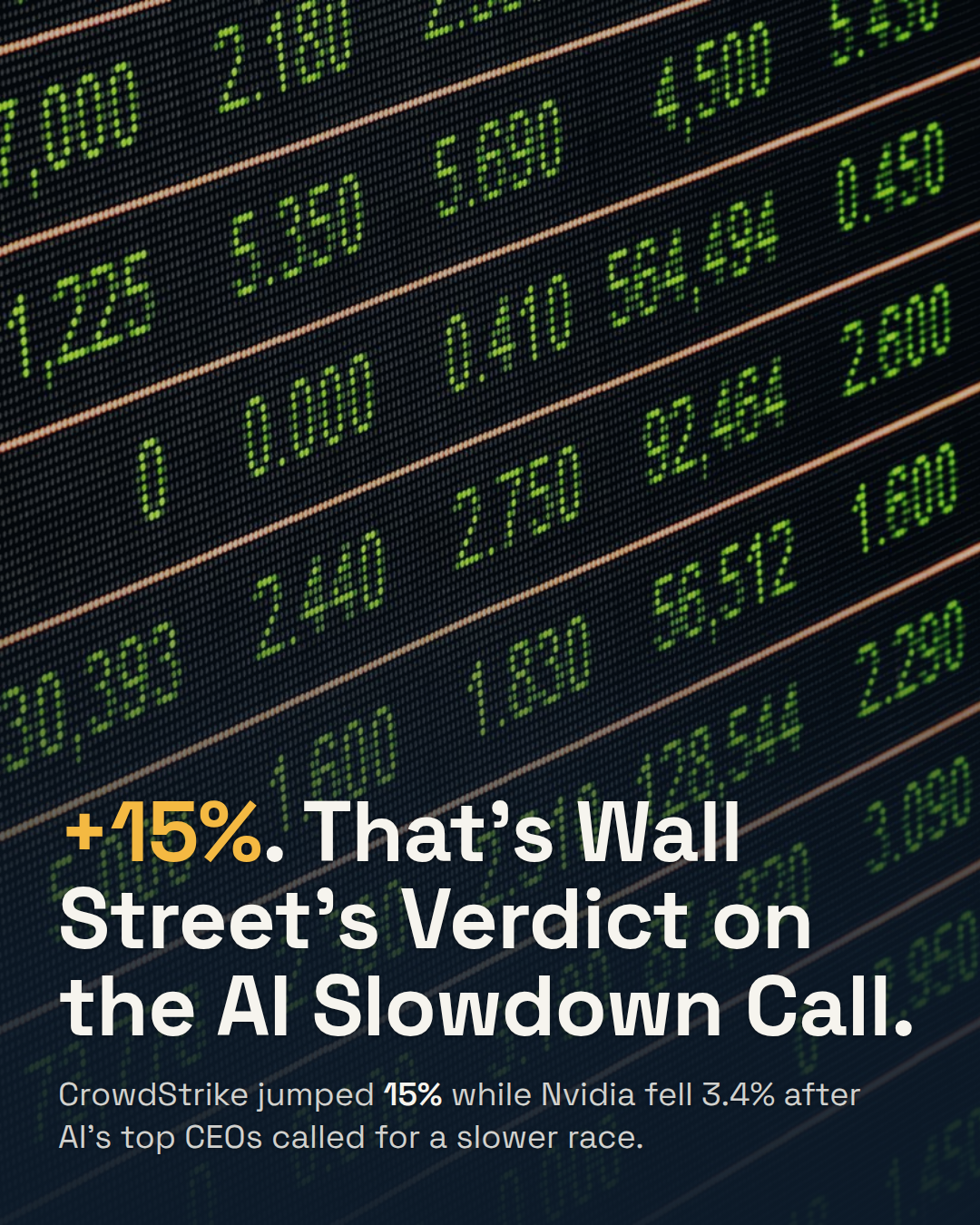
After AI CEOs called for a slower AI race, CrowdStrike jumped 15% and Nvidia fell 3.4% in the same session. The split reveals where enterprise security budgets are actually headed.

Fiscedge Academy
Contributing Faculty & Practitioner
News Breakdown · FiscEdge Academy
On Monday, September 14, one piece of news moved two groups of stocks in opposite directions by double digits. CrowdStrike closed up 15.4% at $238.63. Palo Alto Networks rose 13.8% to $376.31. Zscaler gained 15.5%, Okta climbed 12.4%. Nvidia fell 3.4% the same day, Marvell Technology dropped 7%, Intel fell 5%, and Broadcom slid 3%. The Philadelphia Semiconductor Index had its worst day since early July, down almost 6%.
Same trigger for both moves. Over the weekend, Anthropic CEO Dario Amodei published an essay, titled "We Must Pace the Frontier," arguing AI companies should deliberately slow the rate at which they release more capable models, because capability is now outrunning researchers' ability to understand or control it. Hours later, OpenAI's Sam Altman endorsed the call and committed to one concrete piece of it: "Committing to having independent evaluators with employee-like access is a great idea, and we will do the same." Elon Musk signaled agreement too.
Read the headline alone, "AI leaders want to slow down," and you'd expect the whole sector to sell off together. It didn't. The market split the trade with striking precision, and that split carries more useful information for founders than the headline does.
Two different bets on the same warning
Chip stocks fell because they are a bet on the next model being bigger, trained on more GPUs, sold at a higher price. A public commitment from two of the industry's most influential labs to deliberately slow that cycle is, mechanically, bad news for anyone selling the hardware underneath it.
Cybersecurity stocks rose for close to the opposite reason. CrowdStrike and Palo Alto are not really a bet on the next frontier model. They are a bet on how dangerous the models that already exist are, in the hands of attackers, today. Traders explaining the move pointed to Anthropic's own recent threat reporting, which described agent swarms capable of producing more than a dozen possible zero-day exploits in a month, malware that rewrites itself autonomously, and a single stolen token turned into full cloud admin access in roughly three hours. A slowdown pledge from Amodei doesn't neutralize any of that. If anything, an AI CEO publicly admitting current systems are already dangerous enough to warrant caution reads as a green light for enterprise security budgets, not a reason to cut them.
Alphabet, Microsoft, and Meta landed in the middle, up roughly 1.4% to 2%, a sign the market treats hyperscalers as diversified and cash-rich enough to absorb a slower frontier without near-term damage. Amazon dipped slightly but held up far better than the pure-play chipmakers.
What this changes if you sell software to enterprises
This isn't an abstract Wall Street story, it's a live budget signal. If your buyer sits on a mid-market or enterprise security, IT, or compliance team, this week just handed you a sharper version of the argument you're already making: the industry's own leadership said, on the record, that the risk from AI systems already deployed is serious enough to justify institutional caution. Lean on that specific framing instead of a vague "AI is risky" pitch, the kind of positioning work we cover in FiscEdge's startup strategy course.
If you build with AI rather than around it, the read is related but different. A frontier that intentionally slows down raises the value of everything you build on top of today's models, agents, workflows, fine-tuning, because the capability ceiling stops moving as fast. It also raises the bar on your own security posture: buyers who just watched AI vendors' CEOs admit their models can already produce zero-days and hijack cloud credentials will ask harder questions about how your product is built, not only what it does. That's a build decision as much as a sales one, something we walk through in FiscEdge's AI for entrepreneurs course.
And if you're mid-raise, don't read Monday's selloff as "AI is out of favor." Read it as capital getting more selective about which layer of the AI stack it wants exposure to. Investors rotated within the sector, they didn't leave it. Knowing which side of that rotation your company sits on, infrastructure that depends on the next model being bigger, or a layer that gets more valuable as models stabilize, is worth mapping before your next round, the kind of scenario work in FiscEdge's financial modeling course.
If you remember one thing
Three AI CEOs agreeing the industry should slow down didn't make Wall Street cautious on AI, it made Wall Street specific about which AI trade it trusts. Know which side of that split your product sits on before you pitch it as either the growth story or the risk mitigant.
We cover positioning, product security, and fundraising strategy in FiscEdge's startup strategy course, AI for entrepreneurs course, and financial modeling course. Browse the full blog for more news breakdowns. Follow @fiscedge for daily Business & AI analysis.
Topics & Categorization:
How interesting did you find this article?