Databricks Raises $5B at a $190B Valuation. Investors Offered Three Times That.
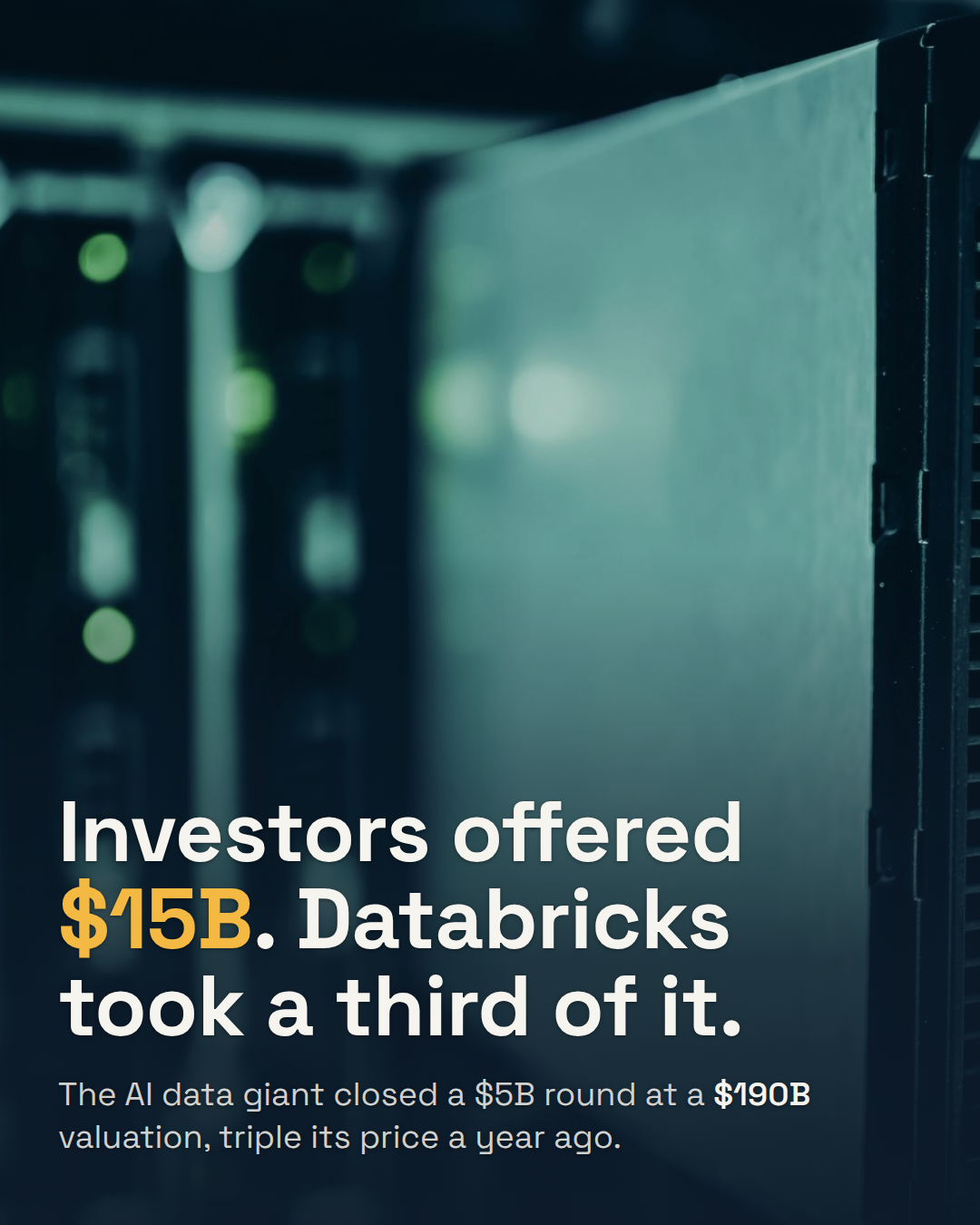
Databricks closed a $5B round at a $190B valuation, a third of the $15B investors wanted to write, as its revenue run rate topped $7B growing above 80% a year.
Fiscedge Academy
Contributing Faculty & Practitioner
News Breakdown · FiscEdge Academy
Databricks closed a $5 billion strategic funding round on August 13 at a $190 billion valuation, up from the $188 billion term sheet it signed in mid-July and nearly 50% higher than the $134 billion it was worth just eight months ago. The round was led by existing backer Coatue, joined by Blackstone, MGX and T. Rowe Price Investment Management, with Sixth Street Growth coming in as a first-time investor alongside BOND, Clearlake Capital, Point72, Premji Invest and TPG.
The number is the least interesting part. What actually matters is how the round happened: Databricks went out asking for $1 billion. Investors wanted to hand over $15 billion. The gap between those two figures, and which one CEO Ali Ghodsi picked, is the real signal for anyone raising capital right now.
The company asked for $1B and got a $15B offer
Ghodsi told TechCrunch the company wasn't even actively fundraising when this started. Databricks was heads-down running its annual conference in June when The Information reported the company was working on a raise. That story alone triggered what Ghodsi called "insane" interest: $15 billion of demand from a select group of investors the company approached, fifteen times the $1 billion it originally wanted. Databricks took $5 billion, five times its own target and a third of what was on the table.
That is not how fundraising is supposed to work in a tight capital market. It is a direct readout of how much institutional money is chasing a narrow set of AI infrastructure companies with real, provable revenue, and how much leverage that gives a founder who doesn't actually need the cash.
The revenue behind the multiple
Databricks' annualized revenue run rate crossed $7 billion in its latest fiscal quarter, up more than 80% year over year, following $4.8 billion in run-rate revenue and 55% growth reported just eight months earlier. At a $190 billion valuation, that prices the round at roughly 27 times forward run-rate revenue, well above the 6 to 10x public SaaS companies trade at and above the 15x ceiling most aggressive private AI rounds have stayed under this year. Investors aren't pricing Databricks like a data-and-analytics vendor anymore; they're pricing it like the AI-agent infrastructure layer itself.
The valuation trajectory makes the point on its own: $28 billion in 2021, $100 billion in August 2025, $134 billion by December, $188 billion on a term sheet in July, and now $190 billion closed, roughly a 90% increase in twelve months.
Where the money is going, and why no IPO
The new capital is earmarked for three products: Lakebase, a database built for AI agents that has already crossed $100 million in its own revenue run rate; Genie, an AI assistant that queries a company's own business data; and Unity AI Gateway, a control layer for managing which models an organization uses and what they cost. All three are infrastructure plays for a world where companies run AI agents against their own data at scale, and Ghodsi has argued that AGI, under an older definition, has effectively already arrived.
Despite the size and the demand, Databricks has again pushed past an obvious IPO window. The company has said publicly that going public now would mean "too much distraction in the public market" given current volatility. With private investors willing to write checks at a 27x revenue multiple and zero pressure to report quarterly numbers, there is no financial reason to trade that flexibility away. For founders, the traditional model where hypergrowth companies go public at scale is breaking down for the handful of businesses commanding this kind of demand: staying private longer isn't a compromise, it's the better deal.
What this changes for founders and operators
- Oversubscription is the new signal, not the round size. A 15x oversubscribed raise tells investors (and competitors) more about your position than the headline check does. If you're raising, track and disclose demand, not just the number you close.
- Revenue multiples above 20x now exist for real infrastructure, not hype. If your AI product sits underneath other companies' AI deployments rather than facing consumers directly, benchmark against Databricks' 27x, not a generic SaaS multiple.
- You don't need to IPO to access growth-stage capital. Late-stage private rounds are now large and liquid enough that staying private past $100 billion in valuation is a viable long-term strategy, not just a delay tactic.
- Growth-rate deceleration is fine if the base is big enough. 80% YoY growth on a $7 billion run rate beats 150% growth on $500 million in absolute dollars. Investors are rewarding the size of the base, not just the percentage.
If you remember one thing
Databricks didn't raise $5 billion because it needed the cash. It raised $5 billion because investors offered three times that amount, unprompted, after a single leaked headline. That is what genuine product-market fit at scale looks like from the outside: the money chases you, and the only decision left is how much of it to take.
We teach how to read a funding round and benchmark it against real SaaS multiples in FiscEdge's financial modeling course, and how to build the AI-native infrastructure this story is about in AI for entrepreneurs. For the fundamentals behind valuation math, read what are unit economics on the blog. Browse the full blog for more breakdowns like this. Follow @fiscedge for daily Business & AI analysis.
Topics & Categorization:
How interesting did you find this article?