DeepSeek's Valuation Jumped From $50B to $71B in a Month. Now It's Prepping an IPO.
DeepSeek is reportedly in talks to raise $1.5B at a $71B valuation, a month after its first $7.4B round, while prepping a mainland China IPO for 2027. The real story is who gets to vote.

Fiscedge Academy
Contributing Faculty & Practitioner
News Breakdown · FiscEdge Academy
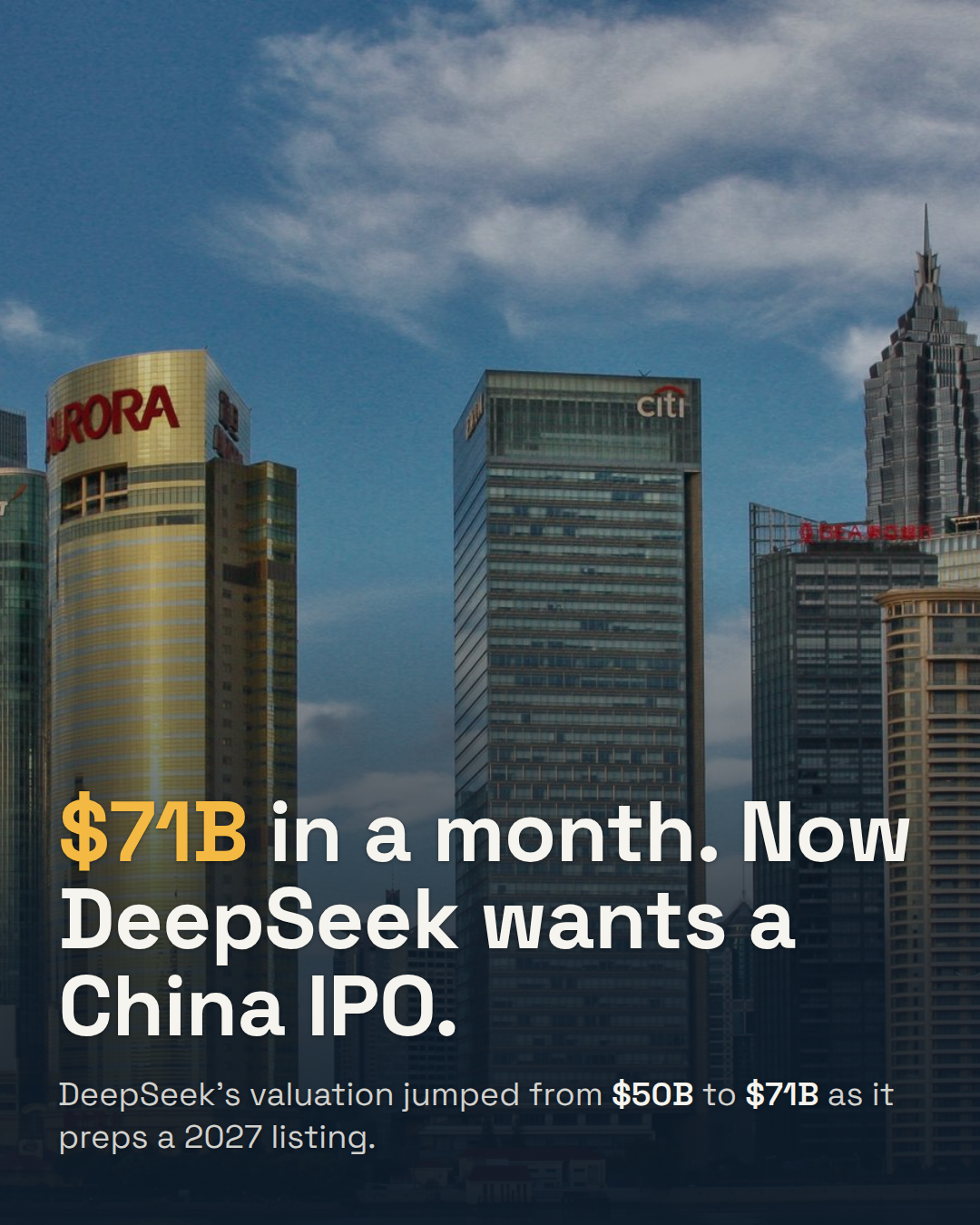
DeepSeek is reportedly in talks to raise roughly $1.5 billion in new funding at a valuation of about $71 billion, according to Bloomberg and the Financial Times, barely a month after the Chinese AI lab closed its first-ever outside funding round at just over $50 billion. Alongside the new raise, DeepSeek has started preparing IPO paperwork for a mainland China listing that could be filed as early as late 2026, targeting a public debut in 2027.
A month. $50 billion to $71 billion. Roughly a 40% markup on a company that only opened its cap table to outside investors in mid-June. That valuation jump is the least interesting number in this story.
The signal under the headline: two classes of investor, one company
Look at who actually held the pen on DeepSeek's first round. Of the $7.4 billion raised, founder Liang Wenfeng put in the single biggest check himself, around $3 billion (20 billion yuan). Tencent invested roughly $1.4 billion, battery giant CATL around $735 million. All of that commercial money went in through a limited partnership controlled by Liang, on a five-year lockup with zero voting rights. China's state-backed National AI Industry Investment Fund, by contrast, invested directly into the company, with full voting rights and no lockup at all.
Now, per reports, Tencent and Beijing's state fund are reportedly back for round two, writing bigger checks at a 40% higher price, a month after accepting terms that gave them no say in the company at all.
That's the actual story: capital is chasing DeepSeek hard enough that sophisticated investors are re-upping at a markup into a structure that still doesn't give them a vote. They're underwriting proximity to a likely IPO, not governance rights.
Why founders should study the cap table, not the number
- The control-versus-capital tradeoff just got a real-world extreme case. Every founder negotiating a term sheet fights over information rights, board seats, protective provisions. DeepSeek's commercial investors gave up all of it and still came back for seconds. If you're raising, remember that the check size someone is willing to write says nothing about what they should get to control in exchange, and vice versa: what you're willing to give up should be priced on its own, separate from how much you need the cash.
- Fundraise-to-IPO timelines are compressing hard in AI. This isn't a multi-year Series A to B to C to S-1 ladder. It's raise, mark up 40%, start IPO paperwork, all inside about six weeks. If you're modeling your own fundraising runway or benchmarking against "AI-speed" comps for your board, this is the new reference point, not the old three-year playbook.
- State-adjacent capital is still capital, and it changes what "independent" means in due diligence. If you're building anything that touches AI infrastructure, model tooling, or data pipelines that could compete with or plug into Chinese AI labs, understand that DeepSeek's investor base now includes a sovereign fund with direct voting control. That's a data point for how you assess competitive and supply-chain risk, not just a headline.
- A fast follow-on round validates that AI capital hasn't dried up, even amid export controls and geopolitical friction. DeepSeek raising its price a month after a record first round, while under continued US chip restrictions, tells you institutional appetite for frontier AI exposure remains high. That matters for anyone benchmarking their own SaaS or AI-tooling valuation against "the market has cooled" narratives; in the segment that matters most to comps, it hasn't.
Why this is bigger than one company
DeepSeek's IPO track now runs in parallel with OpenAI's and Anthropic's own confidential US filings, both reportedly targeting valuations approaching $1 trillion later this year or in 2027. Three of the industry's most closely watched AI labs are all racing toward public markets on overlapping timelines. However that resolves, it sets the bar every AI-adjacent founder will get compared against the next time you're in a fundraising conversation: investors have now seen what "AI speed" looks like on a cap table, and they'll expect you to explain why yours moves slower.
If you remember one thing
Before you accept any term sheet, ask what the investor gets to control, not just what they're paying. DeepSeek's investors wrote nine- and ten-figure checks for zero votes and a five-year lockup, then came back a month later to do it again at a 40% higher price. The lesson for your own raise isn't "give up control for cash." It's that check size and control rights are two separate negotiations, and conflating them is how founders give away more than the money justifies.
We break down how to negotiate a term sheet that protects your control without killing your round in FiscEdge's startup strategy course, and how a 40% valuation markup actually gets modeled in financial modeling. If you're tracking how capital is really moving through the AI race, our AI for entrepreneurs track covers it. Curious whether your own valuation math holds up under scrutiny? Start with is financial modeling hard. Follow @fiscedge for daily Business & AI analysis.
Topics & Categorization:
How interesting did you find this article?