Etched Raises $300M at a $10.3B Valuation. It Bet Everything on One Chip Doing One Thing.
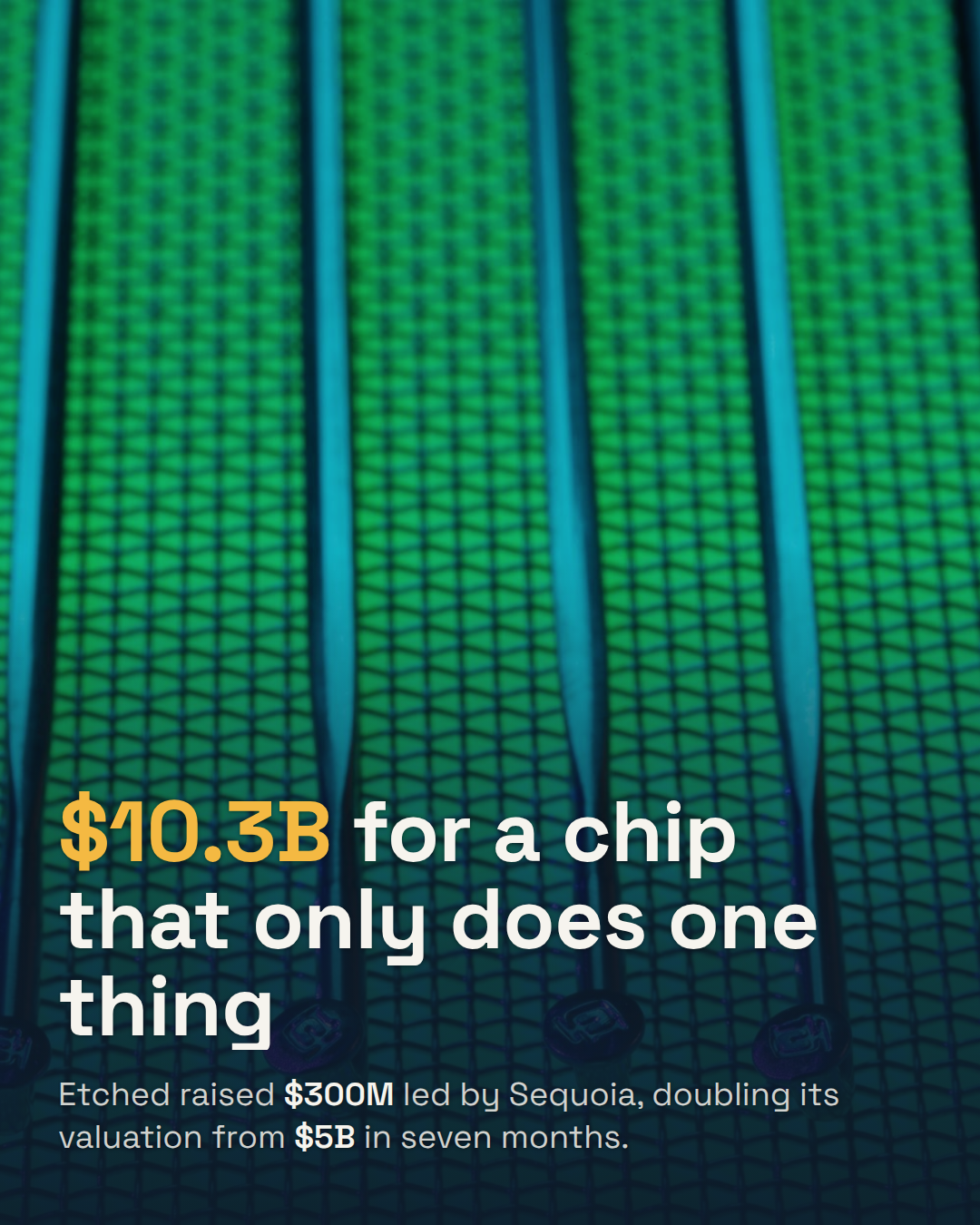
Etched closed a $300M Series C led by Sequoia at $10.3B, more than double its December valuation, betting a transformer-only chip beats general-purpose GPUs.
Fiscedge Academy
Contributing Faculty & Practitioner
News Breakdown · FiscEdge Academy
Etched just closed a $300 million Series C at a $10.3 billion valuation, led by Sequoia Capital with Andreessen Horowitz, Jane Street, Diffusion and SK Hynix joining in. That values the four-year-old chip startup at more than double the $5 billion it was worth just seven months ago, when it raised $500 million in December. Sequoia is calling it the highest valuation it has ever backed in a Series C round. The new money pushes Etched's total funding past $1 billion, less than a month after the company came out of stealth with $800 million already raised and roughly $1 billion in signed contracts.
The number is the least interesting part. What Etched actually sells is the story: a chip, called Sohu, that does exactly one thing and refuses to do anything else.
A chip that can only run transformers
Every AI chip company since 2020 has sold flexibility: general-purpose GPUs that can train a model, run inference, or get repurposed for something else entirely if the market shifts. Etched is selling the opposite. Sohu, built on TSMC's 4nm N4P process, is a transformer-only ASIC, hardware wired specifically for the neural network architecture behind ChatGPT, Claude and Gemini, and it claims up to 20x the inference throughput of an Nvidia H100 on that one workload. If transformers stop being how the industry builds frontier models, Sohu becomes an expensive paperweight. Investors just wrote a $300 million check betting that won't happen anytime soon, and that specialization, not raw compute, is where the next margin in AI infrastructure gets made.
Why SK Hynix's name matters more than Sequoia's
Sequoia leading gives Etched a marquee lead investor. SK Hynix writing a check is the more revealing data point. SK Hynix makes high-bandwidth memory, the component that increasingly bottlenecks AI chip performance more than raw compute does. A memory supplier taking an equity stake in a chip customer is vertical integration dressed up as venture funding, the same logic Nvidia and Samsung already use with their own strategic investments. It signals that the companies making AI's physical inputs expect specialized inference silicon to be a durable, multi-year category, not a startup fad that gets absorbed or shut out once Nvidia responds.
What this changes for founders and operators
- Inference cost curves are about to diverge by workload. If your product runs LLM inference at scale, the assumption that GPU pricing is your compute ceiling is already outdated. Specialized inference chips promising order-of-magnitude throughput gains on transformer workloads mean your unit economics could shift dramatically depending on which hardware your provider adopts, and when.
- "Sold before it ships" is now a fundable model, if you can prove it. Etched's fundraise leaned on roughly $1 billion in signed contracts before its chips were broadly shipping. For B2B and infrastructure founders, pre-committed revenue, not just a working demo, is what is moving valuations at this scale right now. If you're raising, build your pipeline story around signed commitments, not projected TAM.
- Vertical, narrow bets are outcompeting general-purpose ones in AI infra. Sohu works precisely because it refuses to do what a GPU does. If you're building a tool, model or workflow "for AI" broadly, this round is a reminder that founders picking one workload and going deep are raising faster and at higher multiples than horizontal platform plays right now.
- Capital is still flowing hard into AI infrastructure even as public markets get nervous about capex. The same week hyperscaler earnings triggered selloffs over AI spending, private markets valued a single-purpose chip startup at $10.3 billion. Read that gap correctly: public investors are pricing risk on where AI spending lands; private investors are still racing to fund who captures it.
If you remember one thing
Etched didn't win by building a better general-purpose chip, it won by betting everything on one architecture and refusing to hedge. That is a hard, narrow, reversible-looking bet that just got priced at $10.3 billion because the underlying demand signal, real contracts, was already there before the fundraise. If you're building something "for AI," ask whether you are actually building the general tool or the narrow one that goes 10-20x deeper on a single workload. The narrow bet is what's raising money in this market.
We break down deals like this one in FiscEdge's AI for entrepreneurs track, and teach you to model the underlying economics in financial modeling. If you're building a product on top of this compute wave, building SaaS with AI and our breakdown on what it actually costs to build a SaaS are the right next reads. Browse the full blog for more breakdowns like this. Follow @fiscedge for daily Business & AI analysis.
Topics & Categorization:
How interesting did you find this article?