Factory Raises $200M at a $5 Billion Valuation. Its AI Coding Agents Tripled in Five Months.
Factory's AI coding agents tripled its valuation to $5 billion in five months, priced on a growth rate its investors never saw as revenue.
Fiscedge Academy
Contributing Faculty & Practitioner
News Breakdown · FiscEdge Academy
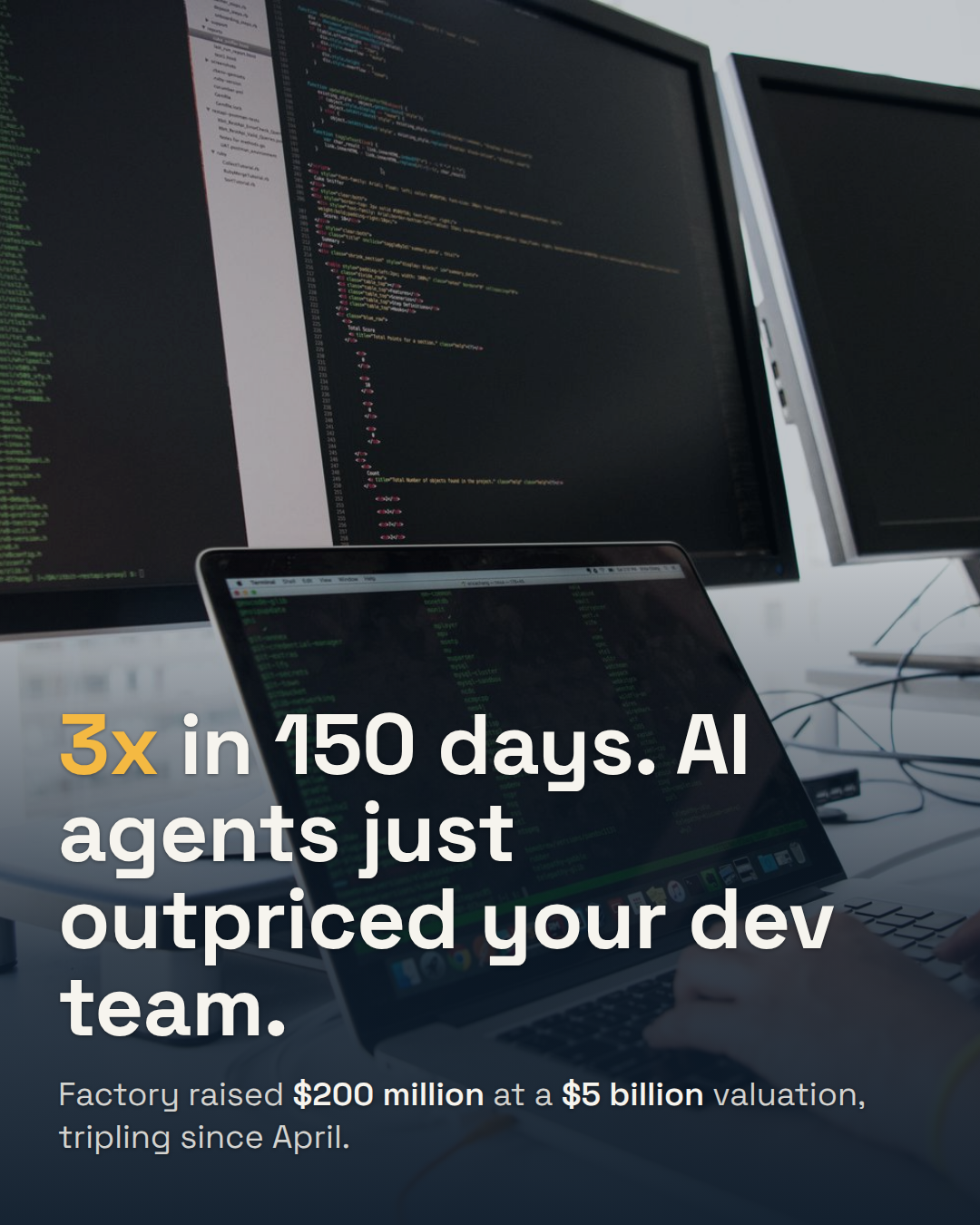
Factory, the San Francisco startup building autonomous AI agents for enterprise software engineering, has raised $200 million at a $5 billion valuation. Five months ago, in April, the same company raised $150 million at $1.5 billion. That is more than a 3x markup in 150 days, and it puts Factory's total funding above $400 million since it was founded in 2023.
The round drew Blackstone, Khosla Ventures, Sequoia Capital, Insight Partners, NEA, Clearlake, Evantic Capital, Sound Ventures and Mantis VC, alongside angels Nico Rosberg, Brad Gerstner and Marc Benioff. But the number on the term sheet is the least interesting part. The signal is in what investors were willing to underwrite without seeing.
What Factory actually sells
Factory's product, "Droids," is pitched as a step past the Copilot-style autocomplete most developers already use. Droids are meant to run end-to-end: writing code, running the test suite, reviewing and merging pull requests, triaging incidents, and pushing deployments, with a human approving rather than typing. Enterprise customers named across the round include Nvidia, Adobe, Palo Alto Networks, T-Mobile, Morgan Stanley, EY, Adyen, MongoDB, Bayer and Zapier, and the company says hundreds of thousands of developers now touch a Droid inside those organizations.
That is the pitch every "AI SDR" and "AI engineer" startup has made for two years. What makes Factory's raise notable is who is writing the check. Blackstone and Morgan Stanley are both investors and customers, which means the diligence on whether Droids actually save engineering hours was done by people who also run large engineering and IT budgets, not just VCs taking a founder's word for it.
The signal under the headline: nobody has seen an ARR number
Factory has not disclosed annual recurring revenue. What it has disclosed is a growth rate: revenue has doubled month over month for six consecutive months. Investors priced a $5 billion company off that trajectory, not off a disclosed revenue base.
That is a meaningfully different bet than the Series C in April, which was underwritten mostly on pipeline and design partners. Five months later, the same investors (plus new ones) are underwriting a tripled price on live usage inside regulated, risk-averse enterprises like Morgan Stanley and Bayer. For founders, this is the tell: the market has stopped rewarding "we have a great model" and started rewarding "a bank's engineering org actually shipped code through us this quarter." Adoption inside a compliance-heavy customer is now worth more, per dollar of ARR, than adoption inside a startup.
What this changes if you are building an AI product
If you are building anything with "agent" in the pitch deck, three things from this round are worth stealing:
- Land where the audit trail matters. Factory's most valuable references are not developer-tool early adopters, they are banks and pharma companies where every merged pull request and every deployment has to be defensible. A regulated logo is doing more work for the valuation than ten SaaS logos would.
- Investors are pricing growth rate over disclosed revenue, but only briefly. A 3x markup in five months on undisclosed ARR is a window that closes. The next round will ask for the number. If you are raising on trajectory alone, know that the grace period is short, not permanent.
- "Full lifecycle" beats "point tool." Droids are positioned against the narrower copilot category by owning testing, review and deployment, not just code generation. A tool that removes one step in a workflow competes on price; a tool that removes the whole workflow competes on headcount, which is a bigger budget line to raise against.
If you remember one thing
Factory's investors did not price $5 billion off a number they were shown. They priced it off a growth rate, inside customers whose engineering standards are unusually hard to fake. If you are building an AI product and your best reference customer is still another startup, that is the gap this round just made visible.
We teach how to price and position an AI-native product in Building SaaS with AI and how to translate usage metrics into a fundable narrative in Startup Strategy. For the cost side of running agentic infrastructure at scale, see what it actually costs to build a SaaS product. Browse the full FiscEdge blog for more breakdowns like this one. Follow @fiscedge for daily Business & AI analysis.
Topics & Categorization:
How interesting did you find this article?