Three Fed Officials Revolted for a Rate Hike. The Nasdaq Fell Into Correction Anyway.
The Fed held rates at 3.50%-3.75%, but three officials dissented for a hike, the most divided vote since 2016, while the Nasdaq 100 sank 10% into its second correction of the year.

Fiscedge Academy
Contributing Faculty & Practitioner
News Breakdown · FiscEdge Academy
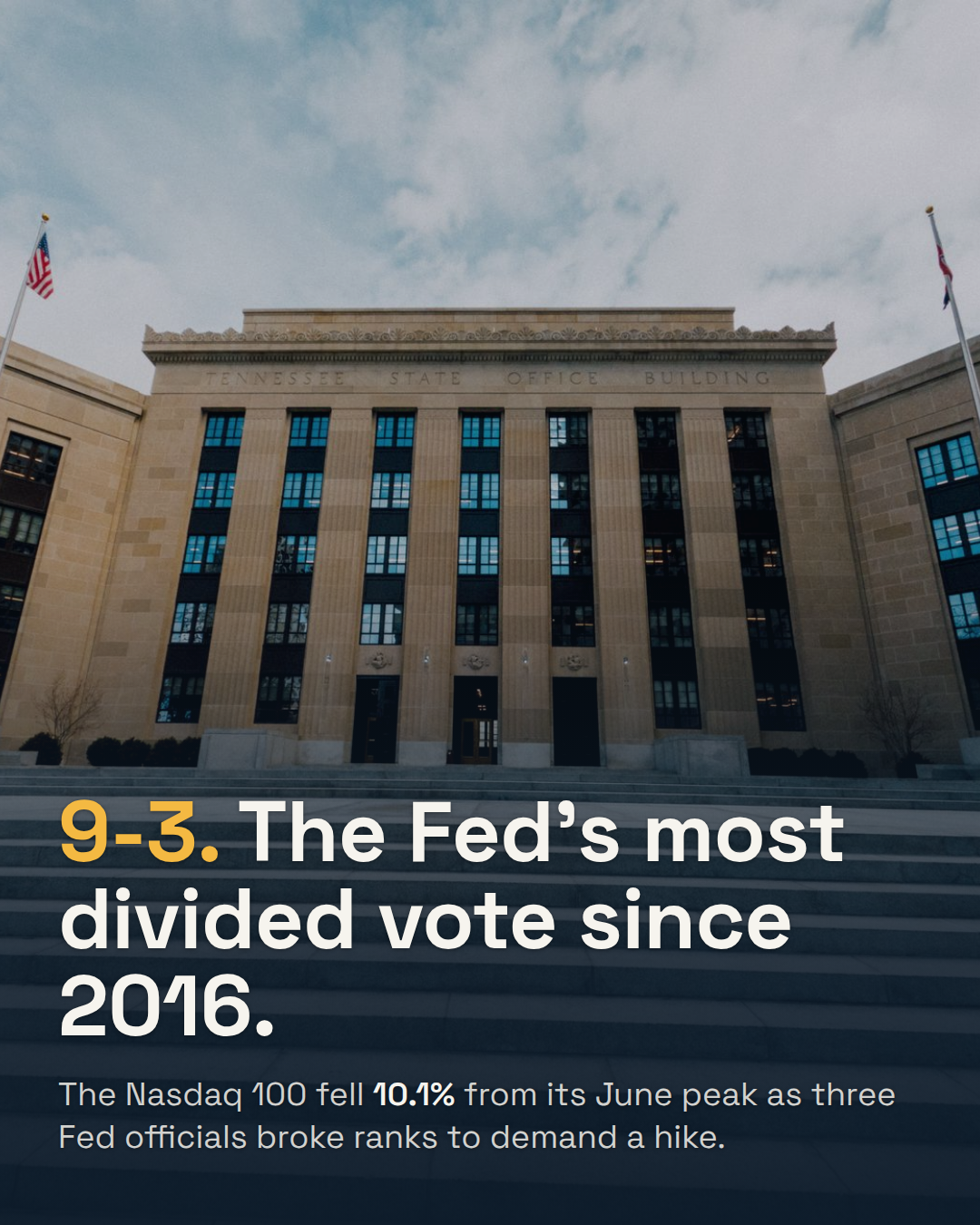
The Federal Reserve held its benchmark rate at 3.50%-3.75% on July 29, the fifth straight meeting without a change. That part was expected. What wasn't: the vote split 9-3, with three regional Fed presidents, Dallas's Lorie Logan, Minneapolis's Neel Kashkari and Cleveland's Beth Hammack, all dissenting in favor of a 25-basis-point hike. It's the first time since September 2016 that three FOMC members have dissented in the same direction. Fed Chair Kevin Warsh called it, in his own words, a "family fight."
Two days later, the Nasdaq 100 closed at 24,442.94, down 10.1% from its June 1 high of 27,190.21: official correction territory, and the index's second correction of 2026. The Philadelphia Semiconductor Index had already fallen 25% from its June 22 peak, a bear market, and memory names took the worst of it. The Roundhill Memory ETF dropped roughly 11% in a single session and is down more than 40% from its June high, with Micron and Seagate off more than 8%, Western Digital down nearly 7% and Sandisk down 14%.
The rate vote and the market rout aren't a coincidence, they're the same story. Capital is getting more expensive right when the market is trying to figure out who actually pays for the AI buildout.
Why three Fed officials picked this fight
Logan, Kashkari and Hammack dissented because they see inflation as sticky, not falling, pointing to tariff-driven price pressure and higher energy costs tied to the Iran conflict. Their argument, in short: don't declare victory on inflation while it's still running hot. Warsh held the line at 9-3, but a three-way, same-direction dissent this pointed hasn't happened in nearly a decade. Markets read that as a signal that the "rates stay lower for longer" case just got weaker, and the 30-year Treasury yield responded by climbing toward 5.2%-5.3%, its highest level since 2007.
The chip crash is a financing story, not just a demand story
The trigger for the Nasdaq selloff wasn't a demand miss. China's CXMT completed a blockbuster Shanghai listing and reported a domestic lithography milestone, SK Hynix posted record profit but still missed elevated expectations, and investors started asking the harder question: with hyperscalers, chipmakers and AI labs all layering overlapping multi-year spending commitments on top of each other, who is actually financing all of it, and at what cost of capital? Rising yields make that question sharper. Debt-funded AI infrastructure gets more expensive to service exactly when the market is questioning whether the spending pays off.
What this changes for founders
- Your discount rate just moved. SaaS and tech valuations are priced off the risk-free rate. A 30-year yield near its highest level since 2007 pulls every multiple down, public comps and private markdowns alike; expect the next round of AI-adjacent valuations, including your own if you're raising, to reflect it.
- Debt is no longer the easy AI-capex lever. If you're funding infrastructure, GPUs, or a data pipeline with venture debt or vendor financing, price in a higher cost of capital now. The market just repriced the assumption that debt stays cheap through the AI buildout.
- Volatility is the new baseline, not the exception. Two Nasdaq corrections in seven months means fundraising windows can close fast. If you're planning a raise, don't assume today's market conditions hold through your close; build in a buffer or a faster timeline.
- Watch the next Fed meeting closely. A 9-3 vote with three hawkish dissents is a real signal about where the committee's center of gravity is moving. If dissent grows, "higher for longer" gets more likely, not less, which matters for anyone modeling interest expense or discount rates into 2027.
If you remember one thing
The Fed's most divided vote in nearly a decade and the Nasdaq's second correction of the year are the same signal: the cost of capital is rising just as investors start demanding proof that the AI buildout's spending pays for itself. Price a higher discount rate into your model now, before your next round forces you to.
We cover how discount rates and market cycles feed into valuation in FiscEdge's financial modeling course, and break down the fundraising playbook for tighter markets in startup strategy. If you're building on AI infrastructure, AI for entrepreneurs covers the cost side too. Browse the full blog for more daily breakdowns. Follow @fiscedge for daily Business & AI analysis.
Topics & Categorization:
How interesting did you find this article?