The Fed Hiked Rates to 3.75%-4%, Not Cut Them. Startup Venture Debt Just Got More Expensive.
The Fed raised rates 25 basis points to 3.75%-4%, its first hike since 2023, reversing what markets had priced in. Startups with floating-rate venture debt feel it within 90 days.

Fiscedge Academy
Contributing Faculty & Practitioner
News Breakdown · FiscEdge Academy
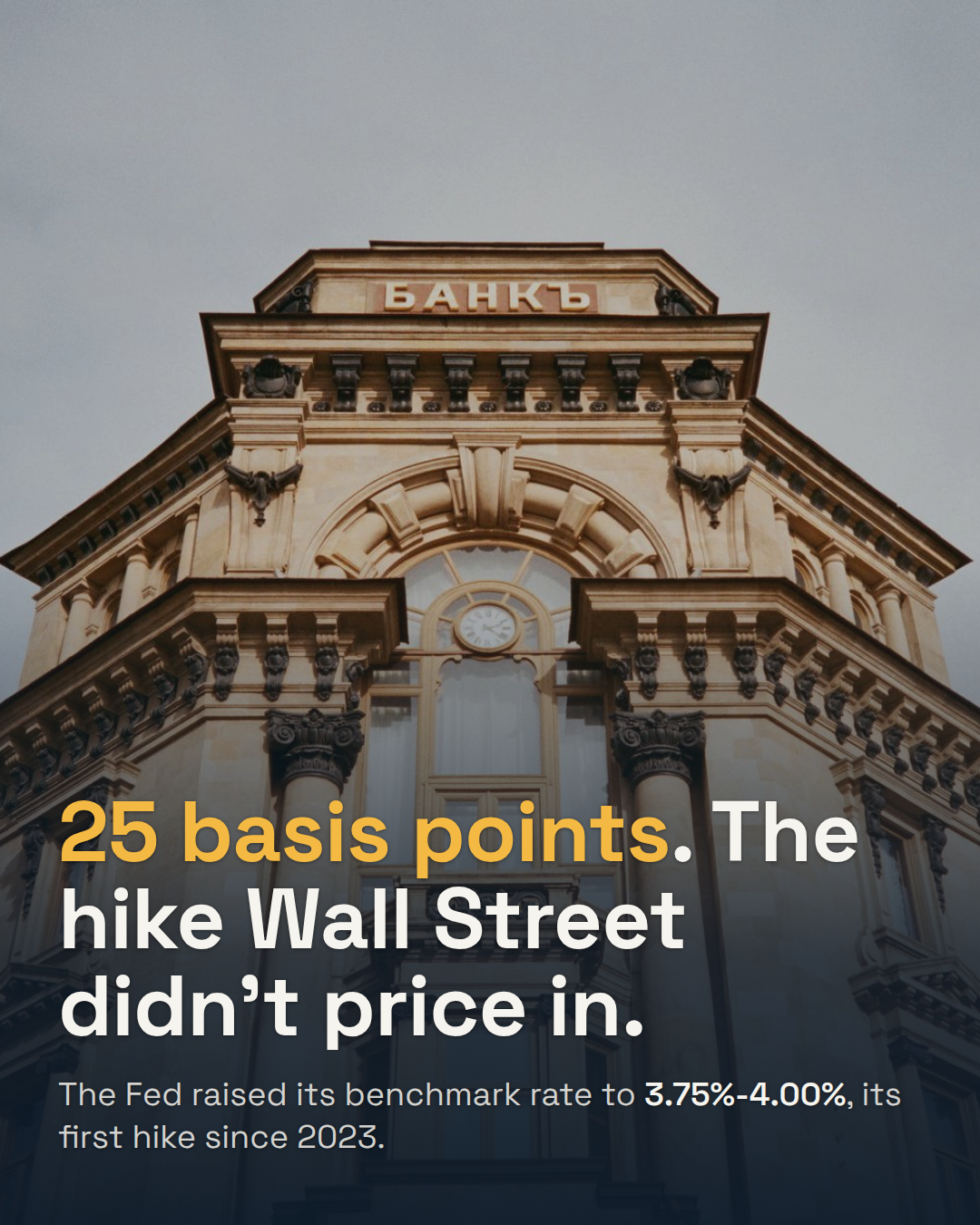
The Federal Reserve raised its benchmark interest rate by 25 basis points on Wednesday, lifting the federal funds target range to 3.75%-4.00% from 3.50%-3.75%. It is the first hike since 2023, and the Federal Open Market Committee voted 12-0 to do it.
Markets had spent the week betting the other way. Going into the meeting, traders were leaning toward a hold, with some still nursing hopes of a cut. Instead, the committee's updated projections pointed to at least one more hike before year-end, with the median rate estimate holding near 4.1% through 2027. Stocks opened higher on the headline, then reversed hard once Fed Chair Kevin Warsh took questions: the Dow closed down 1.2%, the S&P 500 fell 0.4%, and the Nasdaq finished roughly flat as traders repriced how long borrowing stays expensive.
But the rate itself is the least interesting number here. The one that matters is 90.
Your venture debt resets faster than you think
Most venture debt facilities price off SOFR, and SOFR moves with the Fed within days. Loan terms that reset every 30 to 90 days mean this hike is not a slow-moving macro story, it is a line item that lands on your next interest payment. The math is blunt: 25 basis points on a $10 million facility adds $25,000 a year in interest. On a $50 million facility, that is $375,000 a year, pulled straight out of a runway that was already the subject of a board deck.
If your venture debt sits at SOFR plus 600 to 800 basis points, a typical range for startup lenders, this hike alone pushes your effective rate close to double digits before you have drawn a single new dollar. Pull your loan agreement this week and confirm whether you are floating or fixed. If you are floating and did not already model this, the runway number from your last board meeting is wrong.
The cut everyone priced in didn't show up
This matters beyond debt service. A large share of growth-stage valuation models, the ones that justify a rich ARR multiple on the assumption capital gets cheaper next year, were built on an expectation that the Fed would start easing. That assumption just failed. The discount rate in your model, and in the model your next investor is running on your cap table, should now reflect a Fed that is still hiking, not one that is done. We walk through how to stress-test that assumption in FiscEdge's financial modeling course.
The last time the Fed ran a comparable hiking cycle, US venture capital deployment fell from roughly $330 billion in 2021 to about $238 billion in 2022, and kept contracting into 2023. Nobody should assume an identical repeat. But the direction of the pressure, on valuations first and on deal volume second, is the same mechanism now back in motion.
Cash-rich founders get a small, real upside
There is one part of this that helps rather than hurts. If you are sitting on a healthy cash balance between rounds, that cash is now earning more in a money market fund or T-bill ladder than it was a week ago. It will not offset the debt-side cost for a leveraged company, but it is a genuine, immediate improvement to your balance sheet if you have not already swept idle cash into a higher-yield account. Check today, not after the next board meeting, the kind of basic cash-management discipline we cover in FiscEdge's business fundamentals course.
What this changes for founders
Reforecast this week, not next quarter. Pull every floating-rate facility and reprice it at the new SOFR level, not the one from your last model update. If you are mid-raise, expect investors to lean harder on default multiples and cash efficiency rather than the growth-at-any-cost story that a lower-rate world tolerated, a shift we cover in FiscEdge's startup strategy course. And if your unit economics were already thin, this is the print that turns thin into a problem, the gap we break down in our unit economics primer.
If you remember one thing
The Fed did not do what the market was hoping for. It hiked, signaled it might hike again, and every floating-rate dollar you owe just got more expensive within the next 90 days. Model that now, before your lender's next statement does it for you.
We teach founders how to run their numbers through exactly this kind of shock in FiscEdge's financial modeling course and startup strategy course. Browse the full blog for more news breakdowns. Follow @fiscedge for daily Business & AI analysis.
Topics & Categorization:
How interesting did you find this article?