Fed Rate Hike Odds Jump to 60% After Warsh's Jackson Hole Speech. Your Cap Table Should Notice Before September Does.
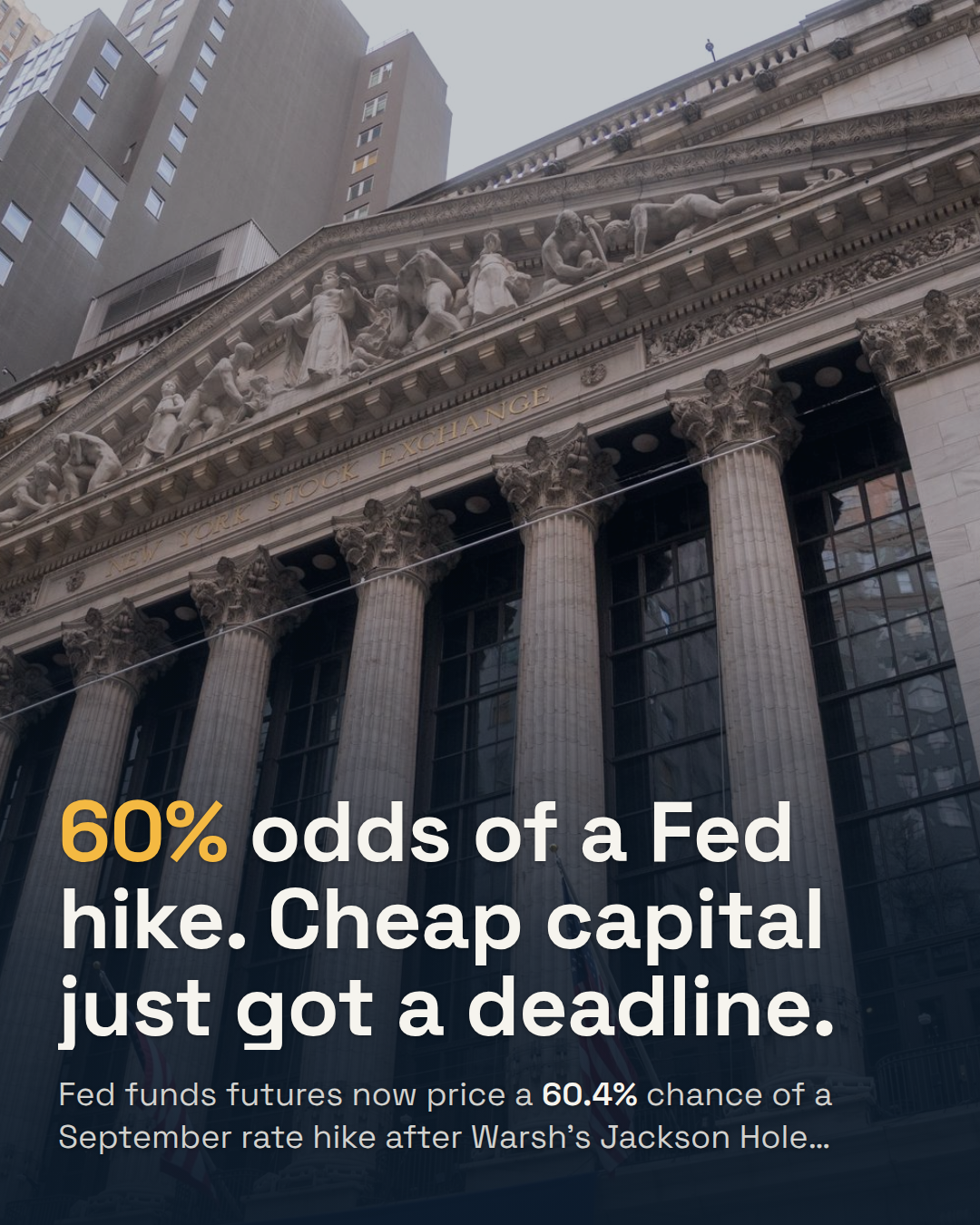
Fed funds futures now price a 60.4% chance of a September hike after Kevin Warsh's hawkish Jackson Hole speech, up from 35% a week ago. Founders raising this quarter should plan around it now.

Fiscedge Academy
Contributing Faculty & Practitioner
News Breakdown · FiscEdge Academy
Fed funds futures are now pricing a 60.4% chance of a quarter-point rate hike at the September 16 FOMC meeting, up from 56% at Friday's close and from roughly 35% before Fed Chair Kevin Warsh took the stage at Jackson Hole. The 2-year Treasury yield, the part of the curve most sensitive to near-term policy bets, jumped more than 12 basis points to 4.36%, its highest level in a month. The dollar index rose 0.6%.
The number is the least interesting part. What actually moved markets is that Warsh, in his first Jackson Hole speech as Fed Chair, chose to sound like an inflation hawk instead of a growth-friendly ally to the White House, which has been pushing publicly for lower rates. "While this summer's PCE and CPI readings were better than expected, they do not tell me that underlying trends have meaningfully improved," Warsh said, adding the Fed will "have work to do" if it isn't confident inflation is returning to target "clearly and at sufficient speed."
The signal under the headline
For most of 2026, the market's working assumption was that the Fed would hold or cut. Warsh just re-opened the door to a hike, and Deutsche Bank now expects two: 50 basis points total across the September and December meetings. That is a real change in the cost-of-capital environment, not a one-day headline. The Fed funds rate has sat at 3.5% to 3.75% since July; a September move would be its first hike in this cycle.
There's a detail in the speech that founders in this newsletter's audience should not skip: Warsh specifically flagged that "ever-expanding pools of capital are pouring into AI-related infrastructure of all sorts" as a factor the Fed is watching. The AI capex boom that has been funding your compute credits, your enterprise pilots, and your investors' term sheets is now part of the Fed's own inflation calculus. That is a new dynamic, and it cuts both ways: AI infrastructure spending is treated as a growth engine worth protecting, but also as a possible source of the "sticky" demand-side inflation Warsh says he's worried about.
What a hike actually does to your numbers
A 25-basis-point move sounds small until you run it through a SaaS cap table. Discount rates used in DCF-based valuations rise in lockstep with risk-free rates, which compresses ARR multiples, especially for companies not yet profitable. Venture debt, increasingly the bridge of choice between equity rounds, is typically priced off SOFR plus a spread, so a hike raises your interest expense the same week it closes. And every LP model that assumes a certain hurdle rate on VC returns gets marginally less generous toward early-stage risk when safe yields go up.
None of this is catastrophic on its own. What matters is the direction just flipped. Since April, most operators have been planning around rate cuts eventually loosening the fundraising market. Now the base case, per fed funds futures, is tighter policy through year-end.
What to actually do before September 16
If you are raising in Q4, the practical move is to stop waiting for a better macro backdrop and instead lock in what you can control. That means finalizing venture debt terms now rather than after a hike repricing, stress-testing your runway model at a higher discount rate, and being explicit with investors about your default-alive date under a "higher for longer" scenario rather than the cut-friendly one most decks still assume. If you're mid-diligence on a round, ask your lead investor directly how they're adjusting their own return hurdles this quarter, because they are almost certainly doing the math you should be doing too.
This is also a moment to separate signal from noise. Not every FOMC-adjacent headline changes your fundraising plan. This one is worth a real look because it moved the two-year yield, not just cable news chyrons, and because Warsh tied it explicitly to the AI capital cycle your company sits inside.
If you remember one thing
The market repriced the odds of a Fed hike from roughly one-in-three to three-in-five in a single speech. Whether or not the FOMC actually moves on September 16, your fundraising and debt planning should already reflect the higher-cost scenario today, because investors' models already do.
We teach founders how to stress-test a cap table against scenarios like this in FiscEdge's financial modeling course, and how to sequence a raise around a shifting macro backdrop in the startup strategy playbook. If discount rates and valuation math still feel fuzzy, start with what unit economics actually means. Browse the full blog. Follow @fiscedge for daily Business & AI analysis.
Topics & Categorization:
How interesting did you find this article?