Regulators Miss the GENIUS Act Deadline. The $323 Billion Stablecoin Market Doesn't Care.
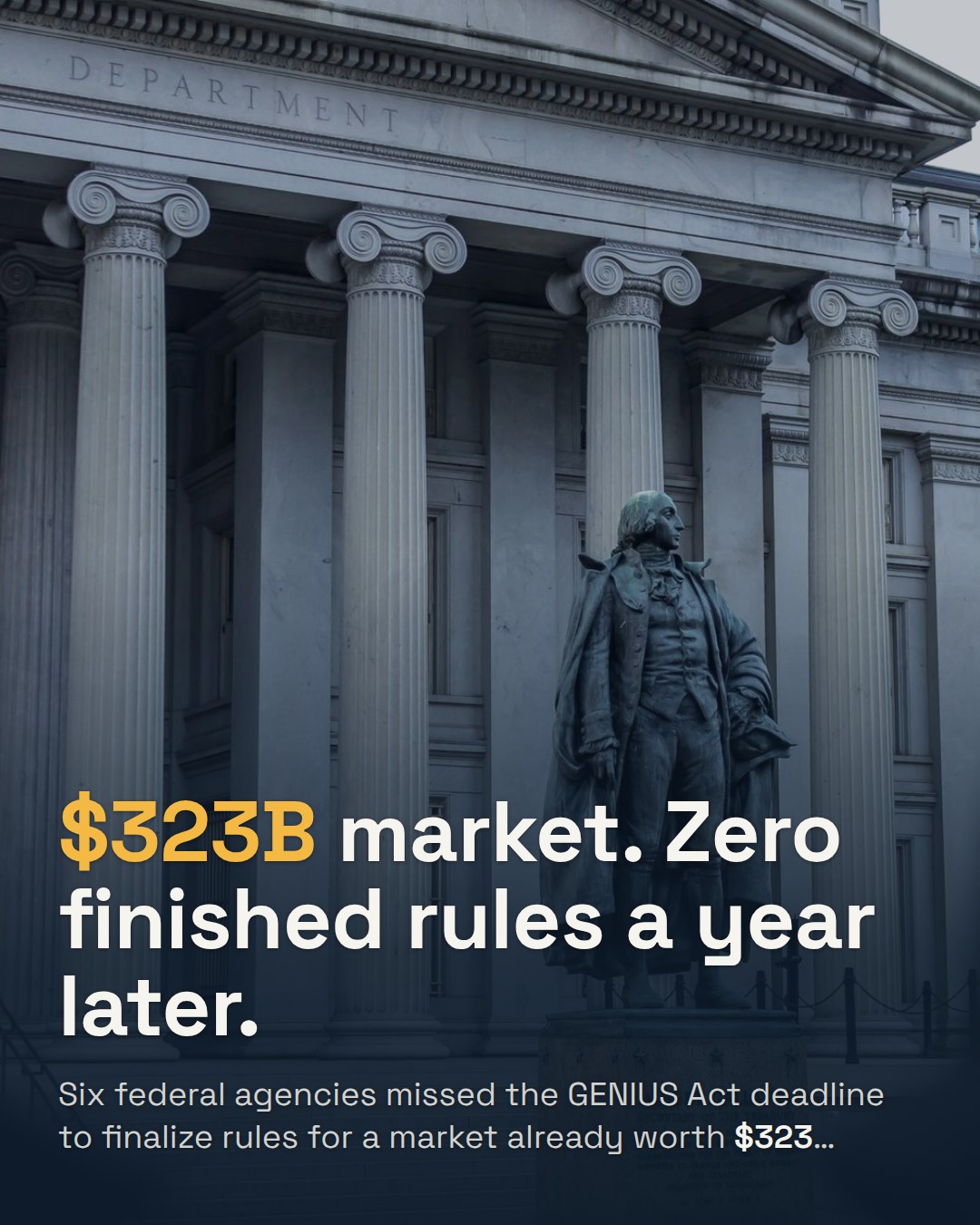
US regulators missed the GENIUS Act's one year deadline to finalize stablecoin rules, leaving a market already worth over $323 billion in compliance limbo until at least January 2027.

Fiscedge Academy
Contributing Faculty & Practitioner
News Breakdown · FiscEdge Academy
Six federal agencies had exactly one year. On Saturday, July 18, 2026, that clock ran out. The GENIUS Act, the first federal law regulating payment stablecoins, gave the OCC, the FDIC, the Fed, the NCUA, Treasury, FinCEN and OFAC twelve months from signing to finalize the rules issuers would have to live under. None of them made it. Every major rule package, from reserve composition to anti-money-laundering standards, is still sitting as a proposal rather than a final regulation.
Here is the number that makes this more than a bureaucratic footnote: the stablecoin market these unfinished rules are supposed to govern has already grown past $323 billion in circulation, according to DeFiLlama data cited by Forbes. The rulebook missed its deadline. The market did not wait for it.
What actually happened, and what didn't
The GENIUS Act was signed into law on July 18, 2025, splitting oversight by issuer size: stablecoin issuers under $10 billion in circulation answer to state regulators, while anything larger falls to the OCC at the federal level. Six agencies spent the following year drafting rules on capital requirements, liquidity tiers, reserve backing (1:1 in cash or short-term Treasuries), redemption standards, and a ban on paying yield or interest to stablecoin holders.
Every comment period has now closed, the OCC's on May 1, the FDIC's and Treasury's on June 2 and 9, FinCEN's and OFAC's on June 9, with only a narrow customer-identification proposal still open through August 21. Six regulators were left with five weeks to reconcile six overlapping frameworks before the deadline. They didn't finish. And here's the part that matters for anyone planning around this law: there is no enforcement mechanism for missing this deadline. Nothing forces the agencies' hand except the statute's own fallback, the framework now takes effect on the earlier of 120 days after final rules are issued, or January 18, 2027.
The signal under the headline
The interesting story isn't regulatory slowness, Washington missing self-imposed deadlines is not news. The interesting story is that a $323 billion market formed, scaled, and kept growing while the rules that govern it were still drafts. Banks are already building stablecoin products. Payment companies are already routing volume through them. None of that waited for legal certainty.
For founders, that's the actual lesson: regulatory clarity is not a precondition for building, it's a moving target you architect around. If your roadmap has a line item that says "launch once the rules are final," you're planning against a date nobody can guarantee. The founders capturing this market are the ones treating compliance as a flexible layer, built to absorb whichever final version of reserve, audit and licensing requirements eventually lands, rather than a wall they wait behind.
What this means if you're building in payments or fintech
- Don't design a single point of compliance failure. Build reserve reporting, redemption logic and audit trails so they can flex toward stricter versions of the rules without a rewrite. Vague inputs today (capital tiers, AML standards) can tighten later; brittle architecture is the expensive mistake, not the ambiguity itself.
- Treat the no-yield rule as durable. Every draft from every agency keeps the ban on paying interest to stablecoin holders. If your model depends on that changing, it's the weakest assumption in your deck.
- Size matters more than most founders assume. The $10 billion state-versus-federal split isn't cosmetic, it changes which regulator you're building a relationship with from day one. Model this into your financials, not just your legal memo, the same way you'd model any other structural cost driver.
- Watch January 18, 2027 as your real deadline, not July 18, 2026. That's the date the framework activates regardless of whether final rules exist. Anyone raising capital in this space should be able to answer, cleanly, what changes for their product on that date.
If you remember one thing
A missed federal deadline didn't slow the stablecoin market down, it kept growing to $323 billion anyway. The founders who win in regulated-but-undefined markets aren't the ones waiting for the rulebook to finish; they're the ones who understand the direction of the rules well enough to build compliance flexibility in from day one. If you're modeling a fintech or payments business, that flexibility belongs in your unit economics, not as an afterthought once the final text arrives.
We break down regulatory shifts like this one in FiscEdge's business fundamentals course, and show you how to bake compliance costs into your numbers in financial modeling. If you're building the actual product on top of shifting rules, building SaaS with AI covers how to architect for change instead of against it. For the underlying math behind pricing and margins in a regulated market, start with what unit economics actually means. Follow @fiscedge for daily Business & AI analysis.
Topics & Categorization:
How interesting did you find this article?