Google Locks In 22 Years of Nuclear Power to Build AI in Finland. €13 Billion Says Power Beats Chips Now.
Google signed a 22-year nuclear power deal with Fortum and committed €13 billion to AI infrastructure in Finland. For founders, that's proof compute's real bottleneck is now the power grid.
Fiscedge Academy
Contributing Faculty & Practitioner
News Breakdown · FiscEdge Academy
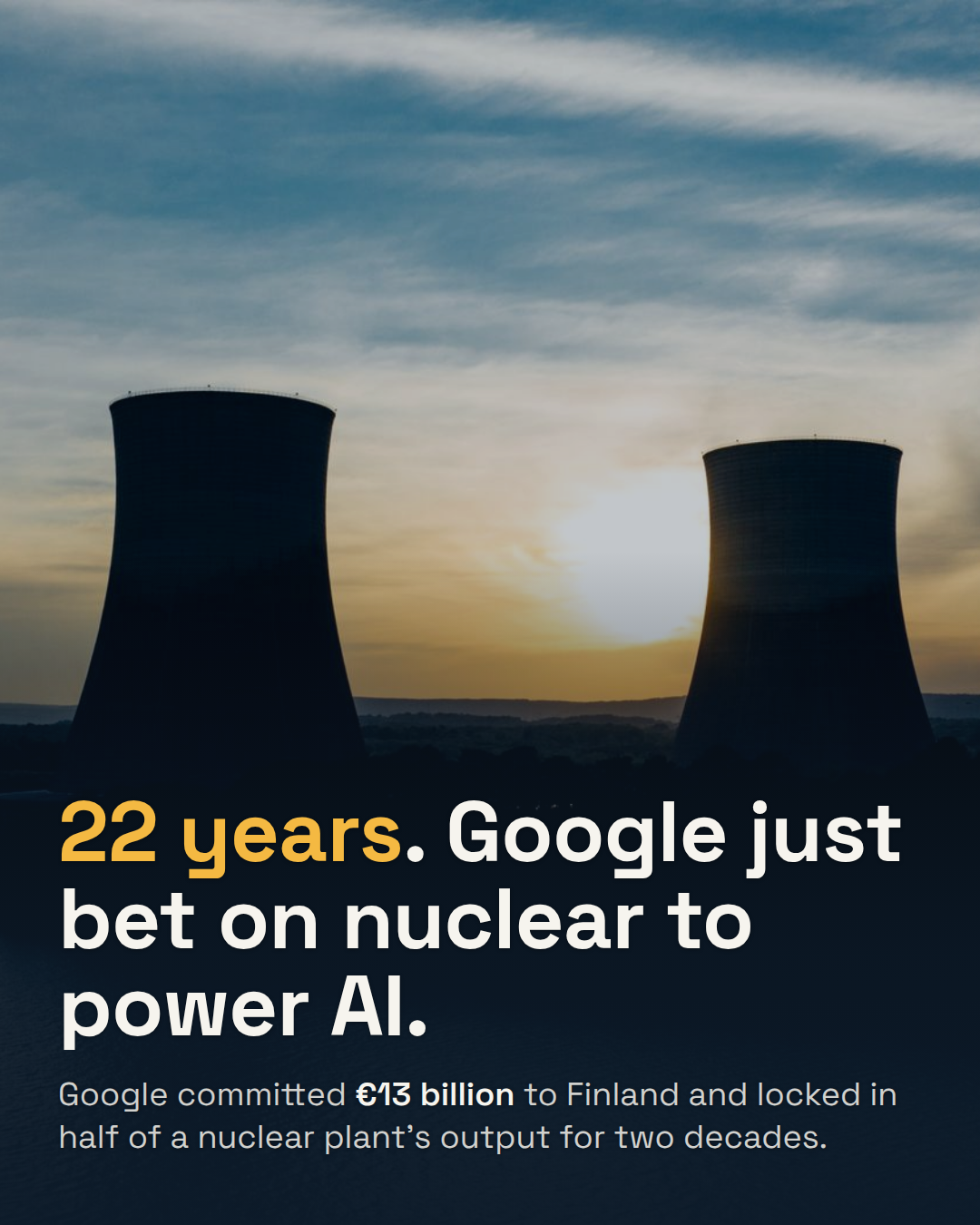
Google just committed €13 billion (roughly $15 billion) to build out AI infrastructure in Finland over 2027 and 2028, its largest single investment announced anywhere in Europe to date. Buried inside that headline number is the more interesting move: a 22-year power purchase agreement with Finnish utility Fortum that locks in up to 50% of the output of the Loviisa nuclear plant from 2030 through 2049, Google's first nuclear power deal outside the United States.
Fortum says the revenue certainty from that contract is what lets it spend roughly €1 billion (~$1.16 billion) extending Loviisa's two reactors, commissioned in 1970, through 2050, plus a planned capacity uprate. Google is also adding new onshore wind deals with Valorem and Suomen Hyötytuuli, bringing its Finland-linked wind commitments to 629 MW. The investment expands Google's existing Hamina data center hub and adds new sites in Kajaani, Muhos and Vaala.
The euro figure is the headline. It is not the story. The story is that a hyperscaler just signed a two-decade power contract to get an AI data center built, which tells you where the actual bottleneck in AI infrastructure has moved.
The signal under the headline
For three years, the AI capacity conversation has been about chips: who has enough Nvidia GPUs, who is waiting on Blackwell allocations, whose cloud is sold out. Google's Finland deal is a reminder that chips were never the real long-term constraint. Power was. You can buy GPUs on a purchase order with a delivery date. You cannot buy multi-gigawatt, always-on electricity that way, especially not clean power a hyperscaler is willing to put its sustainability numbers behind.
A 22-year offtake agreement is not a vendor contract, it is closer to project finance. Google is effectively underwriting a nuclear plant's operating life so that plant can guarantee Google the electricity its AI data centers need a decade from now. That is a fundamentally different kind of commitment than a GPU order, and it is the clearest evidence yet that the biggest AI players are now planning compute capacity on a power-grid timeline, not a chip-cycle timeline.
Why this is a US story wearing a European address
Google is a US company making a decision that will shape where the next wave of AI compute physically sits. Finland offers cold air for free cooling, cheap and increasingly clean grid power, and political stability, the same calculus that has already pulled hyperscaler data centers into the Nordics for a decade. What is new is the willingness to go all the way to a two-decade nuclear PPA to secure it, rather than just buying renewable credits on the spot market. Expect Microsoft, Amazon and Meta, all of which have signed their own US nuclear deals this year, to face pressure to match this move in Europe. Power-backed capacity is becoming a genuine competitive axis among the hyperscalers, not just a sustainability talking point.
What this changes if you build on AI infrastructure
- "Wait for GPU prices to fall" is the wrong plan. If the constraint on AI compute supply is now measured in grid capacity and nuclear plant life extensions, not chip fabrication, expect reserved-instance and API pricing from the major clouds to stay firm for years, not months. Model your unit economics accordingly.
- Where you deploy is becoming a strategic decision, not an afterthought. As hyperscalers concentrate new capacity in power-secured regions like the Nordics, latency, data residency and even pricing tiers for EU-facing products may start to diverge by region. If you serve European customers, watch which regions get the new capacity first.
- Capital intensity at the infrastructure layer keeps rising, which raises the bar to compete with it. A single hyperscaler now needs project-finance-scale power contracts just to keep building. That is out of reach for everyone except a handful of companies, which means the moat for anyone trying to be "neutral AI infrastructure" gets wider, not narrower.
- Energy-adjacent AI infrastructure is a real, fundable category. Power procurement, grid-interconnect software, and nuclear-adjacent engineering are no longer niche energy plays, they are now core AI infrastructure plays with hyperscaler-sized budgets behind them.
If you remember one thing
The AI capacity race stopped being a chip story the moment a hyperscaler signed a 22-year nuclear power contract to secure it. If your planning still treats compute as a line item that gets cheaper as GPU supply improves, revise it: the company with the best visibility into its own future compute needs just bet billions that the real constraint is the power grid, and it is willing to fund a nuclear plant's next three decades to get ahead of it.
We teach founders how to model infrastructure costs and capital intensity before they scale in FiscEdge's financial modeling course, and how AI-native products should actually be architected and priced in Building SaaS with AI. For the broader playbook on scaling a company through capital-heavy phases, see startup strategy. For the underlying cost math behind every AI feature you ship, read what it actually costs to build a SaaS product. Browse the full blog for more News Breakdowns. Follow @fiscedge for daily Business & AI analysis.
Topics & Categorization:
How interesting did you find this article?