Google DeepMind Lost Its CEO and Chief Scientist in One Day. Alphabet Investors Erased $190B.
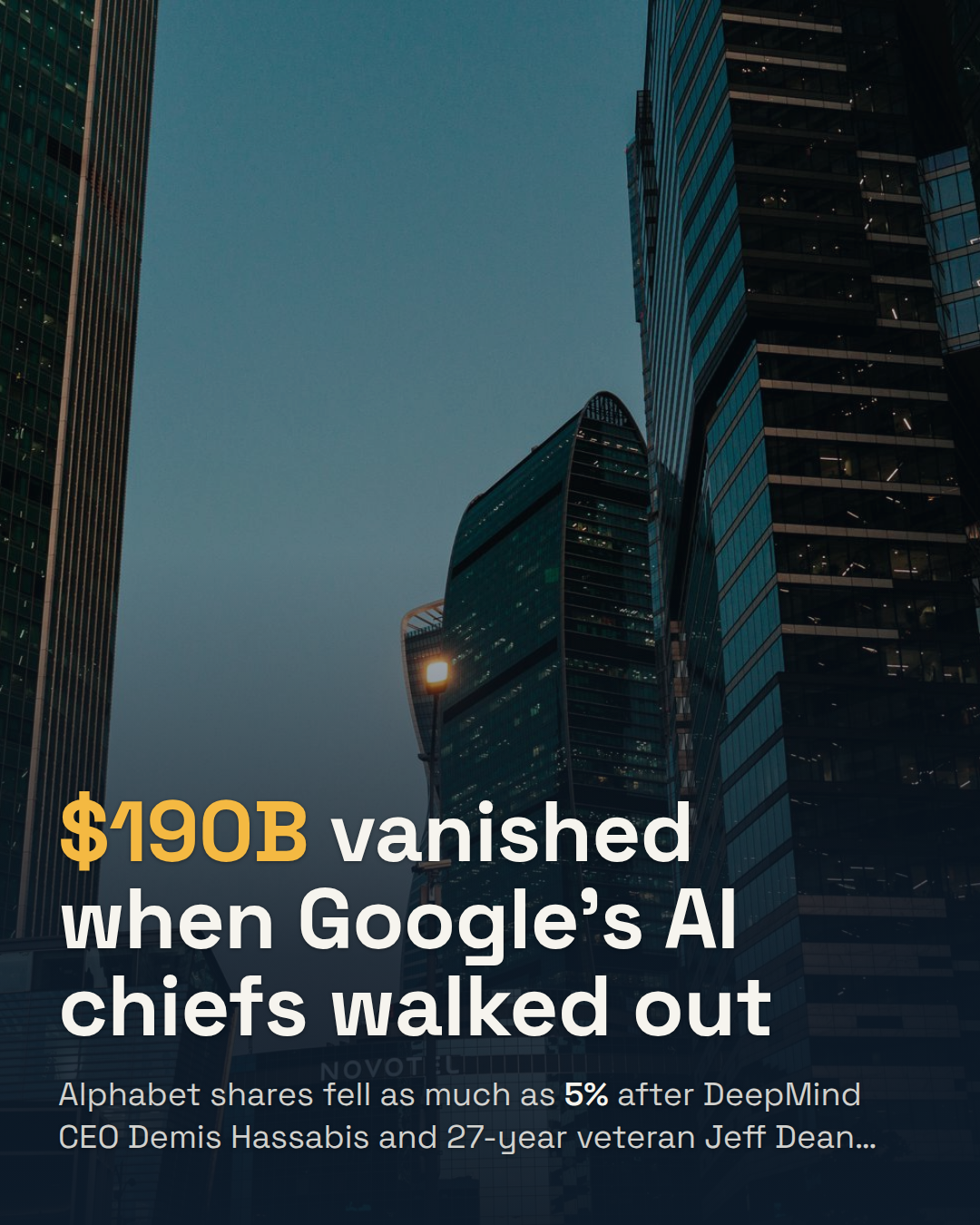
Alphabet shares fell as much as 5% on August 5 after Demis Hassabis stepped down as Google DeepMind's CEO and Jeff Dean left to co-found a new AI startup, Discovery Loop.
Fiscedge Academy
Contributing Faculty & Practitioner
News Breakdown · FiscEdge Academy
Alphabet shares fell as much as 5% intraday on August 5, briefly wiping out roughly $190 billion in market value, after Google announced that Demis Hassabis is stepping down as CEO of Google DeepMind and that longtime chief scientist Jeff Dean is leaving the company entirely. Hassabis moves to Chairman of Google DeepMind and takes on a newly created role as Alphabet's Chief Scientist, while Koray Kavukcuoglu, DeepMind's CTO and Alphabet's Chief AI Architect, takes over day-to-day operations as Senior Vice President, reporting directly to CEO Sundar Pichai.
Dean, a 27-year Google veteran, is not retiring. He is leaving with three other senior AI leaders, Sanjay Ghemawat, Oriol Vinyals, and Quoc Le, to launch Discovery Loop, a public benefit corporation aimed at automating machine learning research and, eventually, scientific and engineering experimentation more broadly. Google is a founding investor and cloud partner in the new venture, with Radical Ventures and Khosla Ventures co-leading an as-yet-unclosed seed round.
The stock drop is not really the story. The number is the least interesting part. The signal underneath it is about how a public company handles losing its most senior AI talent, and it is worth studying whether you are raising, hiring, or building an AI product right now.
A leadership change dressed up as a promotion
Hassabis did not get fired and he did not quit outright. He was moved sideways into a role, Alphabet Chief Scientist, that did not exist before this week, freeing him to focus on AGI strategy and Isomorphic Labs, DeepMind's drug-discovery subsidiary, while Kavukcuoglu, a 13-year DeepMind veteran, absorbs the operational weight of shipping Gemini. The timing matters: Google's next flagship Gemini release has slipped past its planned June launch, and investors have grown louder about Google falling behind Anthropic and OpenAI on frontier models. A reshuffle that reads as "our AGI visionary is now unblocked to focus on AGI" is also, functionally, a response to a shipping problem.
For founders, the lesson is not about Google specifically. It is that investors price leadership structure, not just headcount. When a founder-CEO who is also the product visionary steps back from day-to-day execution, the market wants to see who is now accountable for shipping, on what timeline. Vague reassurance costs you the same 5% a $4.6 trillion company just ate.
The spinout-with-your-blessing playbook
The more unusual move is what Google did with Dean's exit. Instead of treating Discovery Loop as a competitive threat to fight with non-competes and litigation, Google chose to become its founding investor and cloud provider. That is a deliberate bet that keeping a strained relationship with departing star talent, on record as a friendly investor, beats losing them to a rival lab entirely or watching them build in open opposition.
This is a pattern worth borrowing at much smaller scale. If a senior engineer or a co-founder wants to leave to build something adjacent to your business, the reflexive move is to treat it as a threat. The more sophisticated move, when the idea genuinely does not compete with your core product, is to ask whether a small check and a commercial relationship turns a departure into an asset: a friendly startup that might become a customer, a partner, or an acquisition target later, rather than an alumnus with a grudge.
Talent concentration is still the real AI moat
Four of the researchers behind some of Google's most cited AI work, including foundational contributions to TensorFlow, sequence-to-sequence models, and large-scale distributed training, just left in the same week, for the same startup, taking a chunk of institutional AI knowledge with them. Discovery Loop launched as a public benefit corporation, the same governance structure OpenAI, Anthropic, xAI, and Safe Superintelligence have used to signal mission-first intent to investors and recruits.
If you are building or hiring in AI right now, both facts matter more than the funding number. Elite AI talent still moves in small, tightly connected clusters, and the entity structure a new lab chooses is increasingly a recruiting and fundraising signal in its own right, not a legal afterthought. Founders raising seed or Series A rounds for AI products should expect investors to ask not just "what's your model," but "who trained together, and why did they choose this structure."
If you remember one thing
Alphabet did not lose $190 billion because Jeff Dean left. It lost that because the market briefly could not tell who owns shipping the next Gemini model. When you restructure leadership or lose a key person, the fastest way to stop the bleeding is naming who is accountable for the next deliverable, on what date, before anyone has to ask.
We cover leadership structure, equity decisions, and how to keep a company investable through key-person transitions in FiscEdge's startup strategy course and AI for entrepreneurs course. If you're earlier in the journey, our explainer on learning business without an MBA covers the fundamentals investors expect founders to know. Browse the full blog for more news breakdowns. Follow @fiscedge for daily Business & AI analysis.
Topics & Categorization:
How interesting did you find this article?