Google Is Building a Chip Just for Gemini. It Could Cut AI Costs by 10x.
Alphabet shares jumped on reports of Frozen v2, a Gemini-only chip up to 10 times more efficient than current TPUs. The real story is that Google Cloud is already rationing compute.
Fiscedge Academy
Contributing Faculty & Practitioner
News Breakdown · FiscEdge Academy
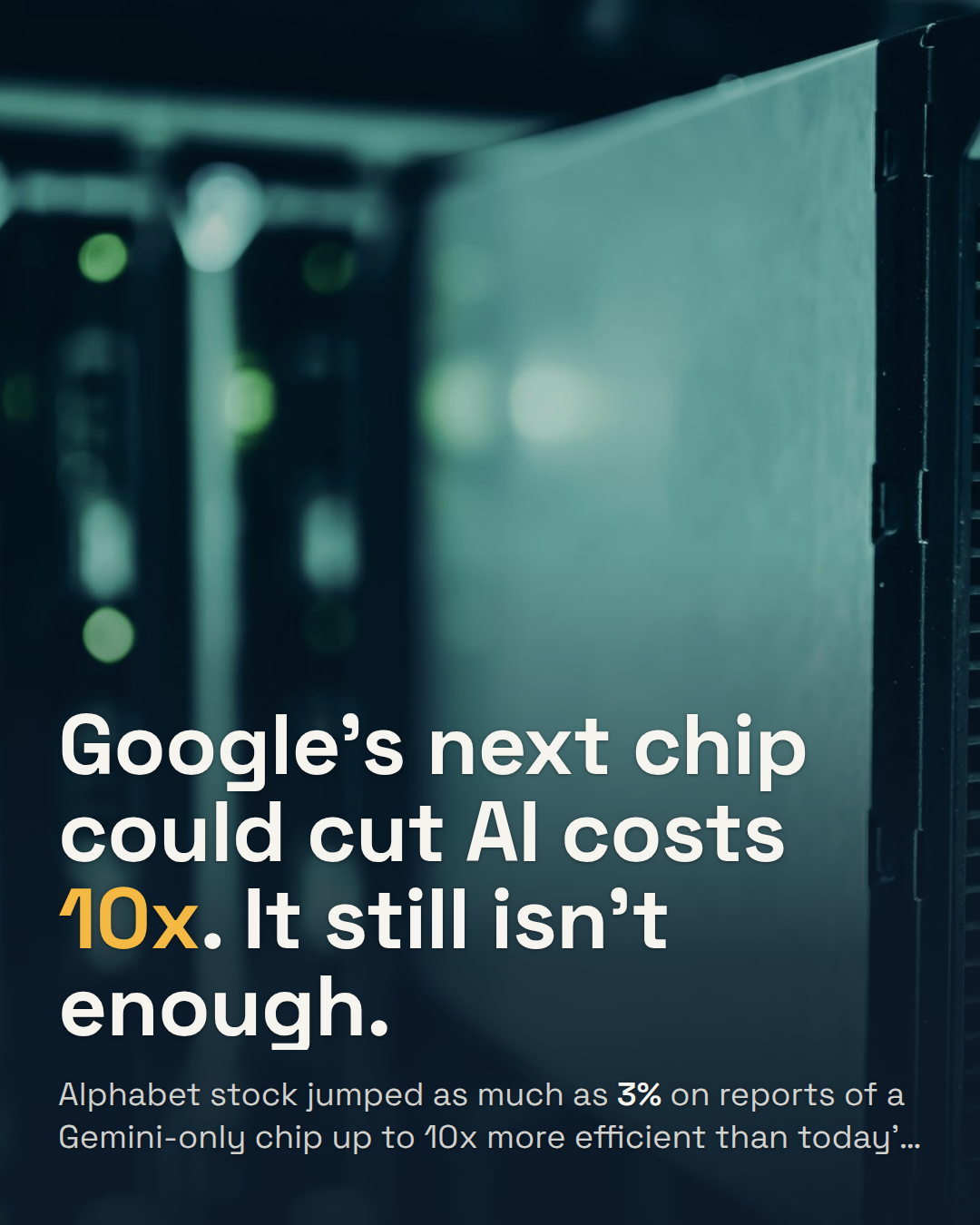
Alphabet shares closed up 1.51% on Monday, July 20, 2026, gaining $5.22 to finish at $351.99, after surging as much as 3% intraday. The trigger was a single report from The Information: Google is quietly building a new server chip, internally called "Frozen v2," designed to run its Gemini models 6 to 10 times more efficiently than the company's current custom silicon. Google is reportedly targeting a 2028 rollout.
Here's the number that actually matters more than the stock pop: Google Cloud has been turning away outside business because it doesn't have enough internal compute to spare. That's the detail buried three paragraphs into most of the coverage, and it's the one founders should actually care about.
What Frozen v2 is, and what it isn't
Google's existing Tensor Processing Units (TPUs) are general-purpose AI accelerators, built to run a wide range of models efficiently. Frozen v2 is something narrower and, in a way, more aggressive: a chip that permanently embeds parts of Gemini's own architecture directly into the silicon. Less general computation, less data movement, faster responses, at a reported 6x to 10x efficiency gain over current TPUs for the specific job of serving Gemini.
Google itself is reportedly treating the project as partly a trial run rather than a full production line on the scale of its TPU fleet. It's not a Nvidia-killer announcement, and it's not shipping this year, or even next. The 2028 target means this is a multi-year infrastructure bet, not an immediate shift in who founders buy compute from.
The signal under the headline
The real story isn't that a trillion-dollar company is building custom silicon, Google, Amazon, Meta and OpenAI are all doing versions of this now. The real story is why Google needs it badly enough to build a chip that does one thing well instead of many things adequately: reporting indicates Google Cloud has already had to turn away outside customers because Gemini's own compute needs are eating the available capacity.
That's a scarcity signal, not a product announcement. When a company with Google's balance sheet and chip supply relationships is rationing compute internally, it tells you the AI infrastructure crunch isn't a startup problem or a mid-market problem, it's showing up at the very top of the stack. If Google is capacity-constrained, the assumption that cloud AI compute is an infinite, elastic, always-available utility gets harder to hold onto for anyone building on top of it.
What this means if you're building on AI infrastructure
- Don't assume your AI vendor's capacity is unlimited. If your product depends on Gemini API access, GPU-backed inference, or any frontier model endpoint, capacity constraints at the provider level are now a real operational risk, not a hypothetical one. Build in fallback providers or graceful degradation, the same way you'd plan for any single-vendor dependency.
- Compute cost curves are not guaranteed to keep falling on your timeline. A 6x to 10x efficiency chip sounds like cheaper inference is coming, but it's a 2028 target. If your financial model assumes AI costs drop 10x by next year, that assumption is doing a lot of unearned work in your unit economics.
- Vertical integration is the new moat, and it cuts against smaller players. Custom silicon that only the biggest labs can afford to design and fab widens the gap between companies that own their model-to-metal stack and companies renting API access. Model that competitive dynamic into how defensible your own AI features really are.
- Multi-cloud and model-agnostic architecture stops being a nice-to-have. If the largest AI provider on earth is capacity-constrained enough to turn away customers, betting your entire product on one model provider's uptime and pricing is a concentration risk worth pricing into your roadmap now.
If you remember one thing
The stock move is noise. The signal is that Google, the company best positioned to have unlimited AI compute, doesn't, and is building custom silicon specifically to relieve that shortage three years from now. If your SaaS product's cost structure or reliability depends on AI infrastructure you don't control, that scarcity is your problem today, not Google's problem in 2028.
We teach founders how to model infrastructure costs into their numbers, not around them, in FiscEdge's financial modeling course. If you're building an AI-native product and want to architect around vendor concentration risk, building SaaS with AI and AI for entrepreneurs both cover this directly. For the underlying math on how compute costs eat into margins, start with what unit economics actually means. Follow @fiscedge for daily Business & AI analysis.
Topics & Categorization:
How interesting did you find this article?