GPT-5.6 and Grok 4.5 Launch the Same Day. The Price War Is the Real Story.
OpenAI's GPT-5.6 and SpaceXAI's Grok 4.5 went public hours apart on July 9, with output pricing five times apart. For SaaS founders, model cost just became a live variable, not a fixed one.
Fiscedge Academy
Contributing Faculty & Practitioner
News Breakdown · FiscEdge Academy
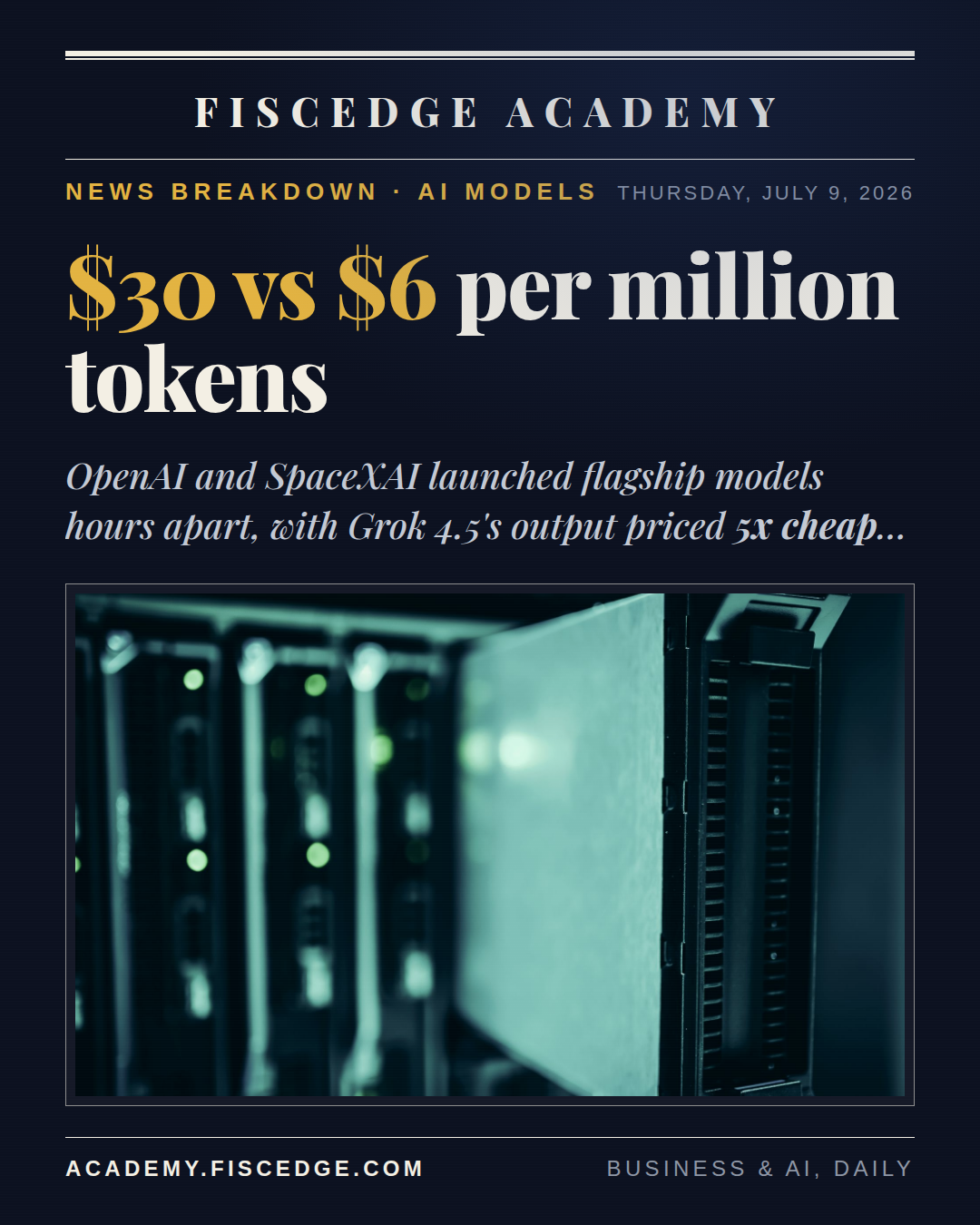
Two frontier AI labs shipped flagship models on the same day. On July 9, OpenAI opened public access to GPT-5.6's three tiers, Sol, Terra, and Luna, priced at $5/$30, $2.50/$15, and $1/$6 per million input/output tokens. Hours later, SpaceXAI (the newly rebranded xAI, now fully absorbed into SpaceX after their $1.25 trillion all-stock merger) pushed Grok 4.5 live at $2/$6 per million tokens.
Do the output-token math and Sol costs 5x what Grok 4.5 and Luna charge for the same volume of generated text. Two labs, one launch day, a five-fold price gap on the exact same unit.
The price tags are the least interesting part of this story. The signal under the headline is that model selection just turned into a live cost decision instead of a one-time technical one, and the release itself came wrapped in a political dispute that founders building on these platforms should be watching.
Two different bets on what "flagship" means
OpenAI's three-tier ladder, Sol, Terra, Luna, is a scaling play: charge more for reasoning-heavy work, undercut everyone on routing and classification with Luna, and let Terra catch the middle. SpaceXAI made a narrower bet. Grok 4.5 was trained alongside Cursor, the AI coding editor SpaceX agreed to acquire for $60 billion in June, and it's tuned hard for coding, legal, and financial-analysis workloads rather than general chat.
The benchmark trade-off is the tell. On SWE-Bench Pro, Grok 4.5 resolves 64.7% of tasks, behind Opus 4.8's 69.2%, but it gets there using an average of 15,954 output tokens against Opus 4.8's 67,020, a 4.2x efficiency gap. A model that's slightly less capable but four times cheaper to run on the same task isn't a worse product for most production use cases. It's a different product entirely, and it's the reason VentureBeat is already framing this as a price war that could squeeze Anthropic and OpenAI's margins.
The regulatory subplot
GPT-5.6 didn't launch cleanly either. The Trump administration had pushed OpenAI to stagger the rollout last month, limiting initial access under a June AI-cybersecurity order that requires frontier labs to submit powerful models for a 30-day government review before public release. Axios reported this week's full public launch came after a "green light" from the administration. The White House disputed that characterization directly to CNBC, saying it never gave OpenAI "approval or clearance" and that release timing "rests entirely with the companies."
Whoever's framing is accurate, the underlying fact holds: frontier model releases are now getting run through an informal government checkpoint before they reach your API keys. If you're building product roadmap around a model's release cadence, that cadence now has a political variable in it that didn't exist a year ago.
What this actually changes for SaaS founders
Run the numbers on a modest production feature generating 1 million output tokens a day, a support agent, a document summarizer, an internal copilot. On Sol that's roughly $900/month. On Luna or Grok 4.5, it's roughly $180/month. Same feature, same volume, a 5x swing in margin depending purely on which model you defaulted to when you shipped.
That has three practical consequences. First, model choice belongs in your unit economics, not just your tech stack, the kind of line-item you'd actually walk through when building an AI-powered SaaS product. Second, coding-heavy internal tools are the clearest place to test Grok 4.5's token efficiency, since a 4.2x reduction in tokens-per-task compounds fast at scale even when the raw capability score is lower. Third, architect for swappability. Hardcoding a single model into your core loop is now a pricing bet as much as a technical one, and the founders who run the true cost of a build before committing are the ones who won't need to re-architect when the next price war lands.
If you remember one thing
Two labs releasing flagship models on the same day at a 5x price spread isn't really about who's smarter. It's proof that AI unit economics move fast enough now that model choice deserves a quarterly review, not a one-time decision baked into your architecture on day one.
We teach how to build and price AI-powered products in FiscEdge's Building SaaS with AI course, and how to run the numbers behind a model-cost decision in Financial Modeling. Browse the full blog for more News Breakdowns. Follow @fiscedge for daily Business & AI analysis.
Topics & Categorization:
How interesting did you find this article?