OpenAI Cuts GPT-6 API Prices in Half. Sol Now Costs $2 per Million Tokens.
OpenAI launched GPT-6 Sol and Luna at roughly half of GPT-5.6's price, three weeks after raising prices on its flagship Astra. For any AI-native SaaS, that split just became your new cost model.

Fiscedge Academy
Contributing Faculty & Practitioner
News Breakdown · FiscEdge Academy
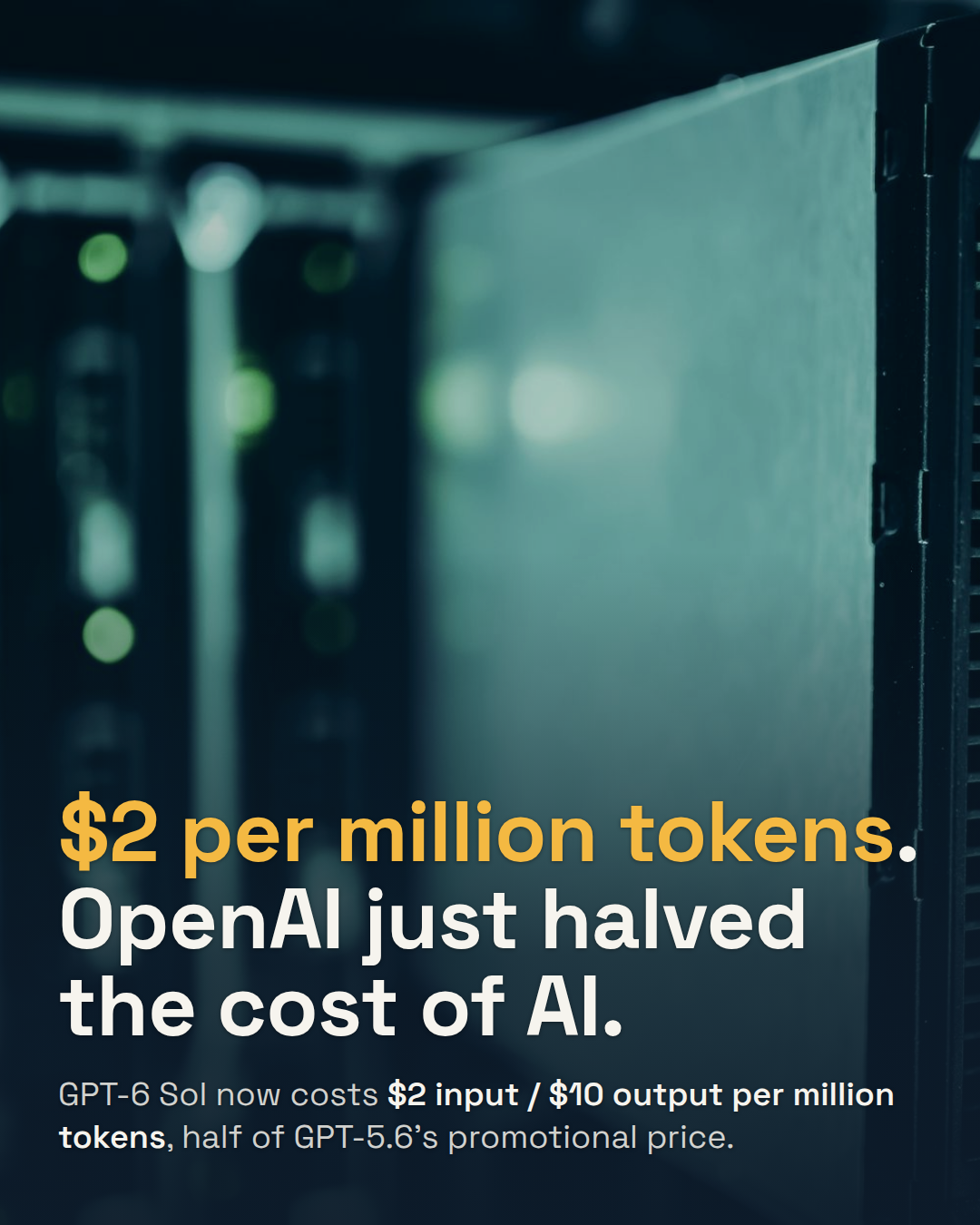
OpenAI cut the price of its workhorse AI model in half on September 22. GPT-6 Sol now runs $2 per million input tokens and $10 per million output tokens, down from GPT-5.6 Sol's promotional rate of $4/$20 (list price $5/$30). A companion model, GPT-6 Luna, launched alongside it at $0.10 input / $0.50 output per million tokens, cheap enough to run high-volume, everyday tasks for pennies.
Both prices are permanent, not a limited-time offer. And they land three weeks after OpenAI raised prices on its flagship model: GPT-6 Astra, launched September 3, costs $10/$50 per million tokens, 2.5 times the model it replaced (we covered the Astra price hike at the time). Read together, these are not two contradictory moves. They are the same pricing strategy, pulled from both ends.
The numbers
- GPT-6 Sol: $2 input / $10 output per million tokens. OpenAI says it makes roughly half as many factual mistakes as GPT-5.6 Sol, a 41% to 54% error reduction depending on reasoning effort, measured on an internal eval built from real ChatGPT conversations users had flagged as wrong.
- GPT-6 Luna: $0.10 input / $0.50 output per million tokens. At higher effort settings, OpenAI says Luna can match GPT-5.6 Sol's factual accuracy at roughly one-hundredth of the task cost.
- On the DeepSWE 1.1 coding benchmark, Sol at maximum effort scores 68.8%, close to rival frontier models, at what OpenAI estimates is a meaningfully lower cost per completed task.
- Sol and Luna are live now in ChatGPT (Plus, Pro, Business, Enterprise, Edu) and Codex; Free and Go users get Luna through the desktop app. Both are also callable through the API immediately.
The mistake-rate and cost figures are OpenAI's own. Cross-lab benchmark comparisons carry the usual caveat: different labs score under different harnesses and effort settings, so treat any "close to rival X" claim as directional, not gospel.
The signal under the headline
OpenAI just told you exactly how it prices intelligence: the frontier tier gets more expensive and the everyday tier gets cheaper, in the same month. Astra, the flagship OpenAI has called an early step toward AGI, sits at a price floor matching Anthropic's top model. Sol and Luna, the tiers built for actual production traffic, dropped by half.
That's a barbell, not a straight line down. It tells you OpenAI expects most commercial volume, chatbots, support agents, internal tools, coding assistants, to run on the cheap end, and it's willing to subsidize that volume to keep developers building on its API rather than switching providers. The expensive flagship exists to win the demo and the headline. The cheap models exist to win the invoice.
What this changes for builders
If your product calls the OpenAI API in a loop, per-token cost moved twice in one month, in opposite directions depending on which tier you use. Three things worth doing this week:
- Re-run your unit economics. If production traffic was already routed through Sol or a Sol-class model, your gross margin on every AI feature just improved, assuming output quality holds after the version switch. If you were calling GPT-6 Astra for anything that doesn't strictly need frontier reasoning, this is the week to downgrade the call and bank the savings.
- Separate "impressive" from "load-bearing." Astra is the model you demo to investors. Sol and Luna are the models that decide whether your AI feature has a defensible cost structure at scale. Confusing the two is how founders end up with a great pitch deck and a margin that doesn't survive Series A diligence.
- Expect this to keep happening. Frontier labs are now running pricing as an active lever, not a fixed cost. Any team building an AI-native SaaS product needs a cost model that assumes provider pricing moves quarterly, not annually.
A 50% swing in your primary vendor's per-token price, in either direction, inside three weeks, is exactly the kind of assumption that belongs as a variable in your model, not a constant. If that line item still lives as a single number in a spreadsheet, it's overdue for a rebuild.
If you remember one thing
OpenAI didn't cut prices out of generosity. It cut prices on the tier that carries the volume, right after raising prices on the tier that carries the headlines. If AI inference is a line item in your COGS, the model to watch is the cheap one, not the one in the press release.
We teach this playbook in FiscEdge's AI for entrepreneurs course, including how to model provider pricing risk into your margins. Browse the full blog for more breakdowns like this one. Follow @fiscedge for daily Business & AI analysis.
Topics & Categorization:
How interesting did you find this article?