Hadrian Raised $1.37 Billion. Its Valuation Went From $1.6 Billion to $7.87 Billion in Seven Months.
Defense manufacturing startup Hadrian closed a $1.37 billion Series D at a $7.87 billion valuation, five times what it was worth in January. JPMorgan anchored it, and the reason says more about 2026 capital than AI hype does.

Fiscedge Academy
Contributing Faculty & Practitioner
News Breakdown · FiscEdge Academy
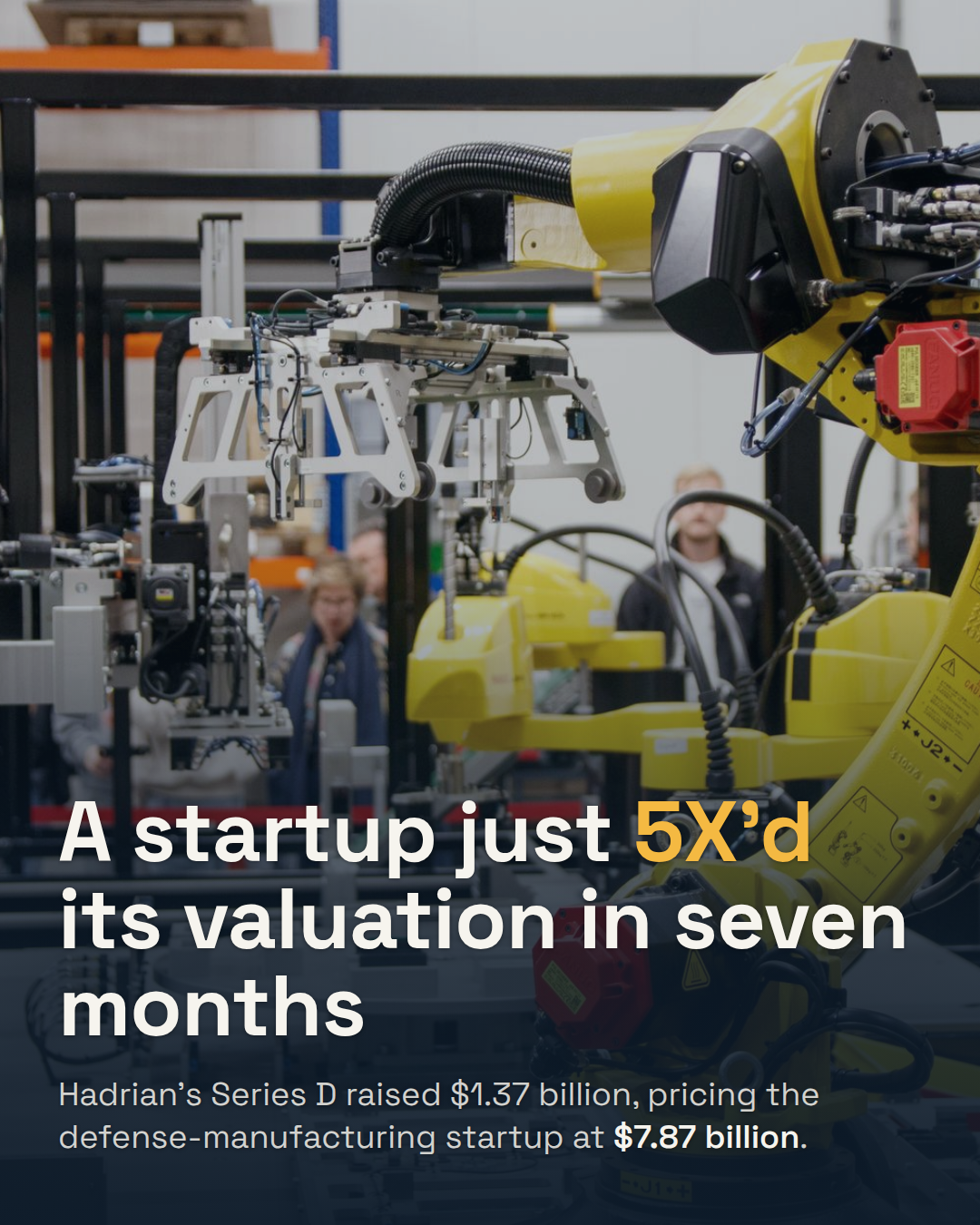
Hadrian, a defense and industrial manufacturing startup that runs AI-controlled, highly automated factories, closed a $1.37 billion Series D on August 6, pricing the company at $7.87 billion. JPMorgan Chase's Strategic Investment Group anchored the round through its Security and Resiliency Initiative, with Valor Equity Partners, Baillie Gifford, Washington Harbour Partners and WCM Investment Management co-leading alongside existing backers Founders Fund and Andreessen Horowitz.
The number that should stop you is the one before it. Hadrian raised at a $1.6 billion valuation just seven months earlier, in a January round led by T. Rowe Price with Altimeter Capital and Lux Capital. This is not a startup that shipped one breakout product overnight; it is a startup whose backers repriced it because the category it sits in, AI-run physical manufacturing for defense and aerospace, got dramatically more strategically important in two quarters.
The valuation jump itself is the least interesting part of the story. What matters is who wrote the check and why.
Strategic capital, not just venture capital
JPMorgan's Strategic Investment Group is not a typical growth-equity shop chasing a multiple. It deploys through a unit built specifically to fund companies relevant to US national and economic security, alongside Baillie Gifford, a public-markets crossover investor, and Valor Equity Partners, industrial capital that backed Tesla and SpaceX early. That combination is worth noticing: the fastest-growing pool of capital in 2026 is not chasing another consumer AI app or vertical copilot. It is chasing companies that pair AI software with a physical, defensible, government-relevant output.
Hadrian's factories, in Mesa, Arizona and Muscle Shoals, Alabama, are two of four sites totaling roughly 3 million square feet that machine parts for Pentagon and Lockheed Martin supply chains. The new capital is earmarked for more factories; founder and CEO Chris Power says it will fund the buildout of what he calls "Factories of the Future" and push the company into munitions and autonomous-systems production over the next year.
Why "physical AI" is pricing differently than software AI
Generalist AI SaaS, chat interfaces, copilots, agent wrappers, has spent 2026 getting harder to fund at premium multiples. Too many teams are building the same feature on top of the same foundation models, with no moat beyond who ships distribution fastest. Hadrian's pitch is the opposite. Its moat cannot be rebuilt by a competitor without also standing up physical factories, winning a national-security customer relationship, and clearing the safety and quality certifications that come with supplying the Pentagon. Investors are increasingly paying up for exactly that kind of moat: hard to copy, slow to build, tied to real-world output, over software-only bets a well-funded team can replicate in a quarter.
What this means if you are raising right now
If your startup's edge is a workflow layered on top of a frontier model API, expect investors to push harder on defensibility than they did a year ago. The bar for "why can't a competitor rebuild this in six weeks" has gone up. If instead you are building anything with a physical, regulated, or government-adjacent component, defense-adjacent hardware, energy, industrial automation, this is the environment to raise into: strategic investors like JPMorgan and Baillie Gifford are actively looking for places to deploy capital outside the OpenAI-and-Anthropic mega-round pattern that dominated the first half of 2026.
Either way, the underlying skill is the same: building a valuation narrative that survives due diligence, not just a pitch deck. A five-times repricing in seven months only holds up if the fundamentals, contracts, revenue, expansion capacity, can support the number once a bank's investment committee tears it apart.
If you remember one thing
Capital is not fleeing AI; it is getting pickier about where inside AI it goes. The startups getting repriced five times higher in under a year are the ones that turned a software advantage into something a competitor cannot rebuild by prompting a better model. Ask that question about your own moat before you ask it about your next round.
We cover how to build a fundable moat and a real capital strategy in FiscEdge's startup strategy course, and how to model a valuation an investment committee will actually believe in financial modeling. If "moat" and "unit economics" still feel like buzzwords, start with what unit economics actually means. Browse the full blog for more breakdowns like this one. Follow @fiscedge for daily Business & AI analysis.
Topics & Categorization:
How interesting did you find this article?