Helsing Raises $1.8B at an $18B Valuation. Europe's Defense-AI Race Just Got Serious.
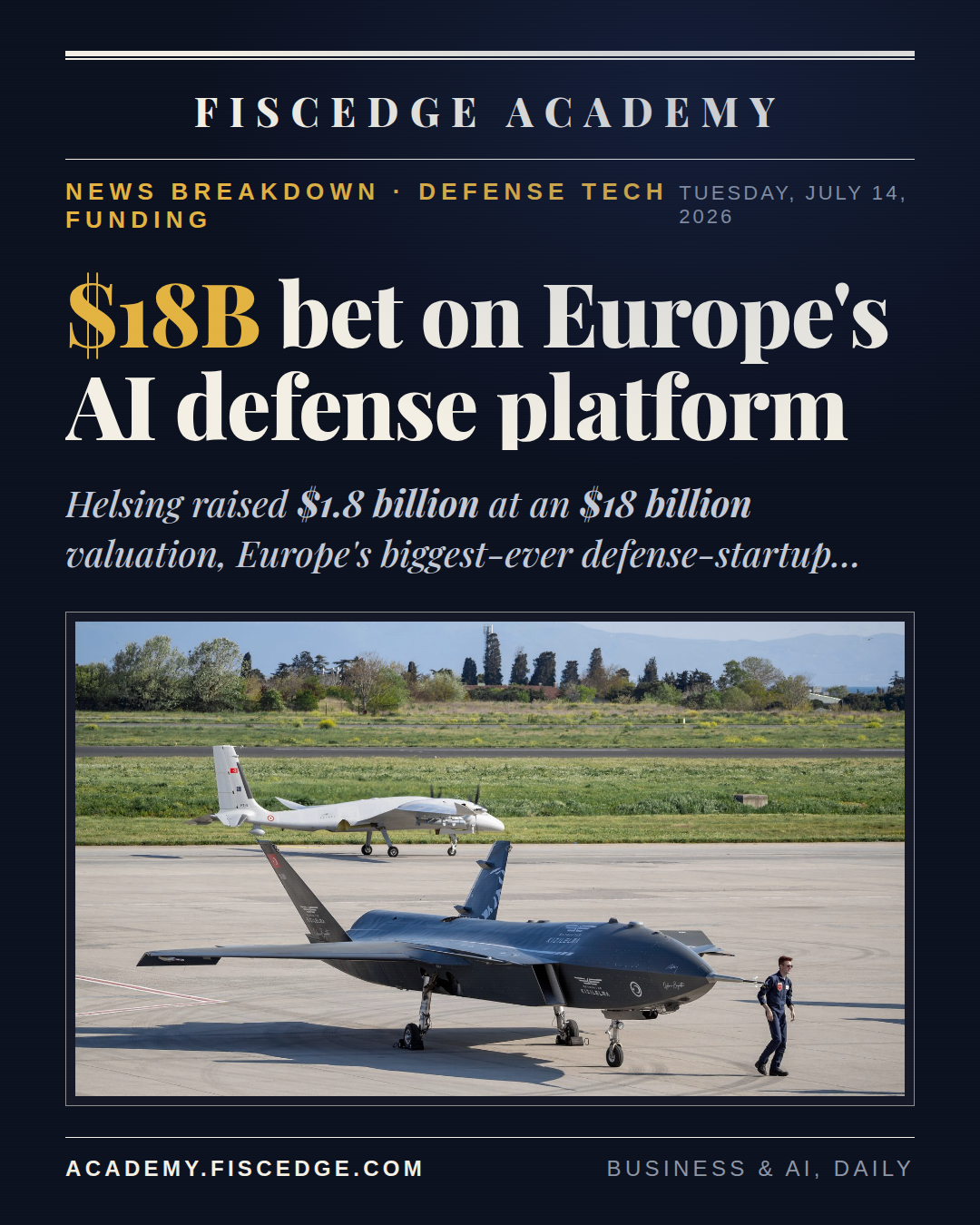
Munich's Helsing closed a $1.8 billion Series E at an $18 billion valuation, Europe's biggest-ever defense-startup round. For founders, government-scale AI budgets are now a legitimate venture category.

Fiscedge Academy
Contributing Faculty & Practitioner
News Breakdown · FiscEdge Academy
On July 13, Munich-based Helsing announced it closed a $1.8 billion Series E round at an $18 billion valuation, the largest funding round any European defense-technology startup has ever raised. The round drew a mix of growth-equity and institutional money rarely seen backing a four-year-old company: Dragoneer Investment Group, Lightspeed Venture Partners, Iconiq, Goldman Sachs Alternatives, JPMorganChase, Canada Pension Plan Investment Board, General Catalyst, Plural and Stepstone all participated, with investor demand reportedly exceeding the allocation available.
Founded in 2021, Helsing now employs roughly 900 people across Munich, Estonia, France and the UK. Its product line has moved fast from software into hardware: the Altra AI-enabled battlefield-operations platform that fuses drone, radar, satellite and camera data into a single real-time picture, the HX-2 strike drone, underwater surveillance systems, electronic-warfare tools, and a concept for the CA-1 autonomous fighter jet.
The number is not the interesting part. What matters is who is writing the check, and why.
Governments are now a venture-scale customer base
Helsing's raise lands against a specific backdrop: the EU's roughly €800 billion defense mobilization target, NATO's push toward 3% of GDP in defense spending, and Germany's ReArm Europe commitment. European defense budgets have nearly doubled since 2021, from about €218 billion to an estimated €381 billion in 2025, and continent-wide military spending grew 14% last year to reach $864 billion.
That is the actual signal under the headline. A sector venture capital treated as effectively uninvestable a decade ago now has a captive, multi-year, government-funded demand curve large enough to justify an $18 billion price tag on a four-year-old company. Helsing isn't selling into a market it has to create; it's selling into budgets that are already appropriated.
Founders should read this as a business-model template, not just a headline
Three things about Helsing's structure are worth studying regardless of your industry.
It sells a platform, not a point solution. Altra ties together sensor feeds across multiple hardware lines and multiple partner nations at once. That is the same reason enterprise SaaS companies that own a whole workflow beat ones that own a single feature; Helsing built the operating layer first, then filled it in with hardware.
Its capital base blends venture, growth equity and banks. JPMorganChase and Goldman Sachs Alternatives sitting alongside Lightspeed and General Catalyst signals that this round was priced like infrastructure, not like a typical Series E swing. A durable, contracted revenue base is what makes that investor mix reachable well before a traditional growth round normally would.
Policy tailwinds are treated as a legitimate part of the fundraising narrative, not a risk to hedge against. Helsing's pitch inverts the usual founder instinct: multi-year, multi-country budget commitments are the thesis itself. If your business benefits from a policy shift you can point to specific line items in, that's diligence-ready material for investors, not a footnote buried in the appendix, and it's exactly the kind of narrative work covered in FiscEdge's startup strategy course.
The competitive read: this is now a two-horse race
Helsing's U.S. rival Anduril raised $5 billion at a $61 billion valuation in May, more than three times Helsing's new price tag. That gap is the real story for anyone tracking the AI-defense category: American and European capital are now backing separate national champions, at very different scales, for what is functionally the same product category. Expect procurement decisions across NATO countries to increasingly become a build-versus-buy-versus-buy-domestic question, with real implications for any founder building dual-use AI, sensor fusion or autonomous-systems technology that could sell into either ecosystem. Understanding how capital gets deployed at this scale, and what it implies for smaller companies riding the same wave, is the kind of pattern-reading we walk through in FiscEdge's financial modeling course.
If you remember one thing
When a policy shift creates a large, multi-year, government-funded budget line, it can turn an entire category from uninvestable to venture-scale almost overnight, and the founders who get there first are the ones who already built the platform layer, not just a single product, before the money showed up.
We teach how to read funding rounds, cap tables and market timing in FiscEdge's financial modeling course and startup strategy course. For the AI infrastructure angle, see our AI for entrepreneurs course. Browse the full blog. Follow @fiscedge for daily Business & AI analysis.
Topics & Categorization:
How interesting did you find this article?