Brent Jumps 4% After a Fourth Strike Wave on Iran. Your Cloud Bill Feels It Too.
Brent crude rose 4.1% to $79.16 after the US and Iran traded strikes near the Strait of Hormuz. Here's what a five-month oil war means for compute costs and your raise.

Fiscedge Academy
Contributing Faculty & Practitioner
News Breakdown · FiscEdge Academy
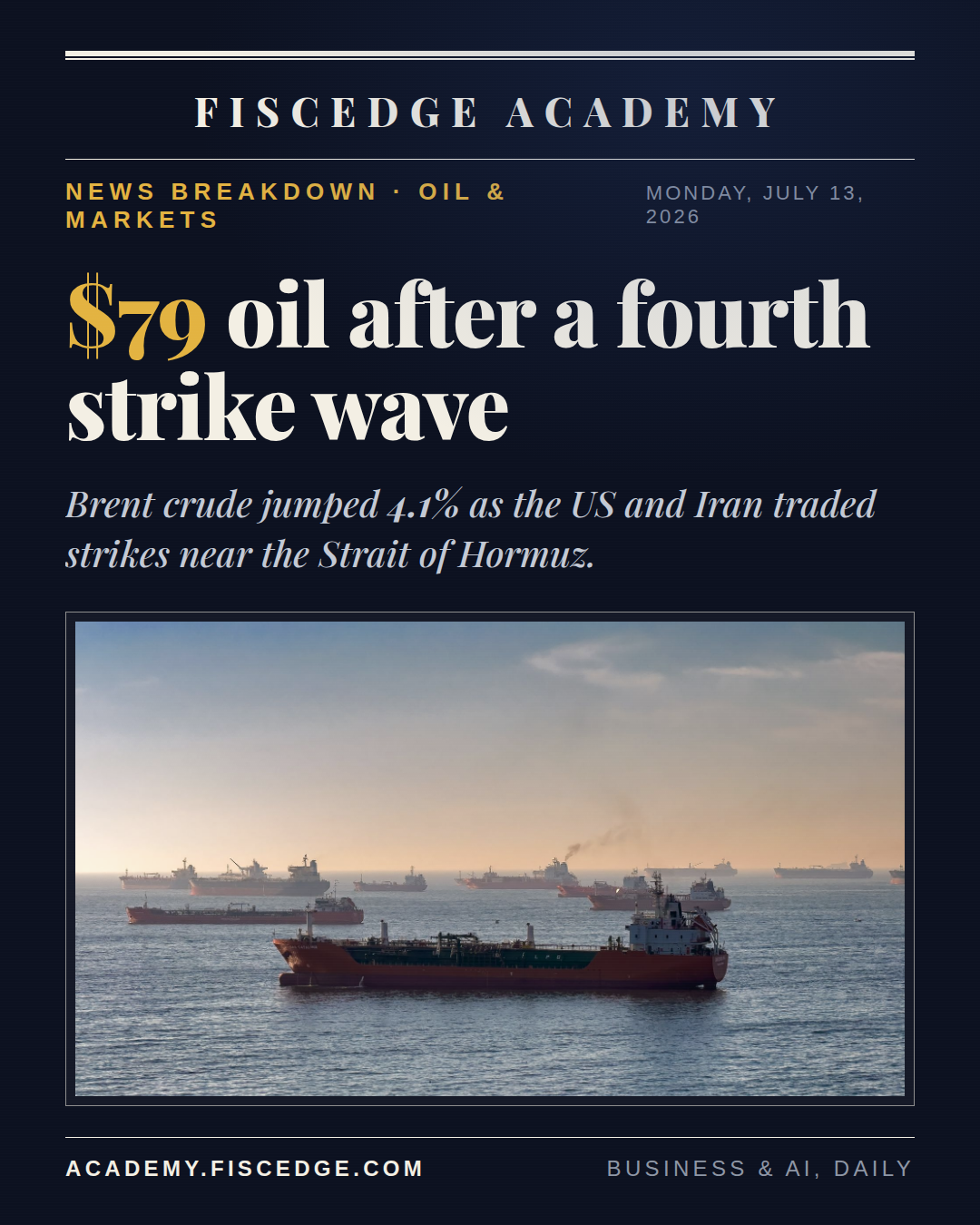
Brent crude jumped 4.1% to $79.16 a barrel on Monday, capping a 5.4% weekly gain, after the US launched a fourth wave of strikes on Iran, using one-way attack drones at sea for the first time. West Texas Intermediate rose 3% to $74.38. Iran retaliated with drone and missile attacks on US-linked sites in Bahrain, Kuwait and Jordan, then declared that tanker passage through the Strait of Hormuz is "not possible."
That headline number is the least interesting part. This is week twenty of a war that started February 28, and the strait it's fought over still carries roughly a fifth of the world's seaborne oil trade.
The signal under the headline
Before the war, 120 to 140 vessels crossed the Strait of Hormuz daily, about half of them tankers moving close to 20 million barrels of oil. By early July, daily crossings had fallen to the low 40s and, on some days, the low 30s. The International Energy Agency now calls it the largest supply disruption in the history of the global oil market, with output still running roughly 9.4 million barrels a day below pre-war levels, even as the IEA still projects a surplus by 2027 if the conflict resolves.
The reason Monday's strikes matter more than the last few rounds of escalation is that they came with a first: drones used against shipping at sea, not just against targets on land. Markets read that as a signal that the campaign is widening rather than winding down, which is why oil moved on the news instead of shrugging it off the way it has shrugged off several previous rounds of strikes since February.
What this means for your compute budget
Founders running lean SaaS teams tend to file "Iran" under geopolitics, not cost of goods sold. That's a mistake this year. US diesel prices are up more than 40% since the war began, according to Energy Information Administration data, which shows up in everything from shipping surcharges to backup-generator fuel for data centers. Less obviously: an Iranian strike in March damaged a Qatari LNG facility that the US Geological Survey estimates supplied roughly a third of the world's helium, an input chipmakers use in semiconductor fabrication. Layer that onto a separate, AI-demand-driven memory shortage, and you get server DRAM prices up 60 to 70% in a single quarter and cloud H100 80GB pricing now spanning roughly $2 to $11 an hour depending on provider, according to industry trackers.
None of that is because of Iran alone. But if you're budgeting AI infrastructure spend for the second half of 2026 off first-half quotes, you're already underestimating it, and an oil shock that raises freight, energy and input costs across the chip supply chain is one more reason your vendor's next quote will be higher than your last one. Before you lock in a compute commitment, it's worth running the higher-cost case through your model rather than assuming this quarter's price holds, a habit we cover directly in financial modeling and in how we teach founders to actually budget AI tooling costs instead of guessing at them.
What this means for your runway and your raise
The Fed held its benchmark rate at 3.50%–3.75% at its June 17 meeting, its first under Chair Kevin Warsh, with inflation running at a three-year high of 4.2%. An oil shock that pushes energy and freight costs higher is exactly the kind of data point that makes a September rate cut less likely, not more. If your model for the back half of the year assumes financing gets cheaper, this week's escalation is evidence against that assumption, not for it.
That matters for how you time a raise. Investors underwriting your round are pricing their return expectations off the same rate curve the Fed just signaled it isn't in a hurry to move. A fundraising strategy built for a rate-cut environment that keeps not arriving is a strategy built on the wrong base case. Stress-test the version where rates and input costs both stay elevated through year-end, and make sure your unit economics survive it, before you assume they don't need to.
The bigger picture
Five months in, the market has mostly learned to treat each new round of US-Iran strikes as background noise, unless something changes the shape of the conflict. Monday's drone attacks at sea did that. Founders don't need a view on the war itself, but they do need a standing habit of re-pricing energy, compute, and capital costs whenever the conflict escalates, rather than only noticing when the invoice arrives.
If you remember one thing
An oil war fought over a shipping lane six thousand miles away is still showing up in your cloud invoice and your financing costs. Model the higher-cost, higher-rate case now, don't wait for the vendor email that tells you it already happened.
We teach founders how to build cost and rate shocks directly into their model in FiscEdge's financial modeling course, how to budget AI infrastructure realistically in AI for entrepreneurs, and how to time a raise in any capital environment in startup strategy. For the fundamentals behind resilient margins, see our breakdown of unit economics. Browse the full blog. Follow @fiscedge for daily Business & AI analysis.
Topics & Categorization:
How interesting did you find this article?