HPE Posted a $12.2 Billion Quarter, Up 34%. Wall Street Sold It Anyway.
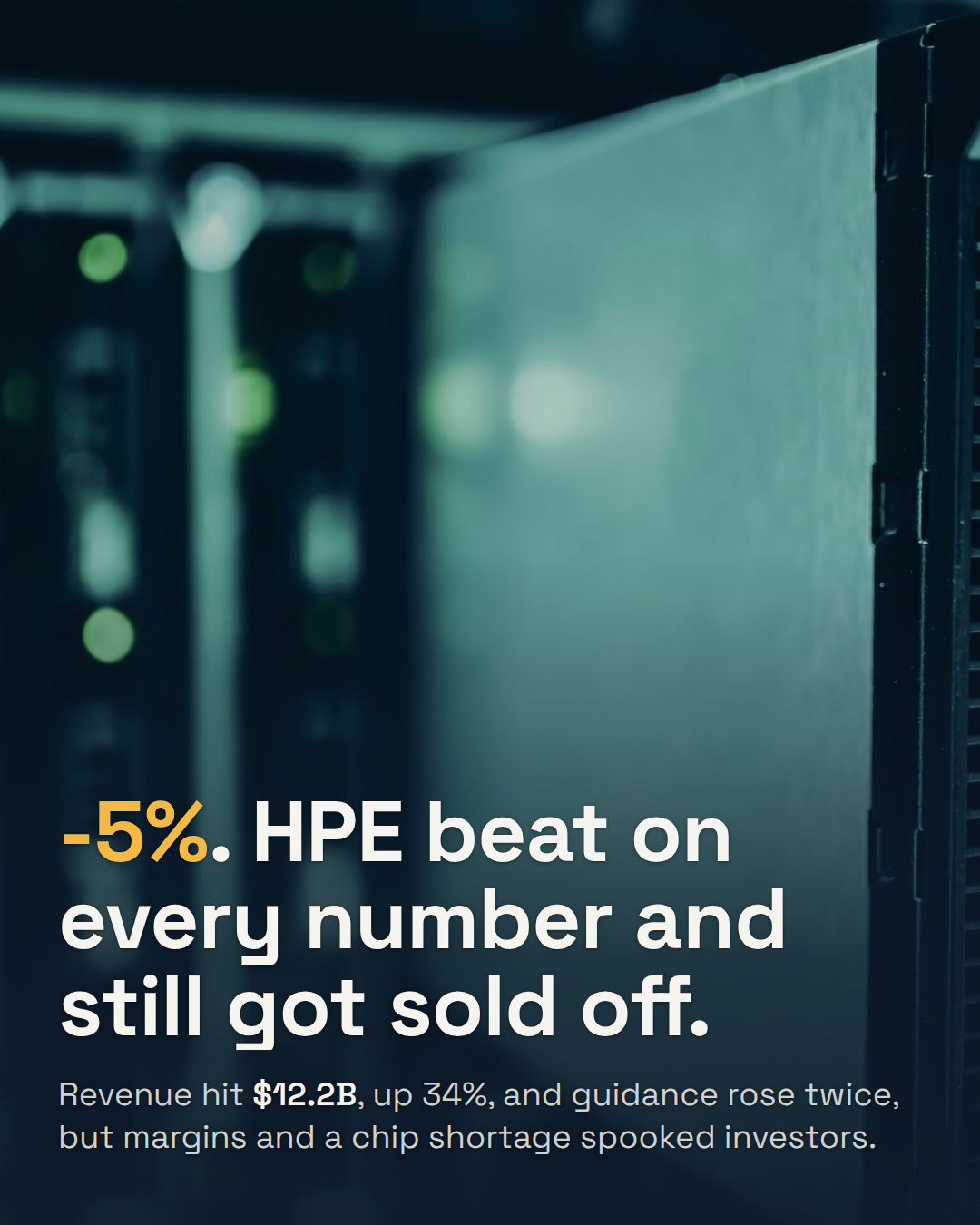
HPE beat every Q3 number and raised guidance twice, yet its stock fell about 5% as investors priced in margin pressure and a memory chip shortage running into 2027.

Fiscedge Academy
Contributing Faculty & Practitioner
News Breakdown · FiscEdge Academy
Hewlett Packard Enterprise beat Wall Street on every headline number Wednesday. Revenue hit $12.2 billion, up 34% year over year from $9.14 billion. Non-GAAP earnings came in at $1.11 a share, beating the $0.92 consensus estimate by roughly 19%. Non-GAAP gross margin hit a record 40%. Then HPE raised guidance, twice: fiscal 2026 revenue growth to a range of 34% to 37%, up from 29% to 33%, and fiscal 2027 revenue growth to 13% to 17%, up from 8% to 12%.
The stock fell about 5% anyway.
That gap, a genuine beat-and-raise quarter met with an immediate sell-off, is the actual story. The number that made the headlines is the least interesting part of it.
What actually grew
HPE's networking business, still mostly the Juniper acquisition it closed in 2025, posted $2.9 billion in revenue, up 74.9% year over year, and HPE raised its full-year networking growth guidance to 73% to 74%. Orders tied specifically to AI networking hit a quarterly record of $700 million, growing triple digits, pushing cumulative networks-for-AI orders to $2.2 billion, past the company's original full-year target with a quarter still to go. HPE now expects to close the year between $2.5 billion and $3 billion in cumulative AI networking orders.
The server side, HPE's Cloud & AI segment, brought in $9.0 billion, up 25.4%, with server revenue specifically up 35.3% to $6.8 billion. HPE also announced an expanded partnership with Oracle to supply routers, switches and AI-operations software for Oracle's AI cloud infrastructure build-out, adding a large, named enterprise customer to a backlog story that had mostly been told in aggregate numbers until now.
None of that reads like a company losing the AI infrastructure race. It reads like the opposite.
Then why did the stock drop
Two things overshadowed the beat. First, management flagged that fourth-quarter operating margins are likely to moderate as the revenue mix shifts further toward AI systems, which carry thinner margins than HPE's traditional server and networking lines, a signal that the record 40% gross margin posted this quarter may not repeat. Second, and more structurally, CEO Antonio Neri told analysts the memory chip shortage driving up DRAM and NAND prices across the industry is expected to keep elevated component costs in place well into 2027, not months, years.
Put together, investors read a company whose top-line growth is real and accelerating, but whose ability to convert that growth into expanding margins is now hostage to a supply chain it does not control. That is a materially different risk than "is AI demand real," which this quarter answered emphatically. It is "what does it cost to serve that demand," and right now the honest answer from the company selling the hardware is: more than it used to, for longer than investors had priced in.
The signal under the headline
This is the second major hardware vendor this quarter to report soaring AI-driven revenue alongside a memory-cost warning that stretches into 2027, and the market's reaction shows that pattern is starting to get priced in as a real, ongoing cost rather than a one-quarter blip. For any founder buying compute, negotiating cloud contracts, or building a product that assumes GPU and server costs keep falling, the read-through is direct: the hardware layer underneath the AI boom is getting more expensive to build, not less, and the vendors closest to that supply chain are now the ones telling you so on earnings calls. It is the same operating-cost discipline we walk through in FiscEdge's startup strategy course.
What this changes for how you build and operate
Three practical takeaways. First, if your unit economics assume falling infrastructure costs as AI workloads scale, stress-test that assumption against a 2027 timeline, not a 2026 one; component costs staying elevated for two more years changes the math on when self-hosting a model beats an API call, a comparison worth running properly rather than as a spreadsheet guess. Second, enterprise deals like the Oracle-HPE expansion are a reminder that the AI infrastructure market is consolidating around a handful of vendor relationships; know which side of that consolidation your own stack depends on, a question worth mapping out in FiscEdge's AI for entrepreneurs track. Third, a beat-and-raise quarter getting sold off is a market telling you it already expected the good news and is now pricing the next risk, a pattern worth recognizing before you pitch investors on your own growth story, where the same "yes, but what's next" scrutiny applies the moment you raise guidance.
If you remember one thing
A 34% revenue beat and two guidance raises were not enough to move HPE's stock up, because the market had already priced in the AI infrastructure boom and started pricing in what it costs to keep supplying it. Growth alone stopped being the story the moment supply chain economics became the swing factor, and any founder whose product sits on top of AI compute should assume the same scrutiny is coming for their own numbers.
We teach how to read an earnings beat against its guidance and model your own infrastructure costs in FiscEdge's financial modeling course and AI for entrepreneurs track. Browse the full blog for more news breakdowns. Follow @fiscedge for daily Business & AI analysis.
Topics & Categorization:
How interesting did you find this article?