Hyundai Just Paid $325M to Fully Own the Robot Its Own Workers Are Striking to Stop.
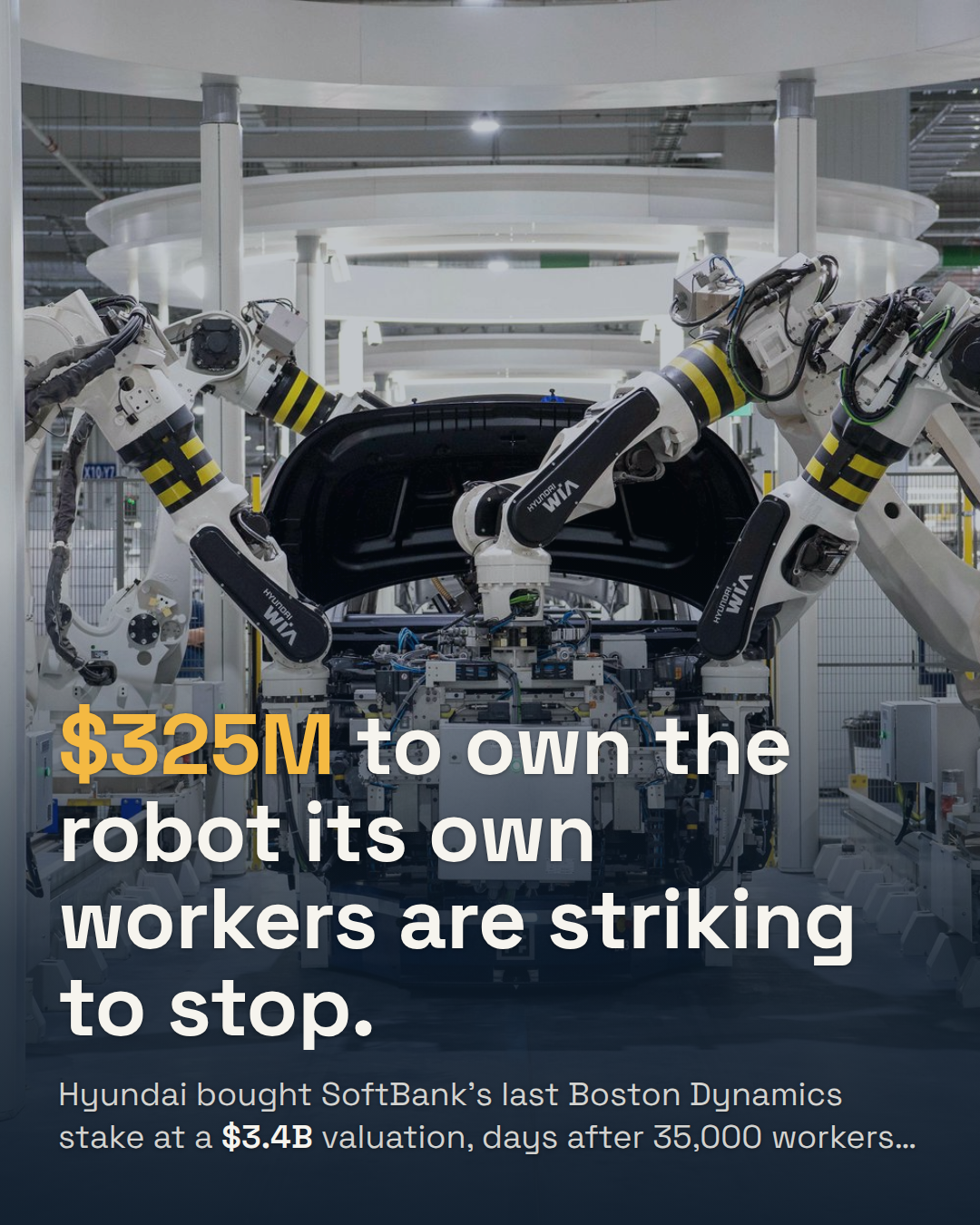
Hyundai bought SoftBank's last stake in Boston Dynamics, valuing it near $3.4B, days after 35,000 Hyundai workers struck over Atlas robot job security.
Fiscedge Academy
Contributing Faculty & Practitioner
News Breakdown · FiscEdge Academy
Hyundai Motor Group just paid $325 million to buy out SoftBank's remaining 9.65% stake in Boston Dynamics, taking full, 100% ownership of the robotics maker behind the Atlas humanoid. The price implies a valuation of roughly $3.4 billion, more than three times what Hyundai paid for its original 80% stake back in 2021. Four days earlier, roughly 35,000 Hyundai assembly workers in South Korea walked off the job two hours early for three straight days, demanding formal negotiations and income guarantees before any Atlas robot sets foot on their factory floor.
Those two facts are not a coincidence, they're the same story told from opposite ends of the org chart. One side of Hyundai just wrote a check to own more robots. The other side just went on strike over what those robots will do to their jobs. Both happened inside the same company, inside the same week.
The stock-and-deal number is the least interesting part. The signal is the timeline: Hyundai is buying full control of a commercial humanoid-robot company at the exact moment its own unionized workforce is organizing pre-emptively against deployment. Atlas isn't even scheduled to arrive on a factory floor until 2028, at a US plant in Georgia, not in Korea at all. The union bargained anyway, three years ahead of deployment, because they'd rather negotiate before the robots show up than after.
Founders don't get to skip the labor conversation just because they're small
If you're building AI or automation tooling that touches anyone's job, ignore the "we're a 10-person startup, this doesn't apply to us" instinct. Hyundai is the preview of what happens when automation intent becomes public before the product ships: the people whose work is on the roadmap organize around the announcement, not the rollout. The lesson scales down. If your product replaces or reshapes a role inside a customer's org (support agents, ops coordinators, junior analysts), the buyer's internal politics around that change will move slower than your sales cycle wants, and faster than your roadmap expects.
The valuation triple is the actual financial story
Boston Dynamics went from a $1.1 billion price tag in 2020 to roughly $3.4 billion today, without an IPO, without a funding round, purely from an internal buyout at a price set by a 2021 put/call option. That's a data point on how fast humanoid-robotics valuations have moved in five years, driven by production milestones (Boston Dynamics began manufacturing the commercial Atlas in January) rather than by public hype cycles. If you're modeling comps for anything in physical AI, hardware-plus-software robotics, or industrial automation, this transaction is a real, cash-settled valuation mark, not a headline number from a pitch deck.
What the strike demands actually reveal about automation's real bottleneck
The union isn't asking Hyundai to cancel Atlas. Their asks are specific: formal talks before robots are introduced, income protection as automation expands human work hours down, and a wage package tied to profit-sharing. That's a template, not a one-off. Every large-scale automation deployment inside a unionized or politically sensitive workforce is going to hit some version of "negotiate the transition, don't just announce it." Founders selling automation software into enterprise, especially anything touching logistics, manufacturing, or back-office ops, should expect procurement to increasingly include a labor-relations sign-off as a gating step, not just an IT and finance one.
If you remember one thing
The bottleneck on humanoid and workplace AI adoption in 2026 isn't the technology, Boston Dynamics is already manufacturing production units, it's organizational trust. The company that wins the automation build-out isn't the one with the best robot, it's the one that negotiates the transition before the workforce forces the conversation. Build that negotiation into your go-to-market now, not after your first union files a grievance.
We cover how to price and structure deals like Hyundai's internal buyout in FiscEdge's financial modeling course, and how to think through the operational and org-design side of deploying automation responsibly in AI for entrepreneurs. If you're building the software layer on top of physical automation, building SaaS with AI covers the product side. For the fundamentals of reading a deal like this one, start with what are unit economics. Follow @fiscedge for daily Business & AI analysis.
Topics & Categorization:
How interesting did you find this article?